

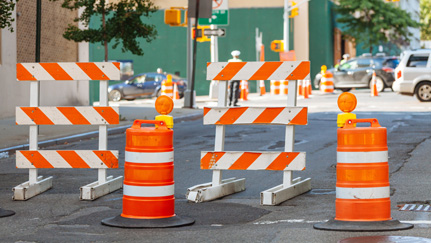
Why work zone safety matters
Understanding the risks
Work zones are hazardous to everyone – workers, drivers and pedestrians alike. In 2022:
- 742 drivers and their passengers died in work zones.
- 51% of work zone fatalities involved a single vehicle striking a pedestrian or fixed object, like a concrete barrier.
- Rear-end collisions were the most common type of multi-vehicle crashes, accounting for 21% of fatal work zone crashes.
- Speed-related fatalities in work zones increased by 2%.
What contractors can do to prevent work zone crashes
1. Develop a comprehensive traffic control plan
A well-designed traffic control plan is your first line of defense. It should be created by specialized firms or individuals that hold the appropriate credentials, and should include:
- Advanced warning signs
- Taper lengths and lateral/horizontal buffer zones
- Crash attenuator trucks
- Flaggers
- Material delivery protocols
These elements are based on the federal Manual on Uniform Traffic Control Devices (MUTCD), Part VI, which the Occupational Safety and Health Administration (OSHA) incorporates by reference, and which sets the national standard for the temporary control of traffic in a work zone.
2. Monitor the work zone daily
- After documenting the initial setup, conduct daily work-zone inspections and maintain these inspections through the appropriate statute of limitations for your state.
- Make sure cones are upright, signs are visible, and warning beacons are functioning, etc.
- Do not rely solely on local inspectors, which may not be frequent or thorough enough to protect you in case of a lawsuit. Your team is ultimately responsible.
- Daily inspections can help identify and correct issues before they lead to accidents.
3. Document everything
- The standard rule is that if you did not document it, it did not happen.
- Keep daily logs.
- Because traffic control devices can be changed during an accident investigation (i.e., knocked down by emergency vehicles), make sure that what was done prior to the accident is well-documented.
- Choose an effective documentation method and be consistent.
- Written documentation is effective if you make sure the traffic control person consistently fills out the appropriate paperwork and sets up an adequate storage and filing system for access when needed.
- Photos can supplement but not replace written documentation. Photos show one point in time but are subject to interpretation and can be challenged in court.
- Videos can take the guesswork out of written documentation or photos, but they must be set up correctly, carefully stored, cataloged, and protected from loss or damage.
4. Risk Transfer
- Prequalify all subcontractors to confirm they meet your experience, insurance and safety requirements
- Require written subcontracts with clear indemnification clauses to be signed for all work
- Verify certificates of insurance and confirm you are being named as an additional insured on endorsements.
- Collect all documentation before work begins and subcontractors arrive at the worksite.
Be prepared for post-accident response
Following a work zone crash, your response can significantly affect outcomes – both legally and financially.
Immediate priorities
- Secure the accident scene
- Ensure personal safety by activating warning devices
- Check for injuries and provide basic aid, if trained
- Contact emergency services
- Document the accident scene thoroughly with photos and a diagram. Be sure to include position of traffic control devices, barriers, speed limits, skid marks, weather, etc.
- Avoid discussion of fault or liability
- Assume all conversations are recorded
- Exchange basic (names, contact numbers, etc.) and insurance information
- Complete your internal accident report.
Legal and liability considerations
Injuries and property damage may create complex legal issues, including lawsuits and possible fines from government agencies. Lawsuits will often focus on the quality and effectiveness of the traffic control plan, making it essential for contractors to ensure that the plan meets MUTCD and OSHA standards, and is fully implemented and adhered to by their work crews. Ultimately, it is the contractor who is responsible for traffic control on your project. You cannot rely on another entity to protect you. If a traffic control plan is defective or is not working, you can be held responsible.
Commonly named parties in lawsuits:
- DOT, project owner or other “authority having jurisdiction.”
- The general or prime contractors
- Subcontractors and suppliers
- Material haulers
- Engineers, designers, and consultants
- Other “potentially involved” parties include equipment and device manufacturers, other drivers, and equipment rental companies.
Common allegations:
- Non-compliance with work-zone standards such as the MUTCD (federal and state) and written traffic control plan
- Improper or ineffective signage, traffic control devices or striping
- Failure to effectively provide advanced warning
- Improper placement of vehicles and equipment
- Improper posted speed for conditions
- Failure to inspect
- Poor visibility
- Hazards such as standing water or drop-offs
Highway work zones are high-risk environments, but with the right planning, vigilance, and documentation, you can protect your workers, the public, and your business. Safety isn’t just a regulatory requirement, it’s a responsibility.