


Floors rarely get much attention - until a slip, trip, or fall occurs. These incidents are one of the leading causes of injury across commercial spaces, accounting for 35% of nonfatal emergency department visits each year.1 That means flooring isn’t just a design decision; it’s a safety and risk management decision with real financial impact, (ranging from medical expenses and lost productivity to liability claims and reputational damage.
This guide translates the technical science of slip resistance into practical steps businesses can use to select safer flooring, maintain traction over time and validate performance.
Flooring selection matters
The amount of traction a floor provides, especially when it’s wet, dirty or worn down, plays a significant role in whether someone slips. Everyday factors include:
- Moisture and tracked-in contaminants (rain, snow, debris) at entrances
- Residues from cleaning chemicals
- Abrupt transitions from one flooring type to another
Research and claims data consistently show that slick surfaces and abrupt transitions between materials are among the most common contributors to these injuries.
DCOF and ANSI A326.3 – what they mean for your business
To help building owners and facility teams choose safer materials, the industry uses a standard measurement called DCOF, or dynamic coefficient of friction. In everyday terms, think of it like tire grip on wet pavement: A higher DCOF means the floor offers better traction, especially when moisture or contaminants are present.
The ANSI A326.3 standard is the main U.S. benchmark for evaluating slip resistance on hard surface floors. It recommends a minimum DCOF of 0.42 for most interior floors, whether the area gets wet or stays dry. Selecting flooring that has been evaluated to this standard helps ensure the surface maintains reliable traction in real world conditions.
Ask for a product’s DCOF rating and confirm testing to ANSI A326.3. Aim for ≥ 0.42 in areas that may become wet.
Key considerations when selecting flooring materials
1. Slip resistance: Choosing materials that keep people on their feet
Different flooring materials offer different natural traction levels. When choosing flooring materials, focus on how the floor will perform in your business, not just in a lab.
- Request slip-resistance test results (such as DCOF values) from the flooring manufacturer
- Verify the material was evaluated under conditions similar to those in your environment (e.g., wet, greasy, or dusty surfaces)
- Avoid polished finishes in high-traffic or moisture-prone areas
2. Environmental conditions: Match the floor to the space
Slip and fall risk is highly correlated with where and how flooring is used. Before selecting materials, it’s helpful to map high-risk zones throughout the property. Mapping these zones helps you match flooring materials to the conditions they will face. High risk zones typically include:
- Entryways and lobbies where water, dirt, and debris are frequently tracked indoors
- Restrooms due to frequent water use and the high likelihood of spills
- Kitchens and food-service areas where grease films and spill-prone surfaces are common
- Transitions between flooring types, where surface changes can affect stability
- Loading docks or service areas where oils, dusts, or powders may accumulate
3. Maintenance compatibility: Cleaning practices can make or break slip resistance
One of the most overlooked contributors to slip incidents is the interaction between floor material and cleaning chemicals, which can reduce slip resistance rather than improve it.
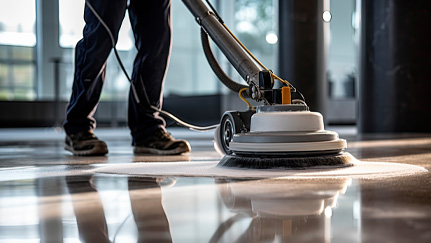
Some common floor maintenance mistakes include over-application of finish, use of incompatible degreasers, or auto-scrubber misuse. Flooring must be compatible with the cleaners, coatings, and equipment used on it.
- Recommended cleaning chemistry: Use products designed for your material and soil type (water, grease, mineral salts, etc.)
- Appropriate equipment: Pads/brushes and other cleaning tools matched to the floor
- Finishes/coatings over time: Understand how coatings change traction as they age
- Need for anti-slip treatments: Evaluate traction-enhancement needs in high-risk areas
A well designed cleaning plan not only protects customers and employees but also prevents deterioration of the flooring surface itself. Even high-traction floors degrade over time without the right care. If you’re unsure whether your current cleaning chemicals are appropriate for your flooring type, ask your supplier for documentation or conduct a small-area test.
Putting it all together
When these components work together, businesses can significantly reduce injury risk, protect their customers and employees, and better control insurance and liability exposures.
Use this quick checklist to confirm your flooring strategy supports a safer environment:
- Ensure flooring meets ANSI 326.3 (≥0.42 DCOF for wet areas)
- Identify and map high-risk zones
- Verify cleaning chemicals are compatible with flooring
- Train employees on maintenance procedures
- Perform regular DCOF testing in high-risk or problem areas
- Evaluate surface coatings annually
Nationwide DCOF Testing Services
Routine DCOF testing helps businesses identify slip risks before an incident occurs. Nationwide’s Risk Management & Client Solutions team has the capability to provide DCOF testing as a preventative tool to help our members evaluate the slip resistance of their flooring under real world conditions. This service may be offered on a case by case basis when it can meaningfully support informed decision making—such as selecting appropriate materials, assessing higher risk areas, or validating maintenance program effectiveness—and helps organizations proactively reduce slip, trip, and fall exposures.
If you are interested in learning more about DCOF testing or how Nationwide can support your slip, trip, and fall prevention program, call your agent directly or contact our team at 1-866-808-2101 or RMCS@nationwide.com.
Sources
[1] CDC WISQARS, nonfatal injury reports, 2023 data, https://wisqars.cdc.gov/.
National Safety Council (NSC), "Top 10 Preventable Injuries 2023 - Injury Facts," https://injuryfacts.nsc.org/all-injuries/deaths-by-demographics/top-10-preventable-injuries/.
ANSI A326.3-2021 - Dynamic Coefficient of Friction (DCOF) of Hard Surface Flooring Materials, https://webstore.ansi.org/standards/tca/ansia3262021.