“Will my retirement funds last?”
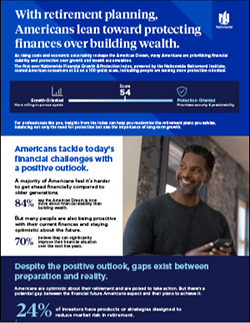
That question is showing up more often in client and employee interactions than it did a few years ago, and it reveals the real anxiety many Americans are now facing. That’s why Nationwide® developed a way to measure how Americans balance their orientation toward financial growth and protection. We formulated the Nationwide Financial Growth & Protection Index, powered by the Nationwide Retirement Institute®, to dig deeper into how today’s economic pressures are reshaping the American dream. According to the first-ever index report, consumers are leaning more toward protection than growth and wealth accumulation in 2026.
Our index suggests many Americans aren’t giving up on their financial dreams; instead, they’re taking a more defensive stance when making financial decisions — focused on protecting their personal and household finances, preserving progress and avoiding setbacks.
Three-quarters (75%) say their primary financial focus is covering basic expenses, while 84% say the American dream is now more about financial stability than building wealth. The same percentage believes it is harder to get ahead financially than it was for previous generations.
People still want to build wealth, but today's environment has made financial stability and resilience just as important as accumulation.
Despite the shifting economic landscape, Americans remain optimistic about their financial future and are poised to take action. In our survey, 7 in 10 (70%) believe they can significantly improve their financial situation over the next 5 years. However, our index highlights a potential gap between the financial future that Americans expect and their plans to achieve it.
Nearly 80% worry that rising costs will reduce their standard of living in retirement, while 61% worry about outliving their savings. Yet only 24% currently have products or strategies designed to reduce market risk in retirement, and just 22% took steps in the past year to plan a retirement income strategy.
Employer-sponsored plans are the most common retirement savings vehicle among Americans, creating an important opportunity for retirement planning professionals to help workers build strategies that support long-term growth while preparing for unexpected challenges.
More than 8 in 10 consumers (81%) say they would prefer a guaranteed, predictable retirement income stream over higher-growth investments — which means many people want confidence that their savings can support them through market volatility, longer lifespans and life's unexpected challenges. For financial professionals, there’s an opportunity to bring growth and protection together in each client's approach to retirement. For plan sponsors, it's a signal to evaluate whether your plan's investment lineup already offers a path to that kind of certainty through guaranteed retirement income or whether there's a gap in what you're currently providing.
As your trusted partner, Nationwide® offers tools and resources to help you evaluate and address savers’ needs for building wealth and protecting retirement income. Solutions from our suite of lifetime income funds can help simplify the complexities of retirement planning and help you prepare your workforce for retirement.
The Nationwide Financial Growth & Protection Index research was conducted online in the United States among 2,000 adults age 22 and older. The survey was fielded May 1–14, 2026. All statistics represented are sourced from this survey. Respondents were nationally representative by age, gender, race/ethnicity, region, employment status and income level. The Index measures how consumers balance financial growth and financial protection by evaluating responses across three dimensions: mindset, actions and confidence. Individual pillar scores were weighted and combined to produce an overall Index score ranging from 0 to 100, with lower scores indicating a stronger growth orientation and higher scores indicating a stronger protection orientation.
Guarantees are subject to the claims-paying ability of the issuing insurance company.
Provisions of these options may vary based on plan selection and/or by state regulation. These investment options may not be available in all states.