Mark Hackett, CFA, CMT


Markets and economy
Markets and economy
Big bill, bigger tailwinds?
How H.R.1 is shaping market expectations
Key takeaways:
- The market’s recent tilt toward cyclical sectors could be an early sign that fiscal tailwinds from H.R.1—commonly referred to as the “One Big Beautiful Bill Act”—are on the horizon.
- Investors may find growth opportunities by positioning in sectors poised to benefit from renewed capital investment and strengthening consumer demand.
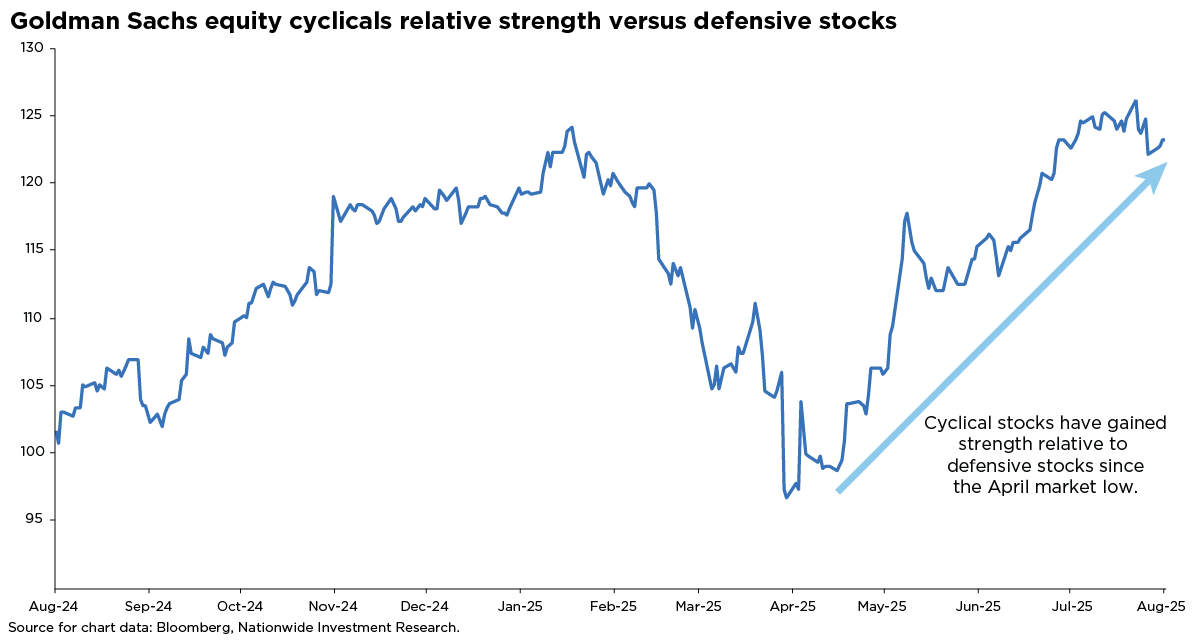
08/13/2025 – While tariff tensions and policy uncertainty continue to grab headlines, the real story may lie in the market’s quiet vote of confidence: cyclical stocks are outperforming their defensive counterparts. This shift suggests investors are pricing in the potential upside of fiscal stimulus and renewed industrial investment.
The shift in market leadership may signal more than a short-term tactical rotation. It could reflect a broader response to emerging fiscal tailwinds, sparked by the recently enacted H.R.1—referred to by many as the “One Big Beautiful Bill.” With its investment-friendly provisions, the legislation has the potential to reshape corporate behavior and shift investor expectations—especially as attention turns toward 2026 earnings.
Second-quarter earnings reports show that capital-expenditure incentives are influencing forward guidance, with firms raising expectations for both cash flow and investment. This sets the stage for a powerful trifecta—productivity, profitability, and broader economic growth—that could support sustained expansion and justify elevated margin expectations.
Another notable change is the move from EBIT to EBITDA for interest deductibility—a shift that expands allowable deductions by including depreciation and amortization. This benefits capital-intensive firms and those with sizable non-cash expenses, potentially boosting both cash flow and reinvestment capacity. As of January 1, 2025, consumers are benefiting from the permanently lower tax rates introduced by H.R.1. Refunds expected in early 2026 could spark renewed momentum in consumer spending—a crucial tailwind, given consumption’s dominant share of GDP growth.
Second-quarter earnings reports show that capital-expenditure incentives are influencing forward guidance, with firms raising expectations for both cash flow and investment. This sets the stage for a powerful trifecta—productivity, profitability, and broader economic growth—that could support sustained expansion and justify elevated margin expectations.
As the second half of 2025 unfolds, the newly cemented fiscal architecture may act as a durable tailwind for investors—rewarding strategic positioning in sectors primed for renewed capital investment and revitalized consumer demand.
Stay focused when news breaks
Author(s)

Mark Hackett, CFA®, CMT®, CFP®
Chief Market Strategist, Nationwide Investment Management Group
Mark Hackett is the Chief Market Strategist for Nationwide’s Investment Management Group, bringing more than 20 years of experience in the asset management industry to the role.
Trending articles
What could matter most for bond investors in 2026? Income, flexibility, and a disciplined approach to security selection.
As sports betting gains popularity, investors may blur the line between gambling and investing. Here's why time and compounding matter.
Looking beyond rates reveals what's historically fueled small-cap gains most: stronger earnings and a growing economy.
Sources/Disclaimers
This material is not a recommendation to buy or sell a financial product or to adopt an investment strategy. Investors should discuss their specific situation with their financial professional.
Except where otherwise indicated, the views and opinions expressed are those of Nationwide as of the date noted, are subject to change at any time and may not come to pass.