

Markets and economy
Bond market signals: opportunity or risk?
Key Takeaways:
- Higher bond yields may create new opportunities, but advisors should stay focused on the forces driving rates higher and their portfolio implications.
- As dispersion widens across fixed-income markets, active management and selective exposure may become increasingly valuable.
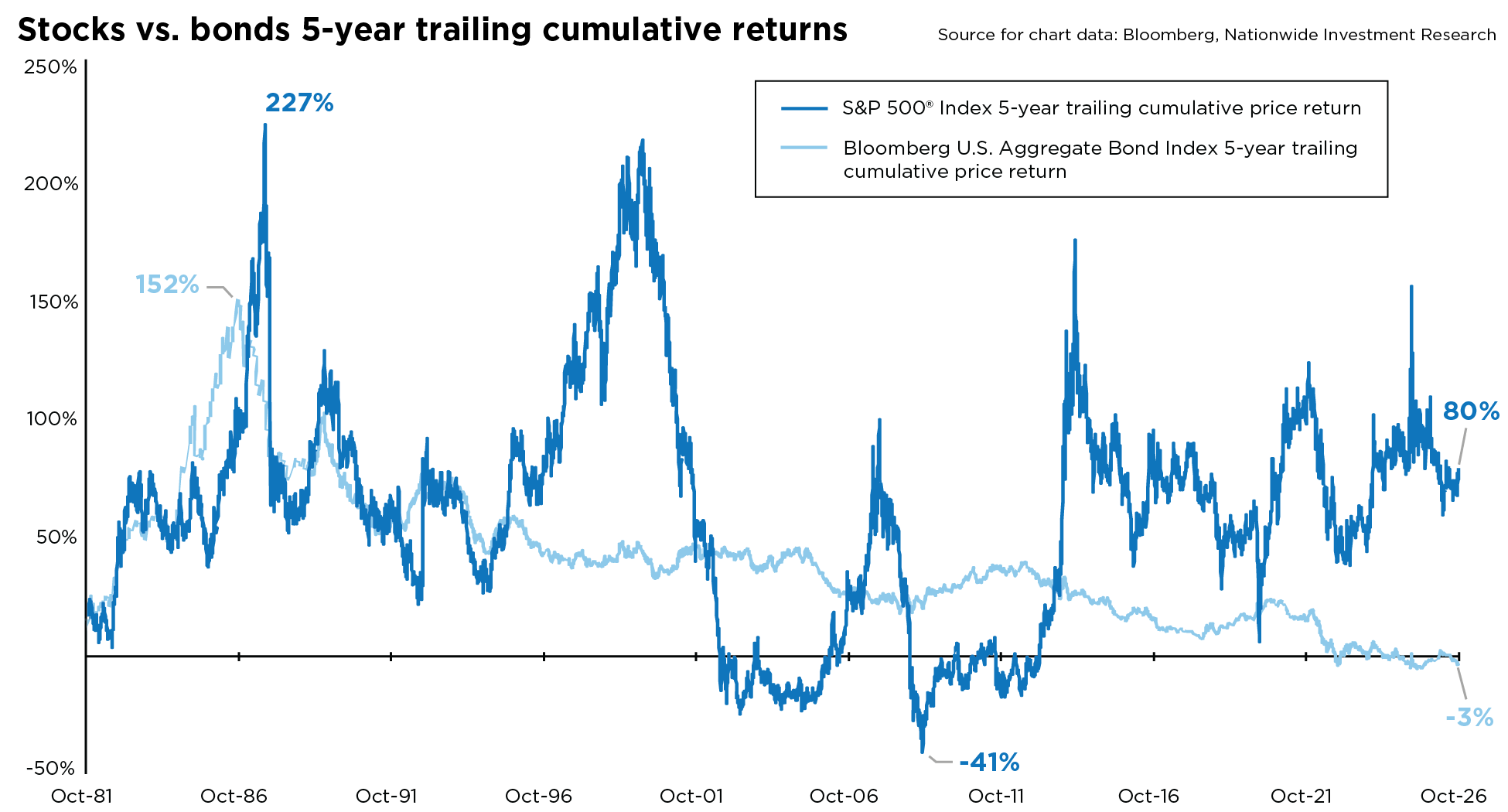
10/29/2026 — Bonds are offering investors yields rarely seen in recent decades, but their rise raises a fundamental question: Are bonds becoming more attractive, or do higher yields signal a more challenging market environment? It’s a timely question following one of the most difficult periods for fixed-income investors in modern history. Over the past five years, the Bloomberg U.S. Aggregate Bond Index has generated a trailing return of roughly -3%, while the S&P 500® Index has gained approximately 80%. (See chart.) The contrast is a stark reminder that bonds have not delivered the returns or diversification benefits many investors expected.
Yet the same forces that made bond investment so challenging, including higher inflation, tighter monetary policy, and rising real interest rates, have also reset yields to far more interesting levels. While higher yields improve income potential, they do not eliminate the risk of further price declines. Whether today’s yields represent an opportunity or a warning sign ultimately depends on what is driving them higher and whether those forces are creating meaningful stress in financial markets and the broader economy.
What is driving the recent rise in interest rates?
A mix of global and domestic forces continues to push interest rates higher. In the U.S. bond market, the 10-year Treasury yield rose 53 basis points in September, reaching its highest level since 2007, while the 2-year Treasury yield increased by 54 basis points. Although the move higher has been relatively orderly, investors may grow uneasy as Treasury yields approach new multi-decade highs and borrowing costs across the economy continue to increase.
Several factors appear to be contributing to the rise in yields:
- Sticky inflation and hawkish central banks continue to put upward pressure on interest rates.
- Higher real rates, supported in part by resilient economic growth, have increased expectations that the Federal Reserve could keep policy restrictive for longer.
- Expanding fiscal deficits and growing capital needs tied to AI infrastructure investment have increased competition for capital, contributing to higher borrowing costs.
- Supply and demand imbalances remain a challenge in the bond market as elevated issuance from the U.S. Treasury, foreign governments, and corporate borrowers meets weaker demand for longer-duration bonds.
Has the recent rise in rates caused stress in financial markets?
Despite a sharp rise in interest rates, the economy has remained remarkably resilient. However, higher rates, combined with escalating geopolitical tensions and rising oil prices, have contributed to increased volatility across financial markets. While uncertainty surrounding the Federal Reserve's policy path has led to greater dispersion across asset classes, credit markets are showing few signs of significant stress. For example, the 10-year Treasury yield rose over 80 basis points during the third quarter, increasing from roughly 4.42% to 5.29% in an orderly adjustment. Although the BofA MOVE Index, often viewed as the bond market's version of the CBOE Volatility Index (VIX), has moved higher, credit spreads have remained relatively contained, with investment-grade spreads still near multi-year lows. This suggests investors are not broadly pricing in a significant deterioration in economic activity or corporate fundamentals.
That said, elevated borrowing costs continue to create challenges for the most leveraged issuers. Healthy corporate balance sheets have helped support overall credit conditions. Some of the market's more speculative segments are showing signs of strain. For example, the spread differential between CCC- and BB-rated debt has widened, indicating greater differentiation between higher- and lower-quality borrowers. Importantly, this widening appears largely confined to the weakest areas of the credit market rather than signaling broader stress across financial markets.
What does this mean for investors?
Bonds can continue to play an important role in portfolios by providing income and diversification benefits, particularly if economic growth slows more than expected. From a tactical standpoint, short-duration bonds and elevated short-term yields may offer attractive opportunities beyond cash, reinforcing the case for active management and selective exposure across credit markets.
As volatility increases and price movements become more technically driven than fundamentally driven, performance dispersion across issuers, sectors, and securities may widen. In that environment, careful duration positioning, sector allocation, and security selection can become increasingly important drivers of returns. While higher rates may test investors' resolve in the short term, they have also created opportunities that were largely absent for much of the past decade. Staying focused on long-term goals, maintaining diversification, and taking advantage of improved yields can help strengthen portfolio resilience, particularly if the economy continues to expand.
Despite ongoing bond market volatility, investors should be cautious about making broad asset allocation changes solely in response to higher rates. Periods like these often create dislocations within fixed-income markets, creating opportunities for flexible, actively managed strategies to identify attractive risk-adjusted returns as securities and sectors reprice.
Author(s)

Mark Hackett, CFA®, CMT®, CFP®
Chief Market Strategist, Nationwide Investment Management Group
Mark Hackett is the Chief Market Strategist for Nationwide’s Investment Management Group, bringing more than 20 years of experience in the asset management industry to the role.