
Fixed income remains compelling despite rising rates
Key takeaways:
- Higher yields remain a headwind for bonds, but the same forces that have made the bond market more challenging this year have also made fixed income more compelling.
- Bond investing may require greater selectivity, with investors approaching fixed income through the lens of portfolio construction rather than broad market exposure.
09/02/2026 – The bond market has recently faced competing macroeconomic and microeconomic forces, including fiscal spending, U.S. Treasury buybacks of long-term bonds, sticky inflation, geopolitical developments, and a lack of forward guidance from the Federal Reserve.
There are also undercurrents roiling the bond market, including stronger economic growth, potential changes to the Federal Reserve's balance sheet policy, and record levels of corporate debt issuance, much of which is funding the AI infrastructure buildout. Taken together, these factors make it difficult to discern how much of the recent rise in yields reflects cyclical strength versus growing concerns about demand for U.S. debt.
While these crosscurrents have weighed on investor sentiment recently, what may be more telling is the 10-year Treasury yield's rise to its highest level since January 2025. Even at its current elevated level, the 10-year Treasury yield has traded within a range of roughly 117 basis points over the past two years. (See chart.)
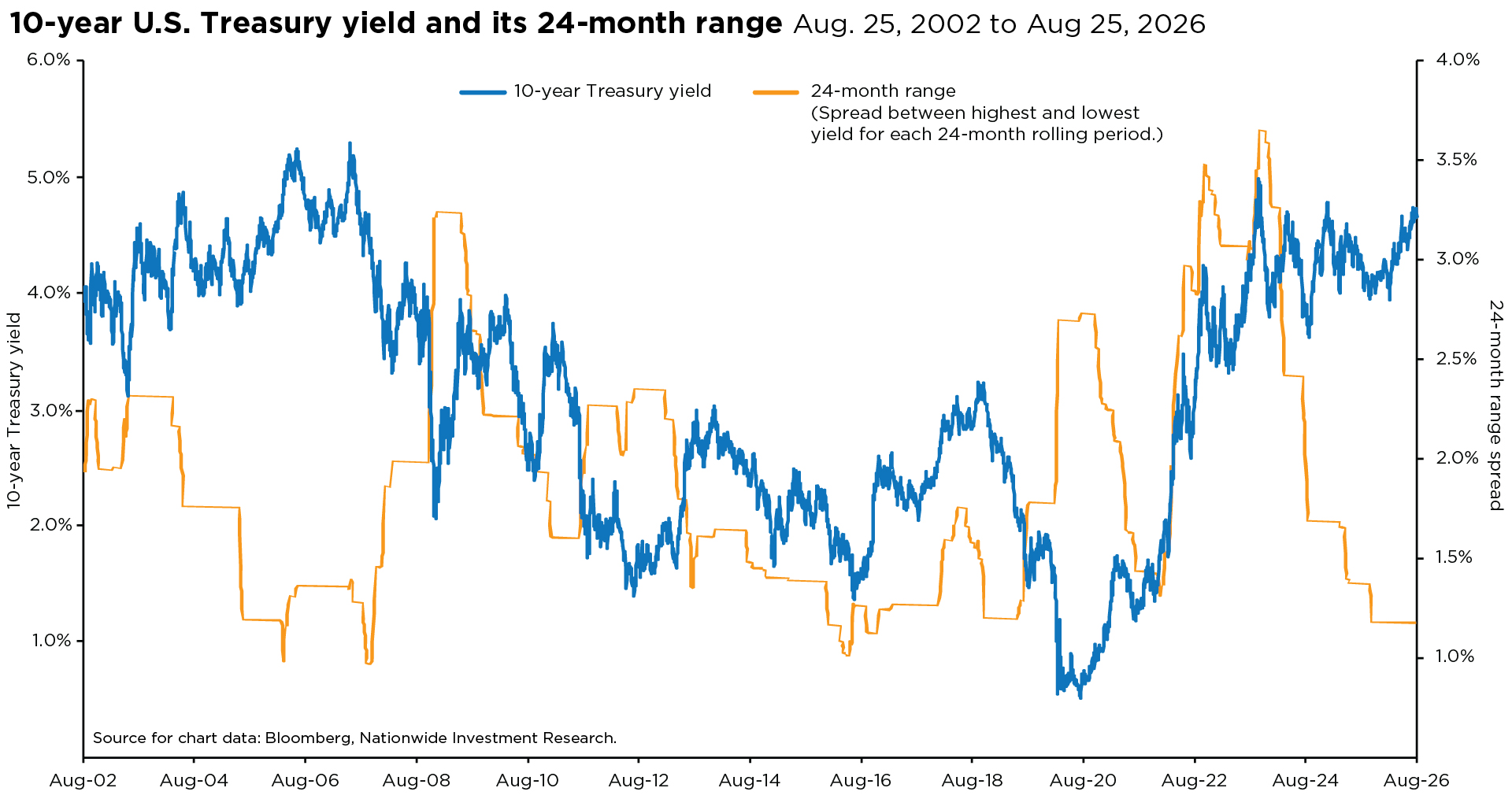
This is notable given the steady stream of market-moving headlines, macroeconomic pressures, and geopolitical developments. Perhaps the simplest explanation is also the most compelling: markets continue to adjust to a world no longer defined by zero interest rate policy. Viewed through that lens, the real surprise is not the level of yields, but investors' tendency to search for a single explanation when several forces may drive the same outcome.
Investors should want to know the level at which interest rates ultimately impair economic growth. However, current yield levels don't align with an economy generating roughly 6.5% nominal GDP growth year over year or with more than $1 trillion in AI-related capital expenditures projected through 2027. Nor do they necessarily undermine the strategic role of fixed income within diversified portfolios.
For bond investors, the year-to-date return on their fixed income holdings may be sobering, as higher yields remain a headwind for bond prices and, to some extent, equity valuations. However, the very forces that have made the bond market more challenging this year have also made fixed income increasingly interesting.
The more important takeaway from today's environment may be that higher yields continue to support the case for fixed income, but bond investing may require greater selectivity. As economic growth, inflation, fiscal dynamics, and policy outcomes become more differentiated, investors may need to rethink their approach to fixed income through the lens of portfolio construction rather than broad market exposure alone. Income should remain the primary driver of bond returns in 2026, but in a market increasingly shaped by crosscurrents and less influenced by predictable central bank guidance, flexibility, security selection, and disciplined risk-taking will become increasingly important.
The case for fixed income today may be less about making a directional call on rates and more about capturing income while maintaining the flexibility to navigate an increasingly complex macroeconomic backdrop.
Author(s)

Mark Hackett, CFA®, CMT®, CFP®
Chief Market Strategist, Nationwide Investment Management Group
Mark Hackett is the Chief Market Strategist for Nationwide’s Investment Management Group, bringing more than 20 years of experience in the asset management industry to the role.
Trending articles
What could matter most for bond investors in 2026? Income, flexibility, and a disciplined approach to security selection.
As sports betting gains popularity, investors may blur the line between gambling and investing. Here's why time and compounding matter.
Looking beyond rates reveals what's historically fueled small-cap gains most: stronger earnings and a growing economy.