
How to use small-cap stocks to build
resilient client portfolios
Key takeaways:
- Small-cap stocks have historically outperformed large caps after Fed rate cuts, making them appealing when interest rates shift.
- The Russell 2000® Index has led the S&P SmallCap 600® Index this year—likely driven by investor demand for speculative growth and momentum plays.
11/05/2025 – After years of lagging behind large-cap stocks, small caps have stepped into the spotlight since the April 8 lows. Their recent strength reflects several supportive factors—most notably, expectations for further Federal Reserve rate cuts. For advisors, this shift could open opportunities to revisit diversification strategies and client conversations around market leadership.
Since 1990, small-cap stocks have typically outperformed large caps in the months following Fed rate cuts, making them relatively more attractive when the interest rate cycle shifts. Historically, small caps benefit from monetary easing because lower rates improve cash flow and fuel growth for smaller, fast-growing companies.
It’s worth noting that small-cap benchmarks aren’t all created equal. The Russell 2000® Index—often viewed as the go-to small-cap gauge—includes a sizable portion of unprofitable companies, about 40%. By contrast, the S&P SmallCap 600® applies profitability and liquidity screens, aiming to include higher-quality businesses in its lineup. The Russell 2000 has outperformed the S&P SmallCap 600 year-to-date, but that gap likely signals investors’ preference for speculative growth and momentum plays (see chart). Many of these companies report negative earnings and carry fragile balance sheets, so lower rates make their cash flows appear more attractive.
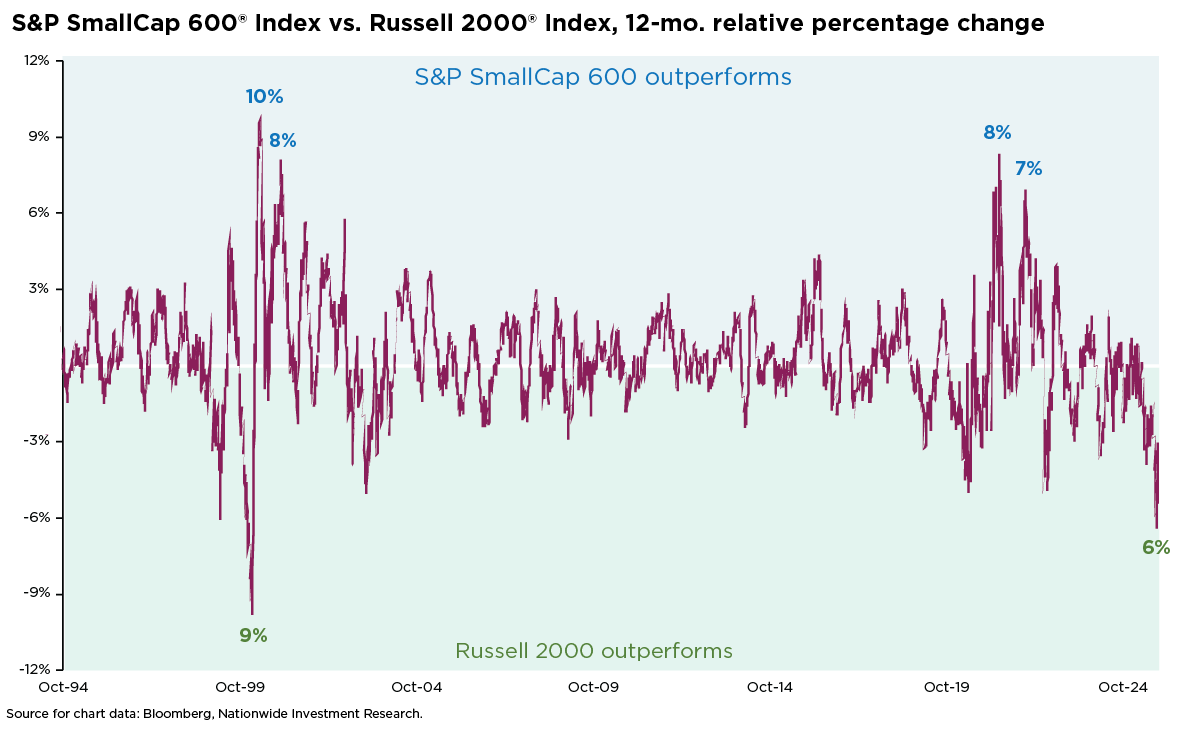
The S&P SmallCap 600’s recent underperformance isn’t a flaw—it’s a feature of today’s market dynamics. Its focus on earnings stability makes the Index less sensitive to rate-fueled rallies, yet potentially more resilient when economic conditions turn volatile.
Since its launch in 1995, the S&P SmallCap 600 has posted stronger and steadier results—averaging 10.6% annually with lower volatility—versus the Russell 2000’s 9.2% return and higher 20% standard deviation. While the Russell 2000’s recent surge may look appealing, much of that rally has been powered by speculative sectors that thrive in momentum-driven markets, including AI, quantum computing, nuclear technology, and biotech.
Companies that clear basic screens—profitability, manageable debt, and solid return on equity—have trailed in the current rally, not because fundamentals have weakened, but because investors have chased more speculative opportunities with perceived upside. When momentum fades, higher-quality names are positioned to deliver, while unprofitable firms are unlikely to withstand losses.
For advisors focused on building sustainable, all-weather portfolios, the S&P SmallCap 600 provides targeted small-cap exposure with an emphasis on profitability—an attribute that often proves critical when the economic cycle shifts.
Author(s)

Mark Hackett, CFA®, CMT®, CFP®
Chief Market Strategist, Nationwide Investment Management Group
Mark Hackett is the Chief Market Strategist for Nationwide’s Investment Management Group, bringing more than 20 years of experience in the asset management industry to the role.
Trending articles
What could matter most for bond investors in 2026? Income, flexibility, and a disciplined approach to security selection.
As sports betting gains popularity, investors may blur the line between gambling and investing. Here's why time and compounding matter.
Looking beyond rates reveals what's historically fueled small-cap gains most: stronger earnings and a growing economy.