

Markets and economy
How will bonds perform as the Fed begins
raising interest rates?
Key takeaways:
- If the 40-year bull market in bonds is over, advisors should be cautious about relying too heavily on historical bond performance when setting client expectations.
- Bonds will continue to play a role in investor portfolios, but how they are used may evolve as market and economic conditions change.
09/30/2026 – What does the historical record tell us about bond returns during a Federal Reserve rate-tightening cycle? While the specifics of each rate-hike cycle vary, bonds have generally lagged following the first hike but produced positive returns over the following 12 months. The chart highlights that pattern across five of the past six rate-hiking cycles, based on average returns for the Bloomberg U.S. Aggregate Bond Index. The takeaway is that maintaining a long-term investment horizon may be more important than reacting to short-term market noise.
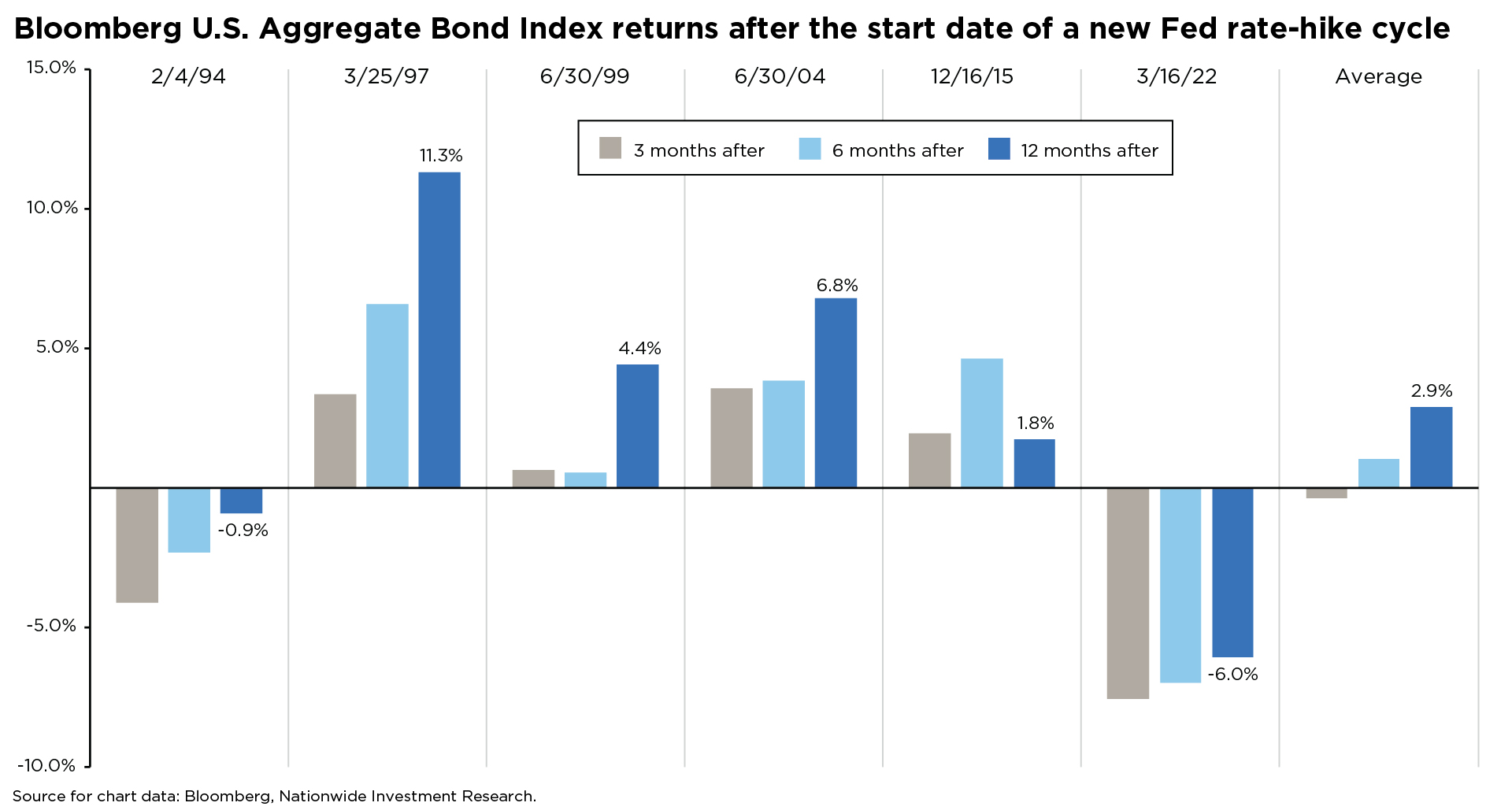
This track record developed during a four-decade bull market for bonds, when long-term interest rates, as measured by the 10-year U.S. Treasury yield, fell from more than 15% in late 1981 to less than 1% at the end of 2020. Throughout this period, bond investors benefited from several favorable trends, including disinflation, globalization and declining interest rates. Together, these forces shaped the historical patterns investors now use to interpret tightening cycles.
Then came 2022, bringing a surge in inflation and steep declines for both bonds and stocks. The fallout may have extended beyond short-term losses. Instead, 2022 may have marked the beginning of a structural shift, challenging the 40-year bull market in bonds and reminding investors that relying too heavily on past market patterns could lead to unrealistic expectations about future market behavior.
As noted earlier, the specifics of each hiking cycle matter. If the 2022 bond drawdown was an early sign of broader changes in the bond market, investors should understand the forces currently shaping the bond market as they consider diversification opportunities. Today, investors are facing a sharp rise in global bond yields, driven in part by strong nominal growth, persistent inflation, geopolitical tensions, expansive fiscal policy, shifting supply chains and a Federal Reserve that is less inclined to provide explicit forward guidance on monetary policy.
Bonds may be adjusting to a different market environment, one that no longer provides the same diversification benefits investors have come to expect over the past 40 years. If so, the historical pattern of positive bond returns in the 12 months following a Fed rate hike may be less reliable going forward.
Investors should not assume that bonds no longer have a place in a portfolio. Far from it. While longer-duration bonds are currently under pressure as yields rise, higher yields can improve long-term return potential. As today's economic environment evolves, bonds may become more attractive despite near-term market volatility.
Author(s)

Mark Hackett, CFA®, CMT®, CFP®
Chief Market Strategist, Nationwide Investment Management Group
Mark Hackett is the Chief Market Strategist for Nationwide’s Investment Management Group, bringing more than 20 years of experience in the asset management industry to the role.