Mark Hackett, CFA, CMT


Markets and economy
Markets and economy
Is the rotation for real?
What the equal-weighted index is signaling
Key takeaways:
- Cyclical sectors are taking the lead. Energy, industrials, and materials are outperforming technology year-to-date, and broader market participation is reinforcing the uptrend.
- Expect shifts in momentum. Leadership will rotate across styles, sizes, and sectors, so help clients stay focused on fundamentals rather than short-term noise.
02/18/2026 – The S&P 500® Equal Weight Index is off to its strongest start to a year relative to the cap-weighted index since 1992. That strength may signal that market leadership—long dominated by the Magnificent 7—is broadening meaningfully. With the equal-weighted index already hitting 13 record highs in 2026, advisors may see the early stages of a rotation with deeper structural support behind it.
Starting last fall, cyclical sectors of the U.S. economy turned higher, supported by the combination of looser monetary policy and more business-friendly fiscal measures—including provisions that allow companies to fully depreciate capital expenditures.
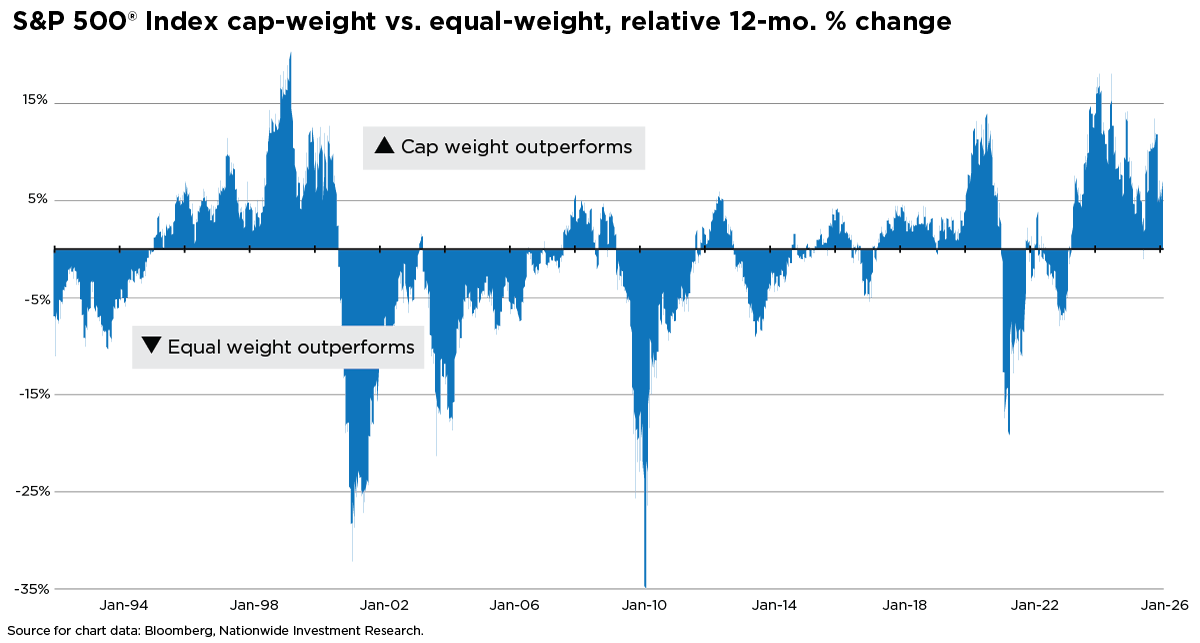
The equal-weighted S&P 500’s string of new highs is encouraging, but the more notable story is the pro-cyclical rotation happening beneath the surface. Sectors long overshadowed by mega-cap technology—such as energy, industrials, and materials—are now outperforming tech year-to-date. Market breadth has strengthened, helping support the broader uptrend.
Profit-margin forecasts for the next 12 months within the equal-weighted S&P 500 have continued to strengthen, pointing to improving fundamentals beyond the index’s largest constituents. Taken together, these trends suggest a rotation supported not only by positioning but by strengthening pro-cyclical forces in the U.S. economy.
While 2026 still looks broadly constructive, advisors should expect momentum to shift as leadership rotates across styles, sizes, and sectors. In this kind of environment, it’s helpful to remind clients to tune out the noise, stay focused on fundamentals, maintain diversification, and remember that periods of volatility are a normal—and often healthy—part of long-term investing.
Author(s)

Mark Hackett, CFA®, CMT®, CFP®
Chief Market Strategist, Nationwide Investment Management Group
Mark Hackett is the Chief Market Strategist for Nationwide’s Investment Management Group, bringing more than 20 years of experience in the asset management industry to the role.
Trending articles
What could matter most for bond investors in 2026? Income, flexibility, and a disciplined approach to security selection.
As sports betting gains popularity, investors may blur the line between gambling and investing. Here's why time and compounding matter.
Looking beyond rates reveals what's historically fueled small-cap gains most: stronger earnings and a growing economy.
Disclaimers
This material is not a recommendation to buy or sell a financial product or to adopt an investment strategy. Investors should discuss their specific situation with their financial professional.
Except where otherwise indicated, the views and opinions expressed are those of Nationwide as of the date noted, are subject to change at any time and may not come to pass.
S&P 500® Index: An unmanaged, market capitalization-weighted index of 500 stocks of leading large-cap U.S. companies in leading industries; it gives a broad look at the U.S. equities market and those companies’ stock price performance.
S&P Indexes are trademarks of Standard & Poor’s and have been licensed for use by Nationwide Fund Advisors. The Products are not sponsored, endorsed, sold or promoted by Standard & Poor’s and Standard & Poor’s does not make any representation regarding the advisability of investing in the Product.
S&P 500® Equal Weight Index (EWI): The equal-weight version of the widely-used S&P 500 Index that includes the same constituents as the capitalization weighted S&P 500, but each company in the S&P 500 EWI is allocated a fixed weight - or 0.2% of the Index total at each quarterly rebalance.