Mark Hackett, CFA®, CMT®, CFP®


Markets and economy
Markets and economy
Recent "Mag 7" weakness
hasn't hurt the broader market
Key takeaways:
- Despite the recent underperformance of the "Magnificent 7," the broader stock market has remained resilient, suggesting that leadership is broadening rather than breaking.
- Earnings growth for the "other 493" companies in the S&P 500® Index may overtake that of the Mag 7 later this year, signaling that broader earnings participation could become the defining feature of the next phase of the cycle.
07/09/2026 – The dominance of the "Magnificent 7" stocks has long cast a shadow over the current bull market, with each bout of volatility reviving concerns about the broader uptrend in the S&P 500® Index. Yet those concerns have not been borne out.
Despite two corrections since last October, the Mag 7's recent underperformance relative to the market has failed to weaken the broader Index. Unlike in 2022, weakness in these stocks has not dragged down the market as a whole. Instead, the Index has remained resilient, suggesting that market leadership is broadening rather than breaking.
While the Mag 7 has surrendered momentum this year, that weakness has not translated into a loss of leadership for the technology sector or the equity market more broadly. Instead, leadership is dispersing across a wider opportunity set. The broader tech sector continues to outperform the S&P 500, with many semiconductor, hardware, and infrastructure stocks extending the gains initially sparked by the AI investment cycle. Since the March lows, four of the sector's six industries have advanced over 30%, underscoring that investor enthusiasm is becoming increasingly distributed rather than concentrated in a handful of mega-cap names.
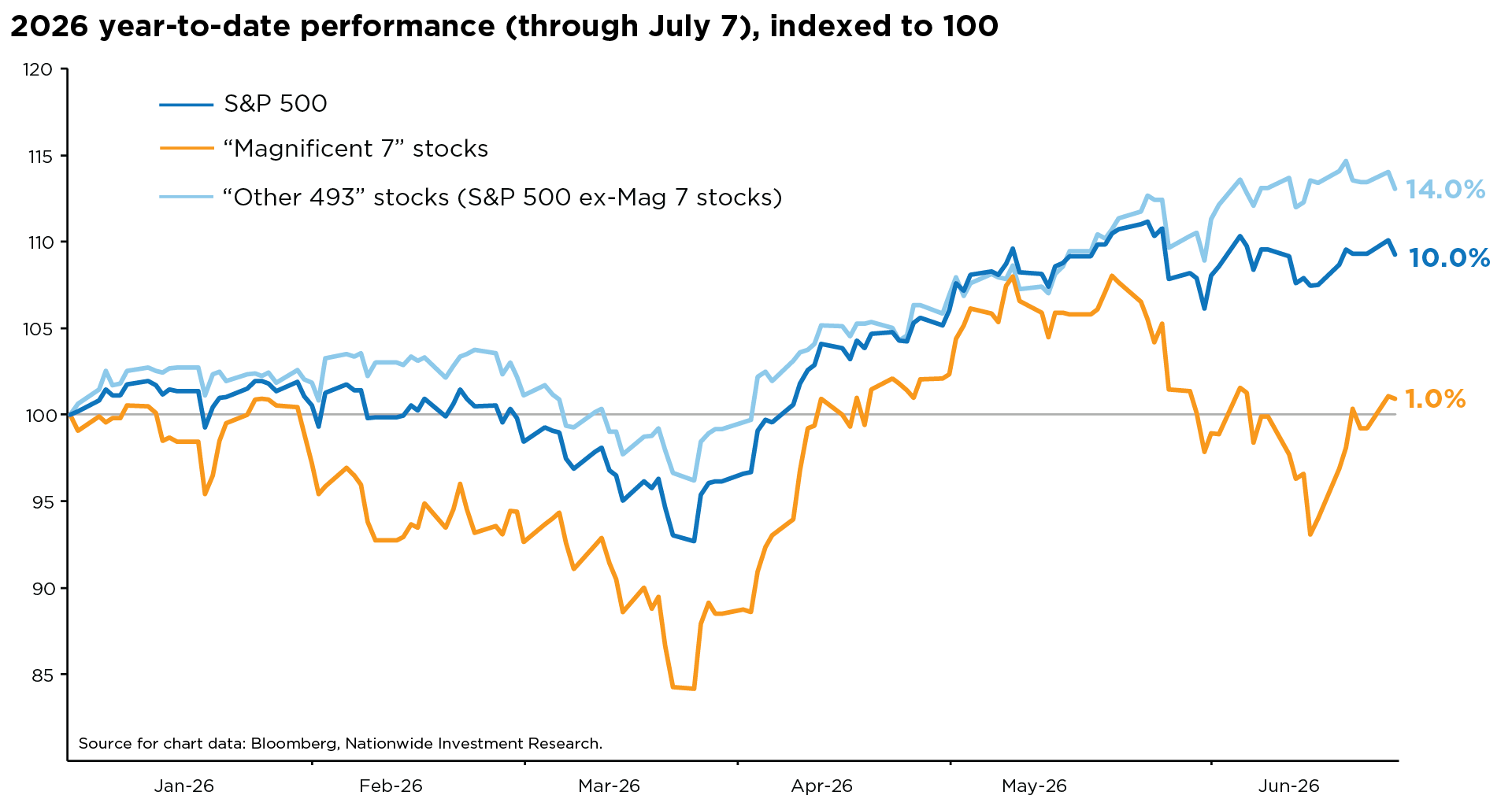
That same broadening is now becoming increasingly clear beneath the surface, spanning market capitalizations and investment styles. A majority of S&P 500 constituents are outperforming the Mag 7 this year, while small-cap stocks have quietly turned higher. The Russell 2000® Index has broken its downtrend relative to the Mag 7 and is approaching its strongest level since 2025—a notable shift after a prolonged period of market concentration. What's more, the Russell 2000 is outperforming the Mag 7 by 27% year-to-date, as of this writing. This is what rotation looks like when leadership changes—not when markets break. The implication is subtle but important: capital is not rotating away from growth, but toward a broader definition of it.
That evolution appears increasingly driven by fundamentals rather than positioning alone. First quarter earnings were both strong and broad-based. Aggregate EPS for S&P 500 companies rose 27% year-over-year in Q1, while the median company delivered 14% earnings growth, marking one of the strongest and most broadly shared earnings seasons in a decade.
While the momentum trade has dominated investor attention in 2026, the resilience of the economy should continue to underpin the wide dispersion of returns across the market. Should economic data remain resilient, earnings growth is likely to broaden across industries that spent much of the past several years constrained by restrictive policy and uneven demand.
To that point, consensus expectations now call for the "other 493" companies in the S&P 500 to overtake the Mag 7 in earnings growth later this year, marking a notable shift in the market's earnings profile. If realized, investors may no longer need to rely on a small group of companies to repeatedly exceed lofty expectations for the Index to advance. Instead, stronger participation across technology, cyclical sectors, and the broader economy could provide a more balanced foundation for equity returns.
The recent underperformance of the Mag 7 is more likely a reflection of investor caution around elevated capital spending and pressure on free cash flow than a signal of deterioration in the underlying bull market. Broader earnings participation may become the defining feature of the next phase of the cycle, even if the path forward remains uneven.
Author(s)

Mark Hackett, CFA®, CMT®, CFP®
Chief Market Strategist, Nationwide Investment Management Group
Mark Hackett is the Chief Market Strategist for Nationwide’s Investment Management Group, bringing more than 20 years of experience in the asset management industry to the role.
Trending articles
What could matter most for bond investors in 2026? Income, flexibility, and a disciplined approach to security selection.
As sports betting gains popularity, investors may blur the line between gambling and investing. Here's why time and compounding matter.
Looking beyond rates reveals what's historically fueled small-cap gains most: stronger earnings and a growing economy.
Sources/Disclosures
This material is not a recommendation to buy or sell a financial product or to adopt an investment strategy. Investors should discuss their specific situation with their financial professional.
Except where otherwise indicated, the views and opinions expressed are those of Nationwide as of the date noted, are subject to change at any time and may not come to pass.
S&P 500® Index: An unmanaged, market capitalization-weighted index of 500 stocks of leading large-cap U.S. companies in leading industries; it gives a broad look at the U.S. equities market and those companies' stock price performance.
S&P Indexes are trademarks of Standard & Poor's and have been licensed for use by Nationwide Fund Advisors. The Products are not sponsored, endorsed, sold or promoted by Standard & Poor's and Standard & Poor's does not make any representation regarding the advisability of investing in the Product.
Russell 2000® Index: An unmanaged index that measures the performance of the small-capitalization segment of the U.S. equity universe.
Russell Investment Group is the source and owner of the trademarks, service marks and copyrights related to the Russell Indexes. The Fund is not sponsored, endorsed, or promoted by Russell, and Russell bears no liability with respect to any such funds or securities or any index on which such funds or securities are based. Russell ® is a trademark of Russell Investment Group.