Mark Hackett, CFA®, CMT®, CFP®


Markets and economy
Markets and economy
Stocks and bonds are moving together—
now what for portfolios?
Key takeaways:
- As stock-bond correlations turn positive, advisors are fielding more client questions about how effective traditional diversification remains in the current environment.
- With stocks and bonds increasingly influenced by the same macro forces, diversification requires a more deliberate approach—placing greater focus on how portfolios are constructed while remaining grounded in core risk principles.
06/10/2026 – Stocks and bonds have been moving in tandem for much of the past several months. As stock-bond correlations rise, advisors are fielding more questions about whether traditional diversification strategies can still deliver as intended.
For much of the past two decades, the answer was largely yes. Stocks and bonds typically moved in opposite directions (i.e., negative correlation), with fixed income providing a reliable hedge during equity drawdowns. More recently, that relationship has been less dependable, as stocks and bonds have increasingly moved in sync—challenging the benefits of passive diversification.
Short-term correlations—measured by the rolling 40-day relationship between the S&P 500® Index and the Bloomberg U.S. Aggregate Bond Index—have climbed to their most positive levels since 1999 (see chart). This points to a market backdrop where uncertainty around policy (fiscal and monetary), inflation, growth, and geopolitics is influencing asset classes in a more unified way.
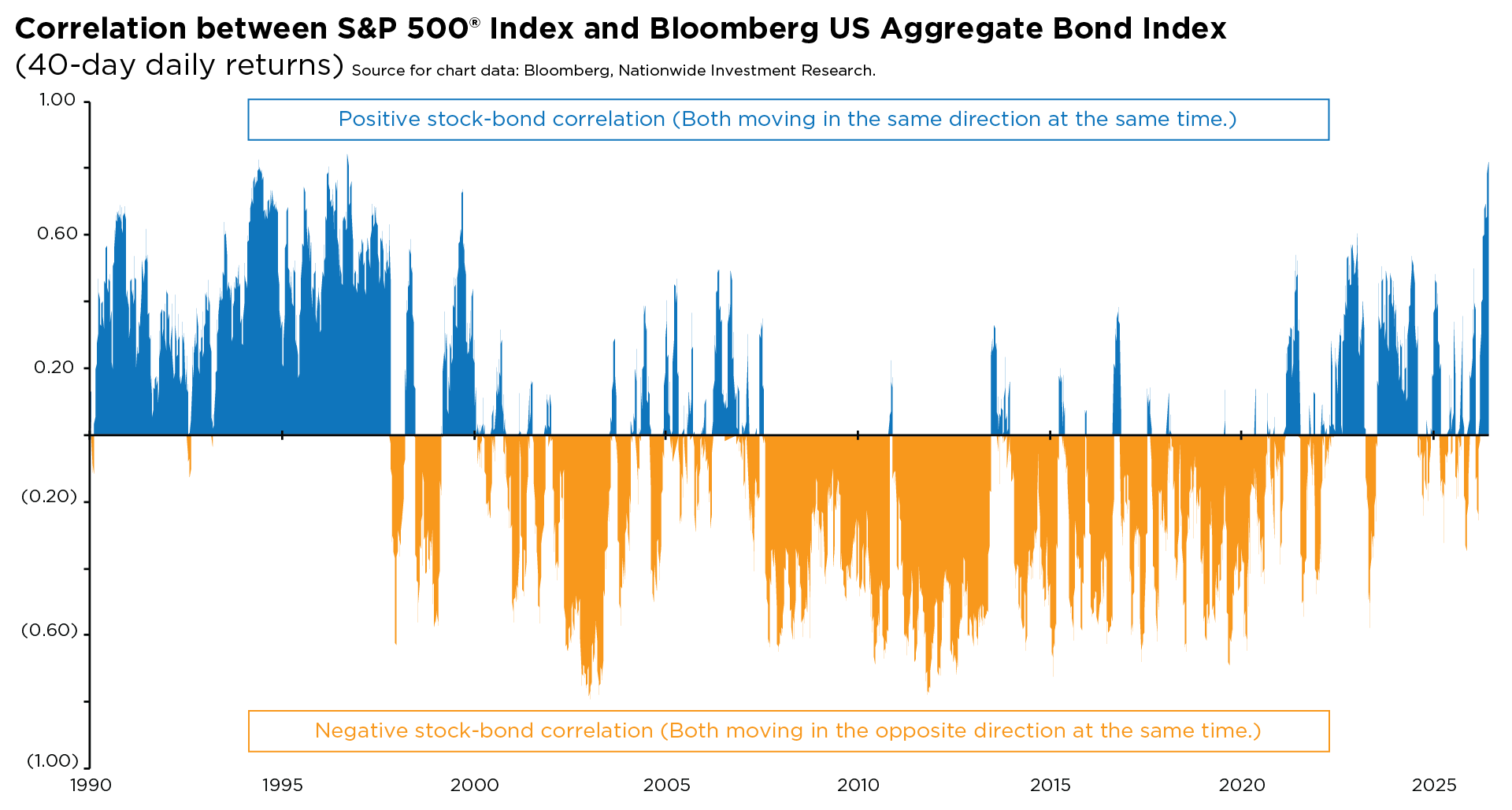
Inflation uncertainty appears to be the dominant driver in the current market environment, reflected in rising real interest rates. Higher rates signal not only persistent price pressures, but also a more constructive long-term growth outlook—partly tied to expectations for AI-driven productivity gains. The result: both equities and bonds are increasingly exposed to the same set of macro forces.
This dynamic underscores how dependent cross-asset relationships are on the prevailing macro environment. When inflation is low and stable, growth concerns tend to dominate—supporting negative correlations, as bonds often rally when equities weaken. In more inflationary settings, however, elevated price pressures can constrain the Federal Reserve’s ability to cut rates, creating a backdrop where both stocks and bonds may come under pressure at the same time. Diversification hasn’t broken down, but it has become more dependent on the underlying economic data.
The traditional 60/40 framework remains a durable foundation—especially as higher nominal and real yields have improved the outlook for fixed income. That said, advisors may need to adapt how they implement it. This could include broadening diversification across assets with different macro sensitivities and being more deliberate within equities, where concentration risk has increased meaningfully.
Staying anchored to strategic allocations, maintaining broad and intentional diversification, and rebalancing with discipline can help portfolios navigate uncertainty. Periods of volatility and shifting asset relationships aren’t aberrations—they’re a natural feature of evolving market conditions. While the environment may change, the core principles remain intact.
Author(s)

Mark Hackett, CFA®, CMT®, CFP®
Chief Market Strategist, Nationwide Investment Management Group
Mark Hackett is the Chief Market Strategist for Nationwide’s Investment Management Group, bringing more than 20 years of experience in the asset management industry to the role.
Trending articles
What could matter most for bond investors in 2026? Income, flexibility, and a disciplined approach to security selection.
As sports betting gains popularity, investors may blur the line between gambling and investing. Here's why time and compounding matter.
Looking beyond rates reveals what's historically fueled small-cap gains most: stronger earnings and a growing economy.
Sources/Disclosures
This material is not a recommendation to buy or sell a financial product or to adopt an investment strategy. Investors should discuss their specific situation with their financial professional.
Except where otherwise indicated, the views and opinions expressed are those of Nationwide as of the date noted, are subject to change at any time and may not come to pass.
Bloomberg US Aggregate Bond Index: An unmanaged, market value-weighted index of U.S. dollar-denominated, investment-grade, fixed-rate, taxable debt issues, which includes Treasuries, government-related and corporate securities, mortgage-backed securities (agency fixed-rate and hybrid adjustable-rate mortgage pass-throughs), asset-backed securities and commercial mortgage-backed securities (agency and non-agency).
Bloomberg® and its indexes are service marks of Bloomberg Finance L.P. and its affiliates including Bloomberg Index Services Limited, the administrator of the Index, and have been licensed for use for certain purposes by Nationwide. Bloomberg is not affiliated with Nationwide, and Bloomberg does not approve, endorse, review or recommend this product. Bloomberg does not guarantee the timeliness, accurateness, or completeness of any date or information relating to this product.
S&P 500® Index: An unmanaged, market capitalization-weighted index of 500 stocks of leading large-cap U.S. companies in leading industries; it gives a broad look at the U.S. equities market and those companies’ stock price performance.
S&P Indexes are trademarks of Standard & Poor’s and have been licensed for use by Nationwide Fund Advisors. The Products are not sponsored, endorsed, sold or promoted by Standard & Poor’s and Standard & Poor’s does not make any representation regarding the advisability of investing in the Product.