Mark Hackett, CFA®, CMT®, CFP®


Markets and economy
Markets and economy
What does the Fed’s hawkish pivot mean for markets?
Key Takeaways:
- The pace of Fed tightening may matter more for markets than the number of rate hikes ultimately delivered.
- History suggests that early-stage rate-hike cycles often bring volatility, but not necessarily sustained weakness for equities.
10/05/2026 — As we transition to a new, more hawkish interest-rate cycle, it won’t only be economic data that influences the Fed, but also the pace at which policymakers decide to raise rates. For investors looking for clues about what the next rate cycle may hold, the first signals about the timing and direction of future Fed decisions emerged during the September FOMC meeting. The Fed largely surprised investors with its hawkish pivot: there were no dissenting votes for the September hike, and a base case of two additional rate hikes by year-end was supported by a 16-2 majority of committee members. Additionally, the median federal funds rate projection remained elevated through 2029, while the median neutral-rate dot rose from 3.06% to 3.25%.
Fed Chair Kevin Warsh described the hike as having "removed a dose of accommodation," a characterization that surprised investors who viewed him as having more dovish inclinations. Rather than attempting to predict how the Fed may respond to future data or infer future moves from subtle shifts in FOMC press conference language, investors should view the next rate-hiking cycle through a historical lens. Doing so may provide a useful compass for the path ahead.
As a new interest-rate cycle begins, what can investors learn from past Fed tightening cycles for equity markets today?
The chart below highlights differences in the pace of Fed rate-tightening cycles and the performance of the S&P 500® Index. However, averages mask a wide range of outcomes and the economic conditions the Fed faced during each period. What distinguishes slow, fast, and non-cycles? In general, a slow cycle occurs when the Fed waits for at least one meeting between rate hikes, though the timing and magnitude of those hikes can vary. Fast cycles are defined by more frequent and often larger rate hikes, with some front-loaded and others featuring multiple hikes within a relatively short period. A non-cycle typically consists of one or two rate hikes before the Fed resumes cutting rates.
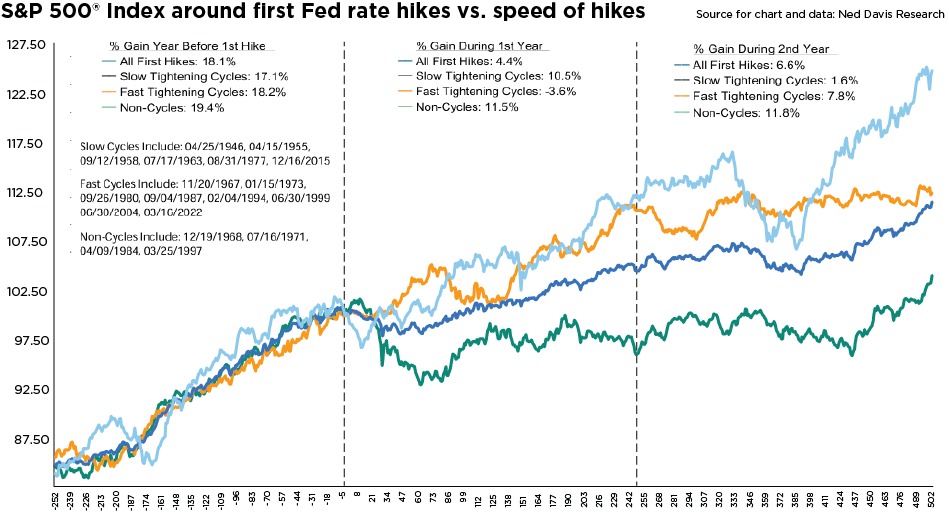
Typically, equity investors take comfort in the fact that the Fed is not tightening aggressively and that they are not at risk of "fighting the Fed." One important caveat is that historical cycles can vary significantly depending on the time period. For instance, since 1988, equity market performance during rate-hiking cycles has varied, though the results have been modestly favorable for equities overall. At the same time, the market's path has rarely been linear or free of volatility. Over the first three months following the initial rate hike, the S&P 500 has historically declined by an average of 2%, highlighting that Fed tightening often introduces near-term volatility as investors adjust to a new policy environment.
Given how unusual the current economic cycle is, it is far too soon to judge what this cycle will ultimately look like. But if history is any guide, it may be reasonable to view the current environment as a blend of a non-cycle and a slow cycle, reflecting the Fed chair's commitment to restoring price stability without necessarily signaling a rapid or sustained tightening cycle.
What are the major takeaways from the Fed’s recent rate decision, the accompanying statement and Warsh’s press conference? How are investors thinking about the path of interest rates into year-end and 2027?
The most important takeaway from the September FOMC meeting wasn’t the number of hikes reflected in the dot plot, but Warsh’s acknowledgment during his press conference that monetary policy remains accommodative. Even though Warsh sounded more hawkish than many expected, market expectations for future Fed policy still appear tilted toward additional rate hikes. That may be understandable given the Fed’s desire to re-establish its inflation-fighting credibility. Yet the economic picture remains uneven. One could argue that one-time factors are driving much of the recent inflation above the Fed's 2% target.
AI-related investment, strong nominal growth, and defense-related activity have helped sustain economic momentum. However, the more interest-rate-sensitive segments of the economy, including housing, autos and lower-income consumers, remain under pressure, creating challenges for policymakers.
The peak in this new rate-hiking cycle may ultimately be lower than current market pricing suggests. While the Fed could raise rates again in October, the economic data does not suggest policymakers are embarking on a 2022-style hiking cycle. Instead, conditions appear to be gradually normalizing, with the pace ultimately determined by whether strength in AI capital expenditures, fiscal spending and geopolitically driven investment continues to outweigh weakness across more rate-sensitive sectors of the economy.
Author(s)

Mark Hackett, CFA®, CMT®, CFP®
Chief Market Strategist, Nationwide Investment Management Group
Mark Hackett is the Chief Market Strategist for Nationwide’s Investment Management Group, bringing more than 20 years of experience in the asset management industry to the role.
Trending articles
What could matter most for bond investors in 2026? Income, flexibility, and a disciplined approach to security selection.
As sports betting gains popularity, investors may blur the line between gambling and investing. Here's why time and compounding matter.
Looking beyond rates reveals what's historically fueled small-cap gains most: stronger earnings and a growing economy.
Disclaimers
This material is not a recommendation to buy or sell a financial product or to adopt an investment strategy. Investors should discuss their specific situation with their financial professional.
Except where otherwise indicated, the views and opinions expressed are those of Nationwide as of the date noted, are subject to change at any time and may not come to pass.
S&P 500® Index: An unmanaged, market capitalization-weighted index of 500 stocks of leading large-cap U.S. companies in leading industries; it gives a broad look at the U.S. equities market and those companies’ stock price performance.
S&P Indexes are trademarks of Standard & Poor’s and have been licensed for use by Nationwide Fund Advisors. The Products are not sponsored, endorsed, sold or promoted by Standard & Poor’s and Standard & Poor’s does not make any representation regarding the advisability of investing in the Product.