Mark Hackett, CFA, CMT


Markets and economy
Markets and economy
What economic revisions mean
for client conversations
Key takeaways:
- Economic data—especially when noisy and frequently revised—should inform portfolio decisions, not dictate them.
- Labor market trends help shape Fed policy, but they shouldn’t overshadow the value of diversification and a long-term investment perspective.
09/17/2025 – Signs of a cooling labor market are evident in many recent employment data releases: hiring is slowing, hours worked are declining, and wage growth in August eased to 3.7% year-over-year. The market reaction to these reports is understandable—especially as downward revisions to payroll data via the Quarterly Census of Employment and Wages (QCEW) have cast doubt on the strength of job growth and added to economic uncertainty.
Many advisors are now weighing whether economic dislocations are deeper than previously believed. A wide range of potential outcomes—from renewed growth to stagflation—each with its own labor market narrative, is reshaping market sentiment and influencing client outlooks.
So, what is the QCEW—and why do its revisions matter? The Bureau of Labor Statistics presents the QCEW as a comprehensive survey of employment and wages, covering over 95% of U.S. jobs. Revisions are made quarterly to provide a more accurate picture of job growth and labor market trends.
Some may view the labor market weakness as a head fake; others see it as a harbinger of recession. But interpreting the economic backdrop is more nuanced than a simple forecast. If the discord in the current cycle has shown anything over the past few years, it’s that traditional signals often fail to materialize. Economic data—especially when noisy and frequently revised—should inform, not dictate, portfolio decisions.
Because data like monthly nonfarm payrolls is frequently revised, it raises the question: is a release meaningful or just noise? Spotting key reversals in real time is notoriously difficult, which makes it even more important not to overreact to any single data point when guiding client portfolios.
Labor market trends are certainly relevant—especially in shaping Fed policy—but they shouldn’t overshadow the importance of staying diversified and maintaining a long-term perspective.
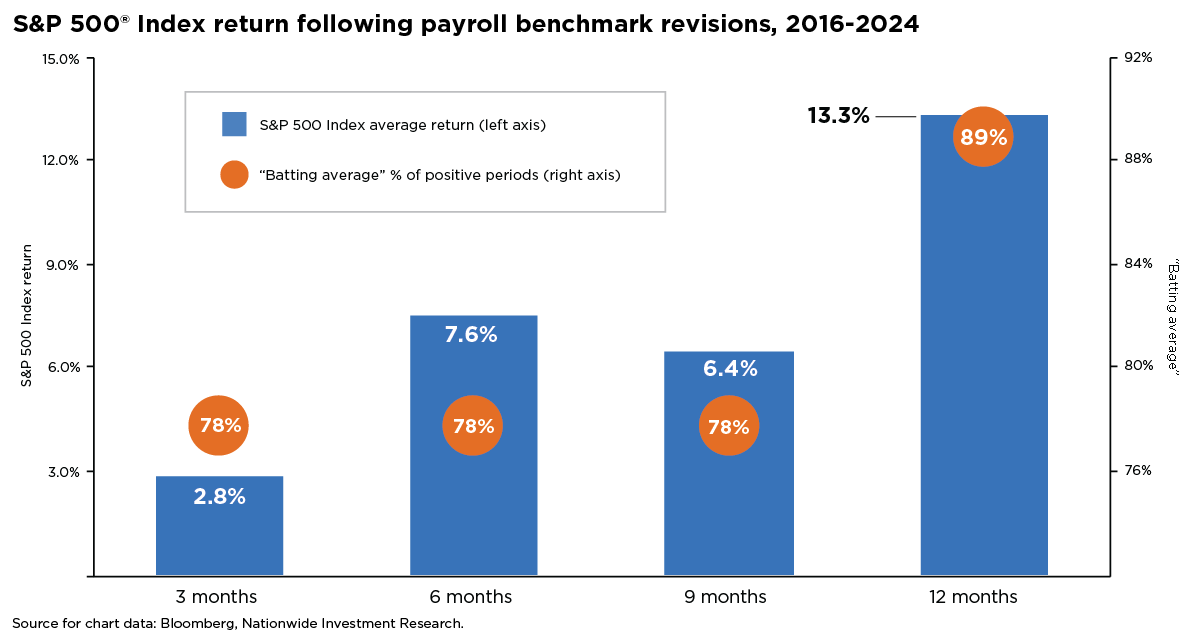
For advisors fielding questions about the recent QCEW revisions and what they might signal for future equity returns, there’s a silver lining: historically, S&P 500® Index returns following QCEW release dates have, on average, remained positive across short-term time horizons (see accompanying chart). For clients tempted to overreact—whether to gloomy labor headlines or revised data—it’s worth reminding them of the risks of market timing. Missing just 10 of the market’s best days each year has historically meant missing out on meaningful long-term gains.
Ultimately, building a long-term portfolio isn’t about reacting to noise—it’s about staying focused on clear goals, broad diversification, low costs, and disciplined decision-making through changing market conditions.
Stay focused when news breaks
Author(s)

Mark Hackett, CFA®, CMT®, CFP®
Chief Market Strategist, Nationwide Investment Management Group
Mark Hackett is the Chief Market Strategist for Nationwide’s Investment Management Group, bringing more than 20 years of experience in the asset management industry to the role.
Trending articles
What could matter most for bond investors in 2026? Income, flexibility, and a disciplined approach to security selection.
As sports betting gains popularity, investors may blur the line between gambling and investing. Here's why time and compounding matter.
Looking beyond rates reveals what's historically fueled small-cap gains most: stronger earnings and a growing economy.
Disclaimers
This material is not a recommendation to buy or sell a financial product or to adopt an investment strategy. Investors should discuss their specific situation with their financial professional.
Except where otherwise indicated, the views and opinions expressed are those of Nationwide as of the date noted, are subject to change at any time and may not come to pass.
S&P 500® Index: An unmanaged, market capitalization-weighted index of 500 stocks of leading large-cap U.S. companies in leading industries; it gives a broad look at the U.S. equities market and those companies’ stock price performance.
S&P Indexes are trademarks of Standard & Poor’s and have been licensed for use by Nationwide Fund Advisors LLC. The Products are not sponsored, endorsed, sold or promoted by Standard & Poor’s and Standard & Poor’s does not make any representation regarding the advisability of investing in the Product.
Nationwide Funds are distributed by Nationwide Fund Distributors LLC, member FINRA, Columbus, Ohio. Nationwide Investment Services Corporation, member FINRA, Columbus, Ohio. Nationwide Retirement Institute is a division of NISC.