Mark Hackett, CFA, CMT


Markets and economy
Markets and economy
What shutdowns don’t do to markets—
and what advisors should focus on instead
Key takeaways:
- Government shutdowns have historically caused short-term market volatility but have rarely affected long-term performance.
- A rise in volatility can serve as a timely reminder for investors not to grow complacent about risk—especially during euphoric bull markets.
10/09/2025 – The third quarter delivered solid gains for equity markets, with the S&P 500® Index rising 8% and notching 23 new all-time closing highs. But the momentum was quickly overshadowed as headlines shifted to the federal government shutdown that began October 1.
Investors aren’t eager for more uncertainty—especially with the economy already on fragile footing. The labor market is showing signs of cooling, and Q3 earnings season is just around the corner. Policy uncertainty could tip the balance. While heightened volatility may feel unsettling, it also serves as a timely reminder not to get complacent about risk—particularly in euphoric bull markets.
Government shutdowns often prompt a familiar question: What do they mean for markets? Historically, the answer has been little. While these events tend to dominate headlines, their direct impact on market performance is typically limited. Case in point: the S&P 500 logged its 29th all-time high of the year on October 1—just hours after the latest shutdown took effect at midnight.
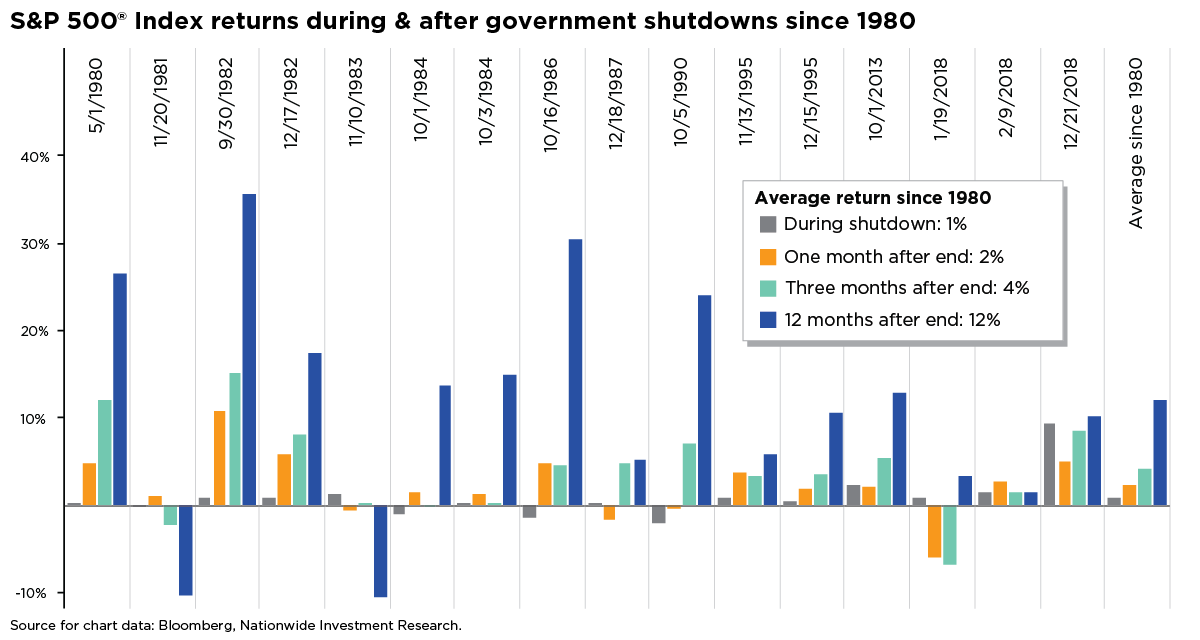
History suggests markets often look past the noise of government shutdowns. While these events can temporarily dampen economic activity and spark volatility, they’ve rarely disrupted the broader market trajectory.
Shutdowns may grab headlines, but their market impact is typically short-lived. Since 1980, the S&P 500® has averaged a 4% gain in the three months following a shutdown—and 12% over the next year (see chart). Even during the record-long 35-day standoff in 2018, the Index returned 10%. Through it all, investors largely tuned out the noise and stayed focused on fundamentals.
While shutdowns can rattle nerves and dominate the news cycle, they rarely rewrite the market narrative. For equity performance, the fundamentals still carry the most weight: economic growth, corporate earnings, and the path of interest rates. That’s where advisors can help clients stay focused—on what truly drives long-term outcomes.
With policy uncertainty back in the spotlight, advisors have a timely opportunity to reinforce the value of portfolio resilience—built to withstand short-term volatility while staying aligned with long-term goals. Shutdowns may stir sentiment, but history shows they’re more noise than lasting disruption.
Stay focused when news breaks
Author(s)

Mark Hackett, CFA®, CMT®, CFP®
Chief Market Strategist, Nationwide Investment Management Group
Mark Hackett is the Chief Market Strategist for Nationwide’s Investment Management Group, bringing more than 20 years of experience in the asset management industry to the role.
Trending articles
What could matter most for bond investors in 2026? Income, flexibility, and a disciplined approach to security selection.
As sports betting gains popularity, investors may blur the line between gambling and investing. Here's why time and compounding matter.
Looking beyond rates reveals what's historically fueled small-cap gains most: stronger earnings and a growing economy.
Disclaimers
This material is not a recommendation to buy or sell a financial product or to adopt an investment strategy. Investors should discuss their specific situation with their financial professional.
Except where otherwise indicated, the views and opinions expressed are those of Nationwide as of the date noted, are subject to change at any time and may not come to pass.
S&P 500® Index: An unmanaged, market capitalization-weighted index of 500 stocks of leading large-cap U.S. companies in leading industries; it gives a broad look at the U.S. equities market and those companies’ stock price performance.
S&P Indexes are trademarks of Standard & Poor’s and have been licensed for use by Nationwide Fund Advisors. The Products are not sponsored, endorsed, sold or promoted by Standard & Poor’s and Standard & Poor’s does not make any representation regarding the advisability of investing in the Product.