Mark Hackett, CFA, CMT


Markets and economy
Markets and economy
When rates fall, equities often rise—
here’s what history shows
Key takeaways:
- There's a growing divergence in the stock market, where momentum is fueled less by fundamentals and more by behavioral dynamics.
- In a market increasingly driven by sharp swings in sentiment, staying grounded in investing fundamentals is more important than ever.
09/10/2025 – All signs from the Federal Reserve point toward a rate cut at the next FOMC meeting on September 17—potentially resuming the monetary easing cycle that began in September 2024. Since then, the S&P 500® Index has returned 17%, prompting investors to ask: Has the market already priced in the benefits of lower rates?
Lower short-term rates have both technical and fundamental implications. They reduce borrowing costs for companies, which can boost profitability and spur investment. Rate cuts also support valuations, as lower yields make equities more attractive relative to bonds and help justify higher multiples. Historically, earnings have risen modestly during rate-cutting cycles that weren’t tied to recessions—such as in the mid-1980s and mid-1990s. Yet equity markets surged during those periods.
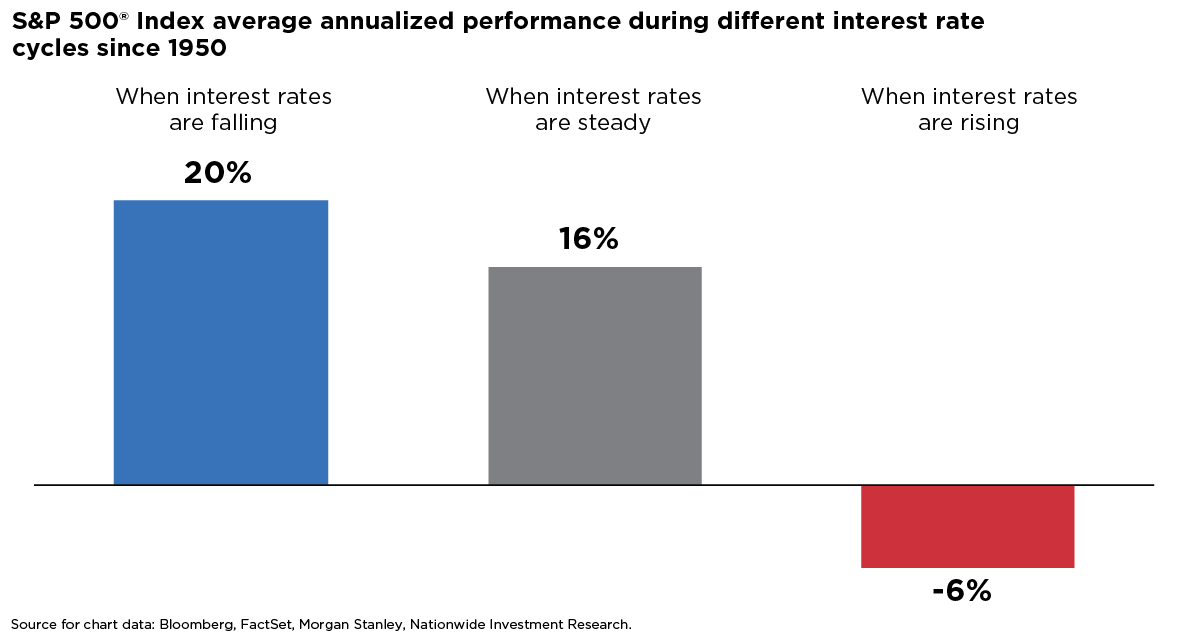
The chart above shows how stocks (as measured by the S&P 500®) have performed across different phases of past interest rate cycles. On average, stocks delivered annualized returns of around 20% when rates were falling.
Typically, economically sensitive sectors lead during easing cycles—think financials, industrials, consumer discretionary, and small caps. Given the performance and valuation gap between large-cap tech and these cyclical sectors, the latter have shown relative strength in recent months. If expectations for Fed rate cuts continue to build, these stocks may have room to run.
Stay focused when news breaks
Author(s)

Mark Hackett, CFA®, CMT®, CFP®
Chief Market Strategist, Nationwide Investment Management Group
Mark Hackett is the Chief Market Strategist for Nationwide’s Investment Management Group, bringing more than 20 years of experience in the asset management industry to the role.
Trending articles
What could matter most for bond investors in 2026? Income, flexibility, and a disciplined approach to security selection.
As sports betting gains popularity, investors may blur the line between gambling and investing. Here's why time and compounding matter.
Looking beyond rates reveals what's historically fueled small-cap gains most: stronger earnings and a growing economy.
Disclaimers
This material is not a recommendation to buy or sell a financial product or to adopt an investment strategy. Investors should discuss their specific situation with their financial professional.
Except where otherwise indicated, the views and opinions expressed are those of Nationwide as of the date noted, are subject to change at any time and may not come to pass.
S&P 500® Index: An unmanaged, market capitalization-weighted index of 500 stocks of leading large-cap U.S. companies in leading industries; it gives a broad look at the U.S. equities market and those companies’ stock price performance.
S&P Indexes are trademarks of Standard & Poor’s and have been licensed for use by Nationwide Fund Advisors LLC. The Products are not sponsored, endorsed, sold or promoted by Standard & Poor’s and Standard & Poor’s does not make any representation regarding the advisability of investing in the Product.
Nationwide Funds are distributed by Nationwide Fund Distributors LLC, member FINRA, Columbus, Ohio. Nationwide Investment Services Corporation, member FINRA, Columbus, Ohio. Nationwide Retirement Institute is a division of NISC.