Mark Hackett, CFA, CMT


Markets and economy
Markets and economy
Why stock market forecasts often miss the mark
Key takeaways:
- Stock analysts are bullish on 2026—but history says forecasts rarely hit the mark.
- Volatility and sector rotation are likely—so focus on what clients can control.
01/15/2026 – As 2026 kicks off, major investment firms are publishing their S&P 500® Index forecasts—and the outlook leans bullish. After three consecutive years of gains above 15%—a milestone reached only four times since the 1950s—strategists now expect the Index to rise about 10% this year, versus the historical strategist average of 7.5%, according to Strategas. Current price targets average around 7,555, with estimates ranging from 7,000 to 8,100—suggesting potential swings from modest to double-digit gains. For advisors, these projections set the tone for client conversations about market optimism and risk.
The optimism stems from a supportive backdrop: AI-driven productivity gains, new incentives for business investment, and expectations for more than 175 basis points of Fed rate cuts—moves that could boost corporate profits and risk assets. Add tax relief and real wage growth, and consumers should have more spending power, helping sustain economic momentum through 2026. For advisors, these trends may shape conversations around growth opportunities and portfolio positioning.
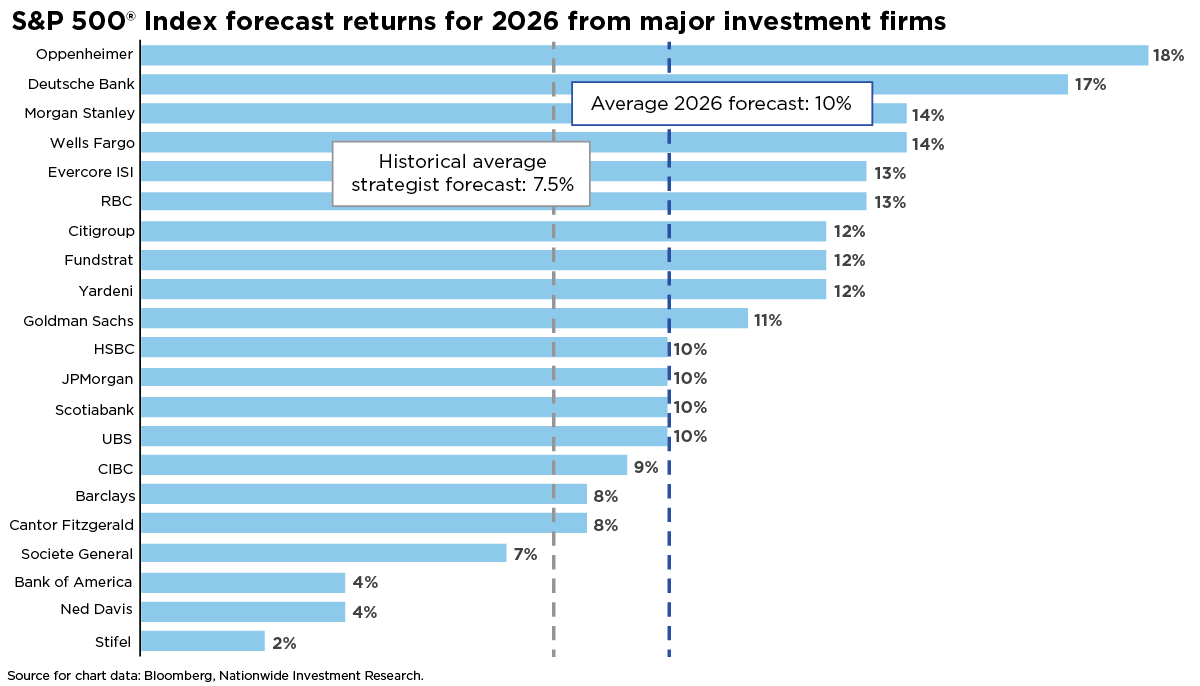
For investors, annual price targets offer a glimpse into market conviction and tactical thinking—but history shows they’re far from guarantees. Since 2012, consensus forecasts for S&P 500 returns have fallen short in 12 of 14 years, missing by an average of 6%. More recently, since 2019, they’ve missed roughly 7% in six of seven years. For advisors, that’s a reminder to frame these projections as directional—not definitive—when guiding client conversations.
Still, any bullish outlook should come with a healthy dose of caution. Risks remain—from elevated valuations and tariff uncertainty to inflation pressures, cooling labor trends, and geopolitical tensions—all of which could challenge the upbeat narrative. Advisors may want to remind clients that markets rarely move in a straight line, even in strong years, and prepare for potential volatility along the way.
Bottom line: price targets grab headlines, but they don’t build wealth. In a market defined by shifting leadership and persistent volatility, success depends on discipline—not predictions. Advisors can help clients stay focused on what they can control: diversification, risk alignment, and maintaining a long-term perspective. That’s how uncertainty becomes opportunity.
Author(s)

Mark Hackett, CFA®, CMT®, CFP®
Chief Market Strategist, Nationwide Investment Management Group
Mark Hackett is the Chief Market Strategist for Nationwide’s Investment Management Group, bringing more than 20 years of experience in the asset management industry to the role.
Trending articles
What could matter most for bond investors in 2026? Income, flexibility, and a disciplined approach to security selection.
As sports betting gains popularity, investors may blur the line between gambling and investing. Here's why time and compounding matter.
Looking beyond rates reveals what's historically fueled small-cap gains most: stronger earnings and a growing economy.
Disclaimers
This material is not a recommendation to buy or sell a financial product or to adopt an investment strategy. Investors should discuss their specific situation with their financial professional.
Except where otherwise indicated, the views and opinions expressed are those of Nationwide as of the date noted, are subject to change at any time and may not come to pass.
S&P 500® Index: An unmanaged, market capitalization-weighted index of 500 stocks of leading large-cap U.S. companies in leading industries; it gives a broad look at the U.S. equities market and those companies’ stock price performance.
S&P Indexes are trademarks of Standard & Poor’s and have been licensed for use by Nationwide Fund Advisors LLC. The Products are not sponsored, endorsed, sold or promoted by Standard & Poor’s and Standard & Poor’s does not make any representation regarding the advisability of investing in the Product.
Nationwide Funds are distributed by Nationwide Fund Distributors LLC, member FINRA, Columbus, Ohio. Nationwide Investment Services Corporation, member FINRA, Columbus, Ohio. Nationwide Retirement Institute is a division of NISC.