Mark Hackett, CFA, CMT


Markets and economy
Markets and economy
Why stock market returns are rarely
"average" year-to-year
Key takeaways:
- "Average" market returns are the exception—not the norm.
- Chasing price targets can distract from what matters most.
- Risk tolerance and time horizon—not market timing—should anchor decisions.
01/23/2026 – The S&P 500® Index has posted eye-catching results in recent years, with calendar-year gains frequently reaching double digits—and sometimes exceeding 20%. Even amid volatility, the benchmark has shown a strong ability to compound wealth. But looking beyond the headline returns reveals a more nuanced story—one that challenges common assumptions about what an "average" stock market return really looks like.
Looking at calendar-year returns for the S&P 500 since 1928; one thing stands out: the market rarely delivers an "average" year—defined since 1950 as roughly a 10% return (see chart). Instead, returns tend to cluster at the extremes. About three out of four years have been positive, and many of those gains exceed the long-term average, often landing closer to 20%. Down years are less frequent and generally smaller in magnitude, with losses averaging closer to 13%.
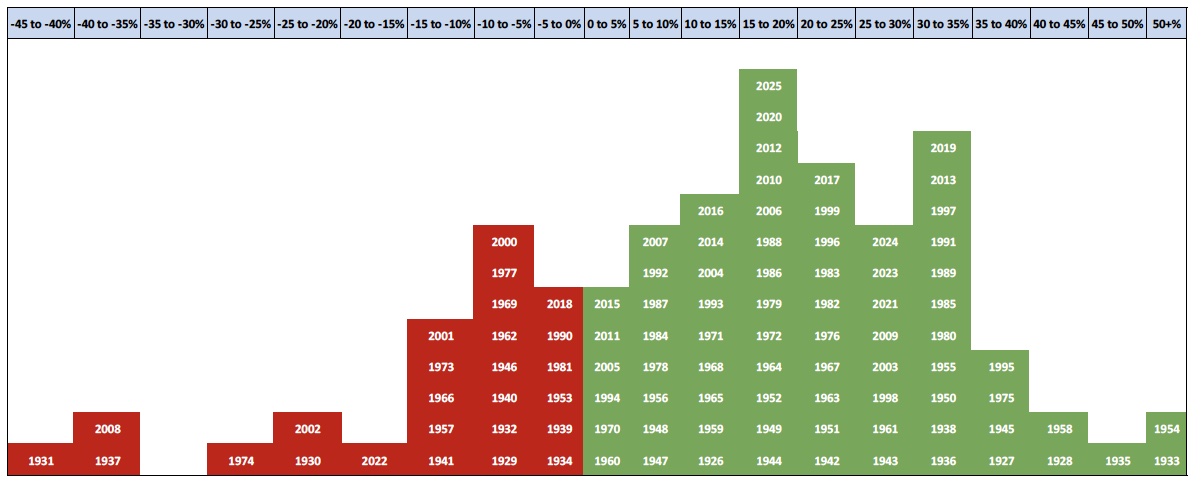
Source for chart: Strategas Research Partners
This imbalance is the quiet engine behind long-term returns. Think of it like a weighted coin toss: "heads" delivers a 20% gain, while "tails" results in a 13% loss—and heads comes up roughly seven times out of ten. No single flip reflects an "average" outcome, yet over many consecutive flips, the math compounds in investors' favor. Markets rarely move in a straight line; they tend to grind higher through a wall of worry, stumble during periods of stress, and then work their way back over time.
For investors, the key takeaway is simple: market returns rarely show up looking like their long-term averages. As the new year begins, the focus shouldn't be on chasing price targets—as we've noted previously—but on reinforcing discipline. That means helping clients anchor decisions to fundamentals, reassess risk tolerance, confirm time horizons, and ensure financial goals remain aligned with their broader strategy.
These factors form the foundation of sound portfolio construction: an asset allocation aligned with an investor's risk tolerance and return objectives. When paired with disciplined rebalancing, those strategic targets can help investors stay focused on long-term goals and prevent emotions from influencing financial decisions.
The next step for investors is straightforward—but essential: stay invested. Time in the market, not timing the market, remains one of the most reliable drivers of long-term outcomes. The longer clients can maintain a diversified portfolio aligned with their objectives, the more the market's natural asymmetry works in their favor.
Author(s)

Mark Hackett, CFA®, CMT®, CFP®
Chief Market Strategist, Nationwide Investment Management Group
Mark Hackett is the Chief Market Strategist for Nationwide’s Investment Management Group, bringing more than 20 years of experience in the asset management industry to the role.
Trending articles
What could matter most for bond investors in 2026? Income, flexibility, and a disciplined approach to security selection.
As sports betting gains popularity, investors may blur the line between gambling and investing. Here's why time and compounding matter.
Looking beyond rates reveals what's historically fueled small-cap gains most: stronger earnings and a growing economy.
Disclaimers
This material is not a recommendation to buy or sell a financial product or to adopt an investment strategy. Investors should discuss their specific situation with their financial professional.
Except where otherwise indicated, the views and opinions expressed are those of Nationwide as of the date noted, are subject to change at any time and may not come to pass.
S&P 500® Index: An unmanaged, market capitalization-weighted index of 500 stocks of leading large-cap U.S. companies in leading industries; it gives a broad look at the U.S. equities market and those companies’ stock price performance.
S&P Indexes are trademarks of Standard & Poor’s and have been licensed for use by Nationwide Fund Advisors LLC. The Products are not sponsored, endorsed, sold or promoted by Standard & Poor’s and Standard & Poor’s does not make any representation regarding the advisability of investing in the Product.
Nationwide Funds are distributed by Nationwide Fund Distributors LLC, member FINRA, Columbus, Ohio. Nationwide Investment Services Corporation, member FINRA, Columbus, Ohio. Nationwide Retirement Institute is a division of NISC.