
Will a Santa Claus rally deliver
the gift of happy returns?
Key takeaways:
- Stocks often rally late in the year, typically starting five days before Christmas and lasting through the first two trading days of January—a seasonal trend advisors can use in year-end conversations.
- While history favors positive December returns, today’s mix of technical, macro, and structural forces could shift outcomes, shaping market direction and advisor strategies as 2026 begins.
12/17/2025 – December has historically been a strong month for equities, and that seasonal trend often sparks talk of a “Santa Claus rally” as the year winds down. This rally refers to the tendency for stocks to rise during the final stretch—typically starting five trading days before Christmas and continuing through the first two sessions of January.
Since 1980, the S&P 500® Index has posted positive December returns about 71% of the time, averaging 1.2%. That strength, however, tends to come late in the month—historically, markets often start December flat before picking up momentum after the 15th, right in time for the Santa Claus rally.
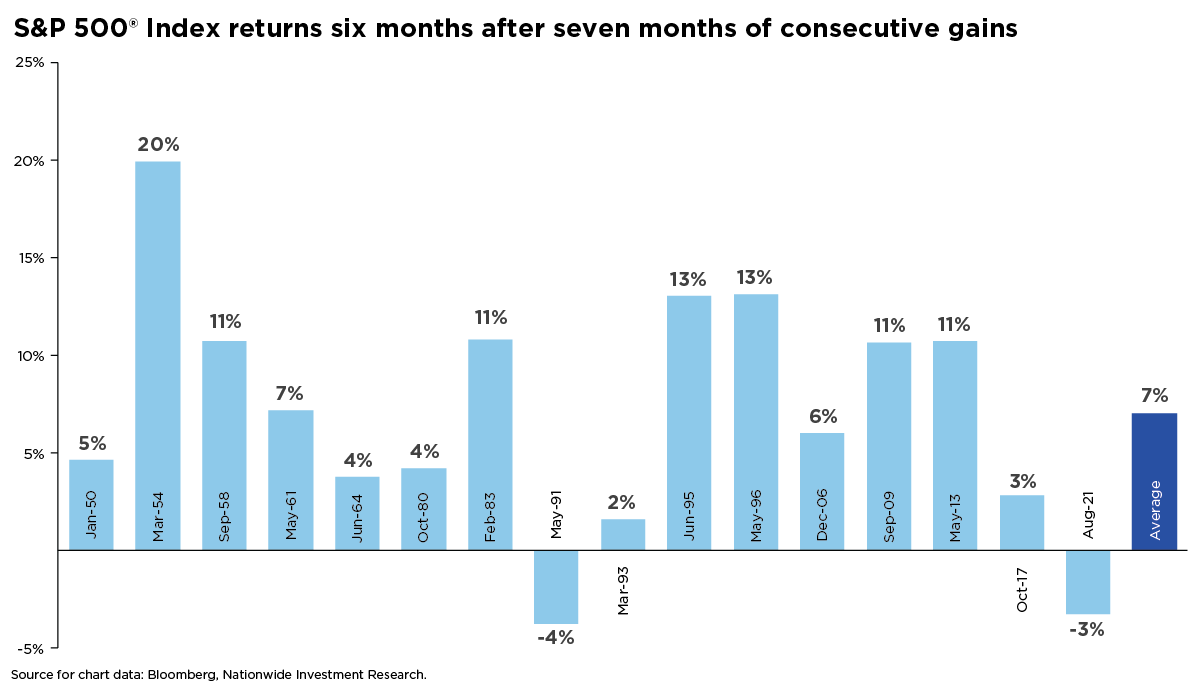
Adding to the seasonal tailwind, the S&P 500 has logged seven consecutive months of gains. Historically, similar streaks have been followed by strong results: the next six months have averaged a 7% return, with gains occurring in 90% of those periods (see chart).
While December’s track record may spark optimism, the Santa Claus rally isn’t guaranteed. This year’s market backdrop is unusually complex. On one side, positioning sensitivity is high as many investors look to protect year-to-date gains. On the other side, technical factors—such as Commodity Trading Advisors (CTA) flows, weak sentiment, and mixed retail and institutional positioning—are creating uneven pressure as the month unfolds.
Layered on top of this backdrop is growing investor fatigue. Over the past month, questions have surfaced about whether the uptrend is losing steam or simply consolidating. Sector rotation may also be playing a role, masking a market where participants are becoming more selective—and increasingly skeptical of lofty outlooks.
While history points to a seasonal tailwind, today’s mix of technical, macro, and structural forces could lead to a different outcome as the year closes. Even if the Santa Claus rally appears, these competing dynamics will likely influence market direction—and advisor conversations—well into 2026.
Author(s)

Mark Hackett, CFA®, CMT®, CFP®
Chief Market Strategist, Nationwide Investment Management Group
Mark Hackett is the Chief Market Strategist for Nationwide’s Investment Management Group, bringing more than 20 years of experience in the asset management industry to the role.
Trending articles
What could matter most for bond investors in 2026? Income, flexibility, and a disciplined approach to security selection.
As sports betting gains popularity, investors may blur the line between gambling and investing. Here's why time and compounding matter.
Looking beyond rates reveals what's historically fueled small-cap gains most: stronger earnings and a growing economy.