Joel Carnes


Retirement savings & income
Retirement savings & income
The costs of companionship: Pets as part of the financial planning conversation
Key takeaways:
- Pets are a major part of retirement for many clients, with 62% of future retirees expecting to share retirement with a pet.
- Asking about pets can help financial professionals better understand client priorities and build stronger, longer-lasting relationships.
- Pet ownership can shape retirement planning, from ongoing care costs to long-term care and mobility considerations.

06/11/2026 — As a financial professional, you probably know a lot about your clients. But how well do you know one of the most important relationships that many of your clients have?
I’m talking, of course, about pets.
People value their pets in different ways. Above all else, pets provide companionship, which becomes increasingly important as people get older. A recent survey from the Nationwide Retirement Institute® found that 62% of future retirees plan to share their retirement with pets, including 48% with dogs and 29% with cats.
In addition to the purpose and happiness many people feel while caring for a dog or cat, there are also physical and mental health benefits that enhance their lives.
What do pets have to do with financial planning?
You may be asking: Why should a financial professional care about my clients’ pets? To begin with, pets are a window into knowing more about the things your clients care about in their lives. That knowledge can help you lead discussions that foster stronger and longer-lasting relationships with your clients.
Pets also offer client insights that could apply to their financial lives, too. For as much as people value their pets, many haven’t accounted for the costs of pet ownership in their retirement plans. For example, over one-third of pet owners we surveyed said they haven’t budgeted for the costs of veterinary care for their dog or cat.
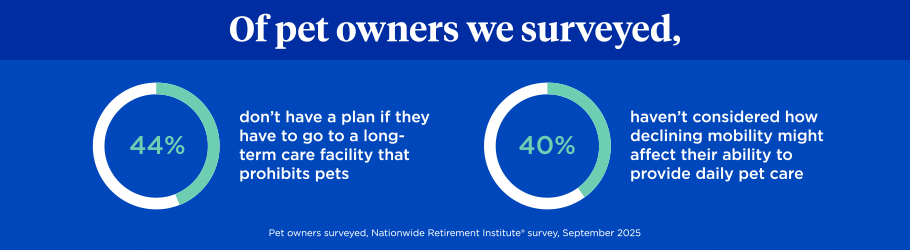
Moreover, many pet owners haven’t considered what would happen to their pet if they were unable to provide care later in life. Of pet owners we surveyed, 44% don’t have a plan if they have to go to a long-term care facility that prohibits pets, and 40% haven’t considered how declining mobility might affect their ability to provide daily pet care.
In your role as a financial professional, you may not be in position to help your clients solve every pet-related issue. But you can show compassion and empathy by helping clients consider the financial implications of pet ownership and account for these costs in their retirement planning when appropriate.
Health benefits of pets for older adults
The pet-owner relationship is a unique bond that provides not only care and affection for the pet but also comfort, happiness and unconditional love for the owner. This “pet effect” often translates into positive mental health outcomes, including reduced rates of anxiety and depression.
According to a Nationwide survey of pet owners:
- 95% agreed that their pets have a positive impact on their life
- 82% said their pets bring them joy
- 65% said their pets enhance their mental health
There are also physical health benefits that many pet owners experience. In our survey, around two-thirds of pet owners say their pets help them get outside more, which can raise both mood and activity level. As a result, they are more likely to have a positive view of their own health; 31% of pet owners think of themselves as "very healthy," compared to just 16% of non-pet owners.
Pet owners also tend to exercise more frequently than non-pet owners, averaging 4 days of exercise per week versus 3.5 days. That correlates to positive indicators of cardiovascular health, like lower blood pressure.
The boosts to mental and physical health are big reasons why older and retired people care a lot about their pets. It’s an important relationship to keep in mind as you learn more about your clients and help them plan for a wide range of financial needs.
The financial aspects of pet ownership in retirement
While the happiness that pets add to our lives is priceless, especially for many retirees, the fact is pet ownership does come with a price tag. Whether it’s for food, medical care, kennel services or more, these costs are essential. Sometimes they are unexpected, which can complicate some clients’ retirement finances.
That’s why it’s important for retired pet owners to consider the costs of care as part of their household budgets and financial plans. So too should their financial professionals.
Veterinary services are probably the biggest expense pet owners face. And just like their human counterparts, the costs of medical care increases as pets get older.
Nationwide Pet tracked the most common ailments for senior cats and dogs, along with the average costs for treatments. Many of these ailments run into the hundreds of dollars. Should a beloved dog or cat require specialized services such as veterinary surgery, those costs can quickly escalate to the thousands of dollars.
While some clients may be able to cover these costs out of pocket, not every client can. This may be particularly true for retired clients who live on fixed amounts of income to fit their lifestyles.
The more expensive services will likely require clients to dip into their savings, so retired clients should think of these potential costs when devising their financial plans. Pet insurance may also offer a solution for clients who want to buffer their retirement savings from these unexpected costs.
Why financial professionals should include pets in client planning discussions
While many Americans understand the need to create a comprehensive financial plan for themselves in retirement, many people may overlook a key consideration—their pets. This planning gap presents an opportunity for you as a financial professional to make sure pets are included in your clients’ retirement strategies.
Here are some ideas on how to include pet ownership costs in your retirement planning discussions with clients:
- Estimate the costs for providing ongoing care for clients’ pets throughout retirement.
- Consider the role pet insurance could play in helping clients manage veterinary care costs.
- Discuss “what-if” scenarios around long-term care and estate planning in the event clients are no longer able to care for their pets.
From a financial planning perspective, your clients’ pets represent an often-overlooked priority. By proactively addressing pet-related contingencies—financial, logistical, and legal—you can help your clients ensure that their retirement is secure for both themselves and their beloved animal companions.
Author

Joel Carnes
SVP, Nationwide Pet
For over a decade, Joel Carnes has worked as a top-level executive, focusing on developing strategy and methodically implementing operations for growth in the private, public, and nonprofit sectors.
Trending articles
Social Security uncertainty creates a timely opening to educate clients on claiming age, retirement income planning, and broader financial needs. View insights from our survey.
Americans remain resilient, but 2026 challenges are reshaping financial success, with consumers leaning slightly more toward protection than growth. Learn more in our latest Index.
Learn how pets shape retirement happiness and health, and why financial professionals should understand clients’ pet priorities.
Sources and disclaimers
The Harris Poll, on behalf of Nationwide, conducted an online survey in the U. S. among 510 advisors and financial professionals and 2,007 investors ages 18+ with investable assets (IA) of $10K+, August 19 – September 2, 2025.
For complete survey methodology, including weighting variables and subgroup sample sizes, please contact vasask@nationwide.com
This material is not a recommendation to buy or sell a financial product or to adopt an investment strategy. Investors should discuss their specific situation with their financial professional.
Except where otherwise indicated, the views and opinions expressed are those of Nationwide as of the date noted, are subject to change at any time and may not come to pass.