Kush Kotecha


Retirement savings & income
Retirement savings & income
With year-round tax planning, you may help close the gap between anxiety and action
Key takeaways:
- Investors who only think about taxes during tax season may affect their long‑term planning outcomes
- Despite anxiety over higher taxes in the future, few investors are taking steps today to prepare for them.
- Financial professionals are looking for tax planning solutions that offer both tax efficiency and steady income throughout retirement.
03/20/2026 — This time of year, most Americans have one thing on their mind—taxes. The good news is, most people don’t spend much time thinking about taxes outside of tax-filing season.
The bad news is, most people don’t spend much time thinking about taxes outside of tax-filing season.
In a new Advisor Authority study, powered by the Nationwide Retirement Institute®, most investors said they're concerned about rising taxes, but only a fraction are taking steps to build tax diversification or tax efficiency into their retirement income plans.
Clients who aren’t thinking comprehensively about taxes—both now and in retirement—may affect their long‑term planning outcomes. As a financial professional, you can be proactive in bringing greater focus to tax planning with your clients, helping them prepare today how taxes may affect their retirement.
Taxes are a year-round opportunity for planning discussions
Tax anxiety is real for most people. Last year’s passage of H.R. 1, more commonly known as the One Big, Beautiful Bill Act, created new tax breaks and made previous tax cuts permanent (at least for the time being!). That should help ease anxieties, but ongoing fiscal pressures from government spending are raising doubts about how long lower taxes can last.
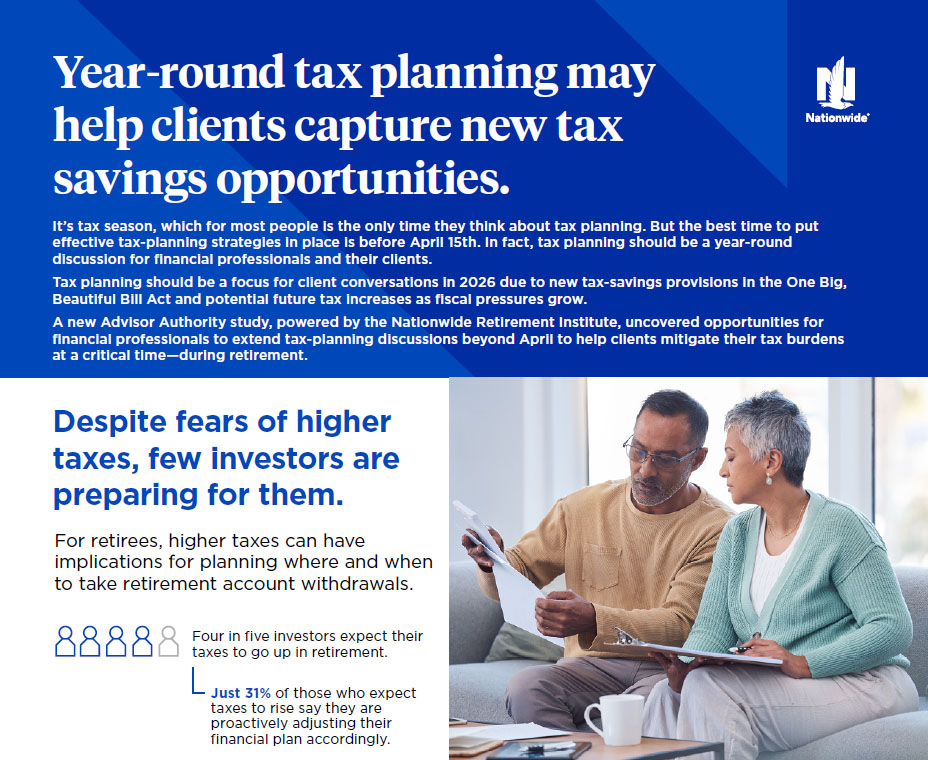
Four out of five investors in our survey (80%) said they broadly expect taxes to rise in the future. For many people, those higher taxes are likely to hit during retirement, when their financial priorities are focused on steady income and preservation of savings.
While there are moves retirees can make to manage their tax burdens, the best time for tax-efficient planning is before retirement. Yet, less than one-third (31%) who say they expect taxes to rise and are being proactive in making adjustments to their financial plans.
Financial professionals take the initiative on tax planning
This gap between worry and action is where financial risks can build. Investors who aren’t aware of how taxes may impact their retirement income or aren’t following a strategy for diversifying the tax treatment of their financial assets are likely to make unforced errors that could haunt them in retirement.
But as many financial professionals know, where there’s risk there’s also opportunity. Year-round tax planning is a way you can differentiate your practice from other financial professionals.
As a financial professional, you should encourage clients not to wait until tax season to put tax-efficient strategies in place. Unfortunately, many investors are doing just that. More than one-third in our survey (34%) said they mostly pay attention to taxes during tax season, and only one in four (26%) engage in ongoing, proactive tax management all year.
It’s also unfortunate that many financial professionals don’t think about taxes outside of tax-filing season. Just 37% of investors who work with a financial professional said their advisor proactively discusses tax planning strategies or tax policy changes as part of regular review meetings multiple times a year. This is one area where you can take the initiative and solidify your client relationships by helping them prepare for future tax liabilities and understand how different accounts will be taxed both now and in retirement.
Proactive tax planning contributes to greater confidence
With the possibility of higher taxes in the years ahead, financial professionals are looking for planning solutions for clients that combine tax efficiency with steady income that can last throughout retirement. For example, more than half of financial professionals in our survey (60%) said they are more likely to recommend clients put part of their portfolios into an annuity or other guaranteed income solution, given the events of the last 12 months.
And as the tax landscape also becomes more complex, you have a critical role in helping your clients navigate the road ahead. Your guidance may help clients feel more confident in their long-term planning. That impact is visible in the confidence gap between investors who work with financial professionals and those who do it alone.
Among investors we surveyed, around two-thirds of those who work with a financial professional (65%) expect to retire on schedule (54%) or earlier than planned (11%). For those without a financial advisor relationship, less than half (44%) said they plan to retire around their original timeline (36%) or earlier than planned (8%).
Practice tax planning with your client throughout the year
Planning investment assets around tax efficiency helps retirees have more control over how and when they pay taxes on their retirement income. In an environment where every dollar of after-tax income counts, guaranteed income solutions such as annuities can be considered. Such solutions can provide predictable income streams, but they may not be appropriate for all clients.
With strategies that diversify their tax burden and solutions that offer guaranteed income, Nationwide can help support you when discussing taxes and long-term income planning with your clients.
Author

President, Nationwide Annuity
Kush Kotecha serves as President of Nationwide Annuity, one of the top ten annuity providers in the United States, overseeing more than $130 billion in assets as of 2024.
Trending articles
Social Security uncertainty creates a timely opening to educate clients on claiming age, retirement income planning, and broader financial needs. View insights from our survey.
Americans remain resilient, but 2026 challenges are reshaping financial success, with consumers leaning slightly more toward protection than growth. Learn more in our latest Index.
Learn how pets shape retirement happiness and health, and why financial professionals should understand clients’ pet priorities.
Sources and disclaimers
The Harris Poll, on behalf of Nationwide, conducted an online survey in the U.S. among 528 advisors and financial professionals and 2,012 investors ages 18+ with investable assets (IA) of $10K+, January 15-February 6, 2026. Among the investors, there were 1,041 who work with a financial professional and 971 who do not work with a financial professional.
For complete survey methodology, including weighting variables and subgroup sample sizes, please contact VASASK@nationwide.com.
This material is not a recommendation to buy or sell a financial product or to adopt an investment strategy. Investors should discuss their specific situation with their financial professional.
Except where otherwise indicated, the views and opinions expressed are those of Nationwide as of the date noted, are subject to change at any time and may not come to pass.