Brad Carrier


Retirement savings & income
Retirement savings & income
Guide clients toward retirement income resilience amid uncertainty
Key takeaways:
- Clients are increasingly willing to act, but many still need help turning that willingness into a coordinated retirement strategy.
- Planning conversations increasingly extend beyond market volatility to include healthcare costs, tax policy, retirement benefits, and reliable retirement income.
- Helping clients connect today's concerns with long-term planning strategies can strengthen confidence and deepen planning relationships.
07/27/2026 — Inflation, market volatility, and ongoing economic uncertainty have created one of the most complex financial environments in recent memory. But new research from the Nationwide Retirement Institute® suggests many investors aren't sitting on the sidelines.
One in three (33%) non-retired investors say they plan to take advantage of investment opportunities now, up from 21% in the summer of 2024, while 22% say they're managing their investments more aggressively over the next 12 months, compared with 16% in the winter of 2024.
For financial professionals, this shift in investor sentiment creates an opportunity to help clients channel their willingness to act into thoughtful, long-term planning decisions.
The impact of rising living costs on retirement planning priorities
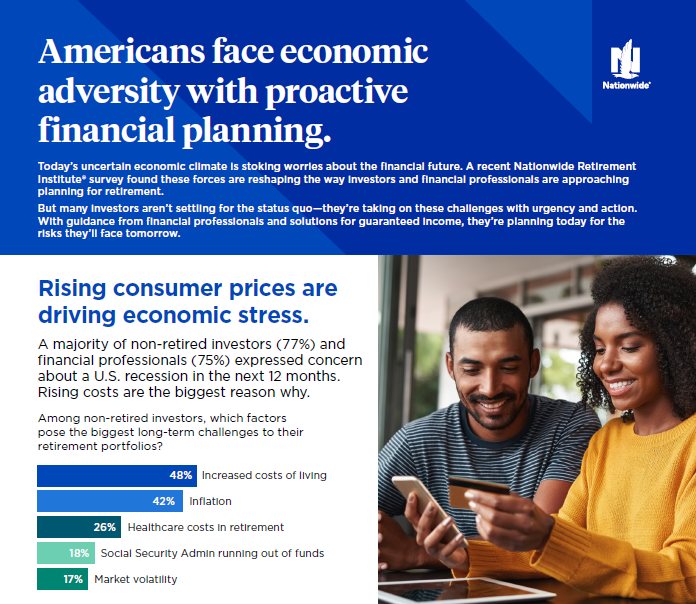
Our research found that more than three-quarters (77%) of non-retired investors are concerned about the possibility of a U.S. recession over the next 12 months. Financial professionals expressed a similar level of concern (75%), indicating they're closely attuned to the broader economic challenges affecting investors today.
Non-retired investors also identified several long-term challenges for their retirement portfolios. Nearly half (48%) cited increased cost of living as the biggest challenge. While inflation is reflected in economic data, clients often experience its effects most directly through rising expenses for essentials such as housing, insurance, and healthcare. The expectation that those costs will continue to increase over time can also raise concerns about whether retirement savings will be able to keep pace.
Taken together, these findings show that while many investors remain concerned about the economic outlook and rising living costs, they're still willing to pursue investment opportunities. That creates an opportunity for financial professionals to help ensure the investment decisions clients make today align with their long-term retirement goals.
Client confidence starts with understanding
Acting on new opportunities is most effective when those decisions are part of a broader retirement strategy.
Our survey found that nearly three in ten (29%) non-retired investors say they do not currently have a strategy in place to protect their assets against market risk. Another 1 in 10 (10%) don’t know or aren't sure whether they have a strategy at all.
Those findings suggest today's environment presents an opportunity to revisit clients' financial plans—not simply to respond to current market conditions, but to help ensure new decisions support long-term retirement goals. Helping clients connect those dots can reinforce confidence during periods of uncertainty and strengthen planning relationships over time.
Planning for more than market risk
Market volatility remains an important consideration, but it's only one of several risks shaping retirement planning today.
More than half (55%) of financial professionals believe Social Security and/or Medicare funding will be reduced or cut, while 58% anticipate higher tax burdens for clients in the future. The common thread is uncertainty—not simply about the markets, but about how clients will generate reliable income and manage rising expenses throughout retirement. Helping them make sense of those questions often requires ongoing planning and informed guidance, which may include evaluating strategies designed to provide greater income certainty in retirement.
Healthcare expenses are also becoming more prevalent in retirement planning conversations. According to our survey, 22% of non-retired investors now rank healthcare costs among their biggest financial concerns over the next 12 months, up from 14% in the summer of 2024. Among retirees, that figure has climbed from 20% in the summer of 2024 to 30% this wave.
Financial professionals are seeing the same shift. Nearly one-quarter (24%) say healthcare costs are among the most immediate challenges affecting their clients' retirement portfolios. In addition, 30% report that paying for healthcare in retirement is one of the topics they discuss most frequently with clients, up from 23% in 2024. As a result, 87% say they've increased their focus on addressing their clients for the increased burden from healthcare costs over the past year.
Growing interest in guaranteed income
Sixty percent of the financial professionals we surveyed say the events of the past 12 months have made them more likely to recommend a guaranteed income solution to their clients as part of their portfolio, while 14% say they have already recommended one into their clients’ current strategy. Use of registered index-linked annuities (RILAs), which provide growth potential while helping manage downside market risk, has also increased among financial professionals with a market risk protection strategy, rising from 39% in the summer of 2023 to 52% today.
Investors appear increasingly open to guaranteed income strategies as well. Our survey found that nearly three in five (57%) non-retired investors say recent events have made them more likely to allocate a portion of their portfolio to an annuity or other guaranteed income solution. That finding suggests many investors aren't simply looking for reassurance during uncertain times. They're increasingly open to exploring strategies that may help strengthen their long-term retirement plans.
For financial professionals, that growing openness may create a natural opportunity to explore which planning strategies, including guaranteed income solutions such as annuities, best align with clients' long-term retirement goals.
Turning uncertainty into opportunity
Retirement planning is about preparing for multiple risks beyond volatile markets. Today's investors are also balancing rising living costs, rising healthcare expenses, and questions about the future of Social Security and Medicare. Encouragingly, many also appear more willing to engage in conversations about the strategies available to help address those concerns.
For financial professionals, that's an opportunity to connect today's challenges with long-term retirement income planning. Depending on a client's goals and circumstances, guaranteed income solutions such as annuities can play an important role in building greater income certainty and supporting a more confident retirement.
Looking for more insights to help guide client conversations?
Visit our Market Insights page for timely market updates, economic commentary, and practical planning resources designed to help you provide retirement planning support for clients amid changing market conditions.
Author
Brad Carrier
Vice President, Brokerage Annuity Distribution
Brad Carrier is Vice President of Brokerage Annuity Distribution at Nationwide Financial. In this role, Brad is responsible for the commission-based annuities business across all channels, including broker/dealers, wires, and banks.
Trending articles
Social Security uncertainty creates a timely opening to educate clients on claiming age, retirement income planning, and broader financial needs. View insights from our survey.
Americans remain resilient, but 2026 challenges are reshaping financial success, with consumers leaning slightly more toward protection than growth. Learn more in our latest Index.
Learn how pets shape retirement happiness and health, and why financial professionals should understand clients’ pet priorities.
Sources and disclosures
The Harris Poll, on behalf of Nationwide, conducted an online survey in the U. S. among 528 advisors and financial professionals and 2,012 investors ages 18+ with investable assets (IA) of $10K+, from January 15-February 6, 2026. Among the investors, there were 1,411 non-retired investors.
This material is not a recommendation to buy or sell a financial product or to adopt an investment strategy. Investors should discuss their specific situation with their financial professional.
Except where otherwise indicated, the views and opinions expressed are those of Nationwide as of the date noted, are subject to change at any time and may not come to pass.