
Beyond the ballot: Helping investors stay focused on the long term
Key Takeaways:
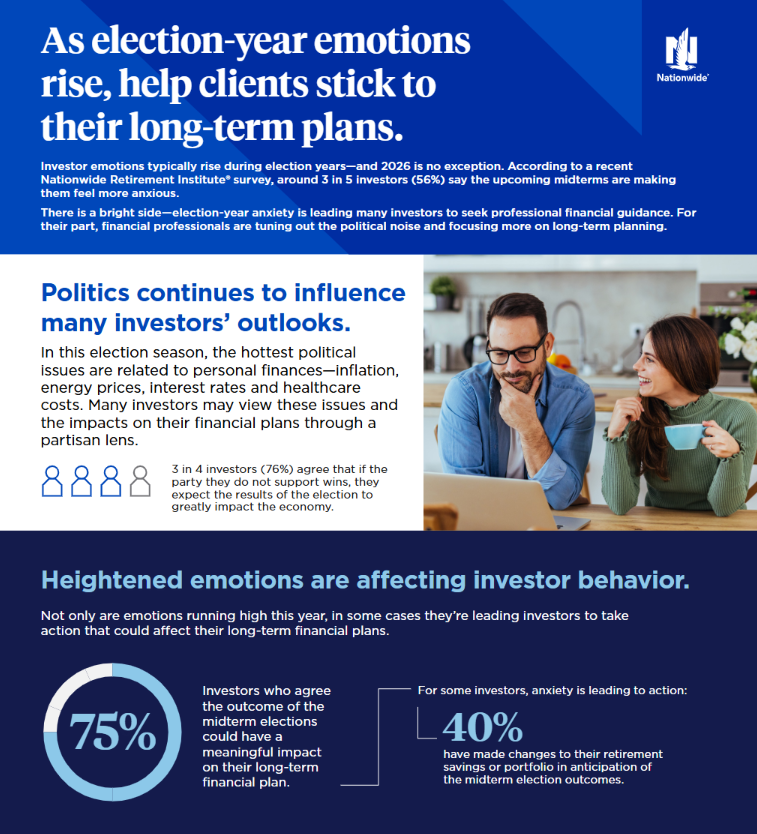
- Investors are acting on election concerns weeks before the midterms. While 75% believe the election could impact their long-term financial plan, 40% have already made changes in anticipation of the outcome.
- Election outcomes aren’t always reliable market signals. Historically, the party in power matters far less than fundamentals such as corporate earnings when it comes to long-term market performance.
- Address clients’ concerns while helping them stay focused on their long-term investment strategy. Use election-related questions as an opportunity to revisit topics such as taxes, Social Security, healthcare, and other issues that may affect their financial plans.
10/13/2026 — The 2026 midterm elections are still weeks away, but investors are already thinking about what the outcome could mean for their finances. According to new data from the Nationwide Retirement Institute®, 56% of investors say the upcoming midterm elections are making them feel more anxious, and 75% believe the outcome could meaningfully impact their long-term financial plan.
That anxiety is causing some investors to make financial moves now instead of waiting until November. Forty percent say they’ve already made changes to their retirement savings or portfolio in anticipation of the midterms. That includes 15% who moved money into more conservative or lower-risk investments and 13% who diversified into different asset classes or sectors.
Investors are also looking to their financial professionals for help making sense of what the election could mean for their plans. Nearly three-quarters (73%) want guidance about the financial impacts of the midterms.
As attention increasingly turns toward the elections in the weeks ahead, you have a timely opportunity to help clients understand how easily politics can shape their perceptions of the economy and markets, and how those perceptions may lead to emotional or short-sighted investment decisions.
Politics can shape how investors see the economy
History shows us that consumer sentiment shifts sharply along party lines when control of government changes. Optimism tends to rise among supporters of the newly elected party while falling among supporters of the outgoing party, even when underlying economic conditions haven’t materially changed.
New data from the Nationwide Retirement Institute® shows that this year’s midterm elections are no exception. More than three-quarters (76%) of investors say that if the party they don’t support wins the midterms, they expect the election results to greatly impact the economy. When it comes to their own party winning, both sides of the aisle diverge sharply: 62% of Republican respondents believe a win by their own party will have no economic impact at all, compared with 46% of Democratic respondents.
Keep the focus on what drives markets
For clients considering investment changes based on expectations about the election, history offers good reason to be cautious about making rash decisions. Historically, long-term stock market performance has not consistently favored one political party over the other.
Rather than focusing on election outcomes, encourage clients to pay closer attention to the fundamentals that have historically driven long-term market returns. Corporate earnings, in particular, are a primary driver of equity market returns. In Nationwide’s Investing in a highly politicized climate white paper, the annualized growth rates of S&P 500 company earnings and the S&P 500® Index were nearly identical over the 20-year period analyzed. While markets can temporarily diverge from fundamentals as investors react to news and events, equity returns have historically tracked corporate earnings more closely over longer periods.
The good news is that financial professionals are increasingly recognizing the value of helping clients maintain a long-term perspective. In Nationwide’s 2026 survey, 63% of financial professionals say not changing investment strategies in an election year is the best course of action, compared with 52% in 2024. Another 23% say they strongly advise against clients making changes and are taking time to explain the long-term risks of reactive decisions.
Balance discipline with proactive planning
Election-related concerns can also provide an opening for deeper financial planning conversations. According to Nationwide's survey, the top policy issues on investors' minds heading into November include:
- Social Security reform: 42%
- Trade and tariff policy: 36%
- Healthcare and prescription drug costs: 33%
- Tax policy and potential changes to tax rates: 29%
- Federal spending: 28%
Start by understanding what's behind a client's concern. Is it the potential impact of tax policy on their financial plan? The future of Social Security? Healthcare costs or trade policy? Identifying the specific issue can help you determine whether there are assumptions in the financial plan worth revisiting. That doesn't require you or your clients to predict what will happen in November or how markets might respond.
Maintaining a diversified allocation, rebalancing when appropriate, and staying focused on fundamentals can help keep short-term political uncertainty from disrupting a long-term investment strategy.
The political noise is only going to get louder as November approaches. The goal isn’t to convince clients that elections don’t matter. Elections can have meaningful policy and economic implications. But an election outcome isn’t, by itself, a market signal. Your role is to help clients put their concerns into perspective so they can make financial decisions based on their long-term goals, regardless of what happens in November.
Author(s)

Mark Hackett, CFA®, CMT®, CFP®
Chief Market Strategist, Nationwide Investment Management Group
Mark Hackett is the Chief Market Strategist for Nationwide’s Investment Management Group, bringing more than 20 years of experience in the asset management industry to the role.
Trending articles
Social Security uncertainty creates a timely opening to educate clients on claiming age, retirement income planning, and broader financial needs. View insights from our survey.
Americans remain resilient, but 2026 challenges are reshaping financial success, with consumers leaning slightly more toward protection than growth. Learn more in our latest Index.
Learn how pets shape retirement happiness and health, and why financial professionals should understand clients’ pet priorities.