

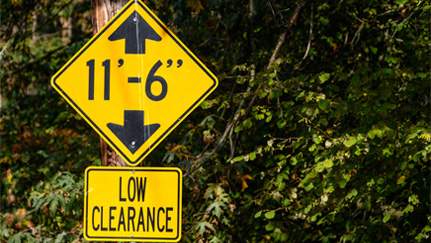
Trucks, trailers and cargo striking bridges and other overhead structures are frequent news topics lately. Several large municipalities have observed an increase in truck-bridge collisions. New York City has even created a task force to investigate the growing trend of these accidents. One emerging issue that is linked to the upward trend is the reliance on GPS devices. A non-trucking GPS can lead a driver away from designated truck routes. These non-trucking GPS systems are not set up to direct trucks away from low bridges and overpasses.
While relying on incorrect GPS and mapping data appears to be responsible for the increase in these accidents, often the incidents are the result of a driver not knowing the height of their load, not adequately planning the route, and not attentively looking for warning signs while driving.
The following are some recent claim file statements as to why a truck struck a bridge:
- “I relied on the shipper’s measurements. They assured me it was less than 13 feet 6 inches when loaded. They were wrong.”
- “I’ve hauled this backhoe over 50 times with no problems. This time they positioned the arm and bucket differently.”
- “I’ve been hauling this pipe for over a year. They changed the blocking which increased the load height by 11 inches. They should have told me.”
- “My route was detoured due to road construction. I missed the sign warning of the low bridge.”
To reduce collisions with low bridges and overpasses, professional drivers need to follow safe work practices. These best practices include:
1. Know the height of your truck, trailer, and load
- While most trucks and van trailers are 13 feet 6 inches or less in height, customized units and add-ons such as roof extensions may increase the height. Measure to make sure.
- Do not rely on shipper’s height measurements of equipment/cargo. They may be inaccurate or an estimate. Their measurements might not include packaging, cribbing, or load securing devices.
- Trailer bed heights vary greatly, even among the same manufacture and model.
- Ensure you adequately secure any moving components such as panel covers, doors, booms, etc., that could rise during transport.
- Measure every flatbed load, even if you have hauled the same item numerous times.
- Always take final measurements while the truck is parked on a flat surface and the load is secured with tarps and straps.
- Write the final measurements on the bill of lading to document the measurement.
- If operating a dump truck, dump trailer or truck mounted crane, always ensure they are properly lowered and secured before driving.
2. Plan your route
- If your load is over 13 feet 6 inches, obtain proper permits and routing information required by states and municipalities you are traveling through.
- Utilize motor carrier atlases and state and local municipality information to identify routes with adequate clearance. Check highway websites for construction closures that may take you off route; for example, https://highways.dot.gov/traffic-info. Ensure detours are appropriate for your load.
- Do not rely on GPS routing, Web/software mapping programs, or maps that are not specifically designed for truck routing or are outdated.
- Discuss routes with shippers and receivers as they may be able to warn you of problem routes or low bridges near their facilities.
3. During transit
- Stick to your planned route unless complications arise. If moving off your planned route, quickly find a safe place to park to evaluate a revised route.
- Attentively scan for road signs warning of low bridges/structures or directions for trucks to use certain lanes. Many older bridges have arched supports with varying clearances, depending on what lane you are in.
- Watch for indications the bridge has been struck in the past.
- Watch for indications that the road surface has recently changed. Road resurfacing can reduce bridge clearances by several inches and clearance signs might not have been updated. This applies to gravel roads as well as pavement.
- Remember that snow and ice buildup can reduce clearances during the winter months.