As a business owner or fleet manager, understanding and managing the risks associated with vehicle use is essential—not only to protect your employees but also to safeguard your bottom line. Vehicle-related incidents can result in severe workers’ compensation claims, lengthy recovery periods, and complex litigation. They can also cause downtime and harm the reputation of your business. Whether employees are driving company vehicles, personal vehicles for work purposes, or operating fleet trucks, the exposures tied to motor vehicle accidents (MVAs) are substantial.


Drive down worker injury risks by gearing up fleet safety controls
The scope of the problem
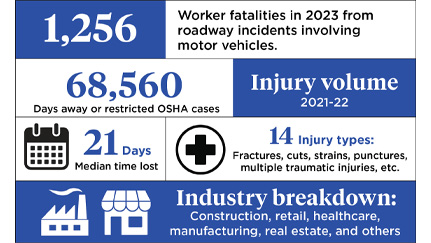
According to the National Safety Council, motor vehicle crashes are the leading cause of work-related deaths in the U.S., with over 1,200 worker fatalities in 2023. Workers in transportation, sales, delivery, and service roles are particularly vulnerable.
The financial impact is equally concerning – during the latest BLS reporting period, motor vehicle accidents resulted in 68,560 OSHA recordable cases requiring days of lost or reduced work capacity with a median of 21 days. Injuries from MVAs rank as the costliest lost-time workers’ compensation claim by cause of injury and are more than double the average cost for all workers’ compensation claims.1
Evaluating risk factors
Incidents rarely stem from a single cause. More often, they result from a combination of interrelated factors. When assessing your motor vehicle operations, consider each of the following system components and the associated risk factors that may contribute to a loss event:
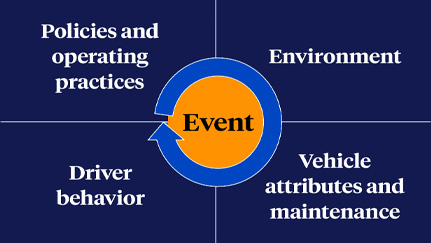
Organizational policies and operating practices: Is there a lack of a formal fleet safety program, inadequate driver training or vetting, or pressure to meet delivery/service deadlines?
Driver behavior: Are there unchecked instances of distracted driving, speeding, aggressive driving, fatigue, drowsiness and/or substance use?
Environmental conditions: Does planning or routing adequately address adverse weather, poor road conditions, construction zones, high-traffic times/areas or unfamiliar routes?
Vehicle selection and condition: Has due consideration and action been taken to provide adequate safety features, proper vehicle selection for the task, and ensure successful maintenance and inspection practices?
A systems-based approach to risk management helps identify potential failures, identify why undesired actions may occur, and minimize negative outcomes. Human error is normal and understanding where and why those errors are likely to occur is a key to safety success. Nationwide’s REPAIR form (PDF) can assist you in this process.
5 ways to put safety into overdrive
1. Utilize telematics and driver monitoring
Fleet telematics systems track driver behavior, including speed, braking, and cornering. Real-time feedback and coaching can reduce risky driving habits and reinforce safety culture. The value of telematics goes well beyond driver safety as explained in our article, "Why vehicle telematics?" This articles includes links to resources on telematics selection, implementation and coaching; as well as dashcam usage.
2. Incorporate advanced driver assistance systems (ADAS) to minimize driver error
In addition to relying on traditional safety efforts focused on desired driver behavior - such as reducing distracted driving, enforcing seatbelt use, and promoting defensive driving – the use of ADAS can help drivers correct or avoid undesired behaviors. Collision avoidance technology such as automatic emergency braking (AEB), lane departure warnings, and adaptive cruise control help prevent crashes before they occur. These systems can actively or passively respond to driver errors and help to reduce rear-end collisions and sideswipes, which are common in fleet operations.
3. Consider advancements in occupant protection technology
Recent developments in occupant protection into your fleet injury prevention strategy. These innovations are helping employers improve outcomes by reducing the potential severity when crashes do occur and protecting the occupants during impact. When purchasing or upgrading vehicles used for company business, consider the following safety features:
- Enhanced airbag systems: Advanced airbag designs now include side-curtain airbags, knee airbags, and multi-stage deployment based on crash severity. These improvements significantly reduce head, chest, and lower limb injuries.
- Seatbelt pretensioners and load limiters: Modern seatbelt systems tighten upon impact and then release slightly to reduce chest injuries. These features are especially effective in minimizing internal injuries and fractures.
- Ergonomic seating and head restraints: Proper seat design and adjustable head restraints help prevent whiplash and musculoskeletal injuries, which are common in rear-end collisions. Good ergonomic designs also reduce the potential for driver fatigue and musculoskeletal injuries related to prolonged static postures.
4. Choose vehicles with superior safety design
Beyond ADAS and occupant protection systems, vehicle design itself plays a critical role in injury prevention. Manufacturers are increasingly engineering vehicles with crumple zones, reinforced cabins, and energy-absorbing materials that protect occupants during impact. High-strength steel and advanced composites help maintain cabin integrity, while smart design elements like lower beltlines and wider visibility reduce blind spots and improve driver reaction time.
For commercial fleets, choosing vehicles with higher safety ratings, better rollover resistance, and improved side-impact protection can make a measurable difference in injury outcomes. Vans and trucks with integrated safety cages and rear-view cameras are becoming standard, and electric vehicles often feature lower centers of gravity, which can reduce rollover risk.
5. Minimize personal vehicle use for company business
Using personal vehicles for work—even occasionally—can result in workers’ compensation claims and liability exposure. Employers lose control over safety features and maintenance standards. If personal vehicle use is part of your operations, implement our non-owned vehicle management program to ensure adequate controls are in place.
Drive your way to success
The cost and disruption from a vehicle accident can have a lasting impact on your business, your employees, and their families. By proactively addressing behavioral, mechanical, environmental, and organizational risks, you can significantly reduce the frequency and severity of these incidents.
Additional resources
- Fleet management: sample safety programs, guidelines, policies, etc.
- Driver training: online training, videos, infographics, etc.
- Vehicle safety ratings: ADAS features and crash ratings
References
[1] https://injuryfacts.nsc.org/work/costs/workers-compensation-costs/
Browse more resources in our library