

Organizations spend considerable time and resources training employees on a variety of safety and security topics, but often provide little or no training on preventing auto accidents. Why is that? Maybe it is because driving has become so routine that we forget about the knowledge and skills it takes to operate a vehicle safely. Auto accidents are the number one cause of work-related fatalities in the U.S., making up 22% of all worker deaths.1 Additionally, liability from auto accidents is one of the largest and most frequent risks an organization faces.
There are many unsafe drivers on the roads. Excessive speeding, following too close, distracted driving and running red lights are just a few of the unsafe behaviors we see daily on the roadway. These unsafe driving behaviors have led to a 24% increase in traffic fatalities since 20192 despite vehicles becoming inherently safer.
It’s likely that you have several unsafe drivers on your staff. Even if you don’t, your drivers are encountering them on the road and must know how to drive defensively near them. For most drivers the only safe driver training they received was through their drivers’ education class when they were in their teens. Remember the 10 and 2 rule, the desired hand position on your steering wheel? Well, that has changed. It’s now 9 and 3,3 and a lot of other safe driving practices have changed as well. Do your drivers know them?
Many experienced drivers develop bad habits over time. Overconfidence can result in aggressive driving and often the driver does not realize how unsafe their behavior has become. Does your organization have a system in place to correct bad driving habits? Organizations must provide regular driver training and coaching to keep drivers current on safe driving techniques and aid them in correcting bad behaviors and habits. Most training can be broken into general training, required of all drivers, and driver-specific training.
General training
All drivers, regardless of experience, should receive driver training when hired and at least annually thereafter. This provides a baseline for all drivers, establishes safe driving expectations, and proof of training may be valuable in defending allegations of negligence in accident litigation. Core driving topics include:
- Speed and space management
- Adjusting speed for changing road, traffic, and weather conditions
- Know how long it takes to stop and maintaining a proper following distance
- Scanning ahead for hazards
- Anticipating unsafe actions of other drivers
- Intersections, merging and lane changes
- Distracted driving prevention
- Vehicle inspection and accident procedures
Driver-specific training
- Unique hazards associated with the vehicle they are driving; prior to operating.
- Large blind-spots, increased stopping distance, roll-overs, etc.
- Proper function and use of Advance Driver Assist Systems (ADAS)
- Passenger safety including wheelchair securement, if applicable
- Proper load securement, if applicable
- Trailer safety, if applicable
- Unsafe driving behaviors identified
- During initial road tests or driver ride-alongs
- Through telematics systems
- Post-accident, to prevent a recurrence
Training methods
People learn in ways that generally fall into two categories: passive and active. Passive learning includes reading, listening to words, looking at pictures or watching videos. Active learning includes participating in a discussion or completing an exercise or demonstration. While passive learning methods work for the acquisition of some knowledge, active learning is generally more effective. Successful organizations use a combination of both training techniques. Methods for driver training include:
Computer-based training
Computer-based training (CBT) has become the most popular format for general training of new employees. CBT is easy to assign, and drivers can take the training when it fits their schedule. CBT involves trainee interaction in the form of questions throughout or a quiz at the end. A record of completion is provided if the trainee passes the quiz. CBT programs are available in one longer program, such as 30 to 60 minutes, or a series of shorter modules. CBT courses are available from a variety of vendors and range from$25 to $100 per driver.
Instructor-led group training
Instructor led group training is an effective means of conducting more focused or specialized training. Instructor led training benefits from driver discussions and the ability to customize topics for the specific organization or group of drivers. Group demonstrations work well for topics such as conducting pre-trip inspections, cargo securement and proper trailer hook-up. Instructors can utilize purchased or free on-line videos to support their training. Training can also cover:
- An analysis of the organization’s top accident types and ways to prevent them.
- A local accident in the news, discussing how it happened and ways to prevent it.
- Recent DOT violations and how to prevent them
- Recent changes in laws or regulations
- Seasonal topics: winter driving, school buses, etc.
- A review of organization rules and policies
One-on-one training
One-on-one training is often used when getting a group together is not possible. While often less formal, the trainer should have a set agenda for the session and a record made of the training.
Behind the wheel (BTW) coaching
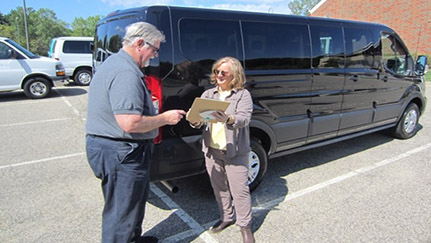
Behind the wheel (BTW) coaching is a form of one-on-one training for individual drivers. It is particularly effective for addressing specific unsafe behaviors identified by telematics systems, manager ride-alongs or an accident. During BTW coaching instructors can discuss proper driving techniques and have the driver demonstrate them. Practicing commentary driving, the process of a driver explaining the hazards they see, and corrective measures being taken, is also an effective BTW coaching tool. “That red pick-up looks like it might not stop at the intersection; I better prepare to brake.” “The white van just cut in front of me. I need to slow to get back my three seconds of following distance.”
Post-accident training
Post-accident training should occur with every driver involved in a preventable accident. Details regarding what caused the accident should be covered as well as changes the driver should make to prevent a recurrence. A ride-along should be conducted following the training to ensure changes have been made if applicable.
Ongoing awareness campaigns
Ongoing awareness campaigns are important to keep safe driving fresh in driver’s minds. A best practice is to schedule monthly topics, often with seasonal exposures in mind. For example, winter driving in November, drinking and driving around the holidays, motorcycle awareness in the spring. Campaigns can include:
- Emailing drivers short safety reminders or infographics
- Posting information on internal websites or in employee break rooms
- Managers reiterating the message during ride-alongs.
Documentation
Documentation should be retained of all training and communication to prove the activity occurred. Documentation should include topics covered and who participated. Copies of resources used, and handouts provided should be retained. Documentation can be used to substantiate your safety efforts and are often requested in accident litigation.
Training follow-up
Training of any kind often fails when there is no follow-up. Organizations should have a process in place to ensure drivers are adhering to the practices and behaviors covered. For driver training, follow-up often involves manager ride-alongs or road observations. Telematics are also a good tool, especially if a driver scorecard is available. Have the number of speeding events gone down after speed related training? Just a reminder to recognize drivers who have taken training seriously and improved their behavior.
Training coordinator/instructor
Most organizations choose a specific individual within their organization to be responsible for driver safety training. This can be a safety manager, supervisor, or a senior driver. The individual should have a good driving record, the respect of other drivers, be a good communicator and be comfortable leading training and coaching other drivers. The instructor should have attended at least one comprehensive safe driving instructor course and should subscribe to fleet publications that highlight fleet safety practices, new regulations, etc.
- Instructor courses are available through the National Safety Council and other organizations. Search on “driver safety instructor certification” in your internet browser.
- Search on “fleet publications” in your internet browser for a list of magazines and e-newsletters available.
Resources
Visit Nationwide Loss Control Services Auto Resources web page for resources that can be used in driver training; one-on-one and BTW coaching; and monthly campaigns.
- Select our Driver Training Topics tab for over 35 training infographics and bulletins.
- Select our Specialty Vehicles and Trailers tab for training resources on large passenger vans and trailers.
- For ideas on training truck drivers:
- Driver safety meetings (PDF)
- Experienced driver training (PDF)
- Driver orientation (PDF)
- Customers can register/log into our website for more resources including:
- Free online Safety Source video library
- Discounts on computer-based training from Drivers Alert I LMS Courses
[1] Bureau of Labor Statistics [2022]. Census of Fatal Occupational Injuries, 2020;
[2] Early Estimate of Motor Vehicle Traffic Fatalities for the First 9 Months (January–September) of 2021, Traffic Safety Facts DOT HS 813 240, February 2022;
[3] The recommended practice for holding the steering wheel in a vehicle equipped with an airbag is 9 and 3. This helps prevent your hands from hitting you in the face when the air bags go off.