

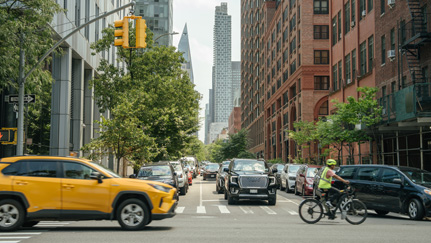
If a company wants to reduce preventable fleet crashes, intersections are a good place to start. Intersections combine cross traffic, turning decisions, changing signals, pedestrians, bicyclists, motorcycles and drivers who are often in a hurry. When things go wrong, the result is often more than a minor fender bender. Intersection crashes can involve side impacts, near-head-on collisions, and serious injuries. According to the US Federal Highway Administration, intersection collisions resulted in over 25% of U.S. traffic fatalities and about one-half of traffic injuries each year.1
The most effective employers do more than tell drivers to “be careful.” They reduce unnecessary exposure, set clear expectations and coach the behaviors that matter most.
Intersections are busy, dynamic places where small mistakes can turn into severe losses.
Why intersections require drivers to be especially careful
For employers, intersection risk is not just about one bad decision at one traffic light. It is a mix of common exposures that show up across fleets and driving environments. Topics to address in training and supervision include:
- Left turns and permissive turns. These are common high-severity situations because the driver has to judge the speed and distance of oncoming traffic while also watching signal timing and scanning for pedestrians, bicyclists and motorcycles.
- Rushing yellow lights and stale green lights. Many severe intersection crashes happen when drivers assume cross traffic will stop or try to “beat the light” instead of slowing early and waiting.
- Distraction and following another vehicle through the intersection. Intersections demand full visual and mental attention. Drivers who rely on the movement of the vehicle in front of them instead of scanning for themselves are setting up a preventable crash.
- Limited visibility. Rain, snow, glare, darkness, roadside obstructions and larger vehicles can hide hazards and make gap judgment worse.
- Vulnerable road users. Intersections are where vehicles most often interact with pedestrians and cyclists. Motorcycles are also easy to misjudge or lose sight of behind other traffic, especially during left turns.
- Speed and poor gap selection. Even modest increases in speed reduce reaction time, increase stopping distance and make it harder to safely accept a gap or stop when conditions change.
Some practical steps to help drivers stay safe
- Reduce unnecessary left turns. When possible, design routes that favor protected left-turn arrows, lower-conflict intersections and travel patterns that do not push drivers into rushed decisions during heavier traffic periods.
- Set a simple left-turn rule. If a left turn can be made at a protected arrow, that should be the preferred option. Drivers should also understand that a flashing yellow arrow is not a protected turn. It means yield to oncoming traffic and to pedestrians and bicyclists before turning.
- Discourage creeping into the middle of the intersection. If there is not enough space to complete the turn safely, the driver should wait behind the stop line rather than gamble that oncoming traffic will stop.
- Train drivers to slow down early and scan the full intersection. Good intersection habits include treating stale green lights as a warning, avoiding rushed yellow lights, checking sidewalks and crosswalks, and looking again while turning rather than making one quick glance and going.
- Coach drivers to expect mistakes from others. Having the right-of-way does not guarantee safety. Drivers should be trained to watch for red-light runners, late stoppers, pedestrians crossing unexpectedly and vehicles pulling out from driveways or parking lots.
- Use road evaluations, ride-alongs and commentary driving. These are some of the best ways to see whether a driver really scans well, leaves enough space, avoids pushing yellow lights, and makes sound turning decisions at live intersections.
- Use post-incident coaching when warning signs appear. If a driver has a failed-to-yield event, risky telematics pattern, a hard-braking trend or near miss at intersections, follow up quickly with specific coaching on these behaviors rather than broad reminders.
- Address unusual intersection types when they are part of the exposure. If routes include roundabouts, skewed intersections, rural intersections with no stop signs, or customer sites with poor sight lines, train to those conditions directly instead of assuming general defensive driving training is enough.
Drivers should never assume what another driver, cyclist, pedestrian or motorcyclist will do.
Technology can help, but it is not a substitute for management and coaching
Technology has value, especially when it supports an already well-managed fleet. Forward collision warning, automatic emergency braking, telematics and dashcams can all help reduce risk or improve coaching. But none of them replace route design, clear expectations, driver supervision and follow-up after unsafe driving behaviors or crashes. The best results usually come when companies use technology to reinforce the basics: slowing early, managing following distance, scanning thoroughly, recognizing stale greens and making conservative decisions at turns.
For most employers, the overall message should be simple. Do not let intersections become routine. They are one of the most common places for serious fleet losses, but they are also one of the clearest areas where management practices, driver training and coaching can make a real difference.
[1] https://highways.dot.gov/safety/intersection-safety/about