

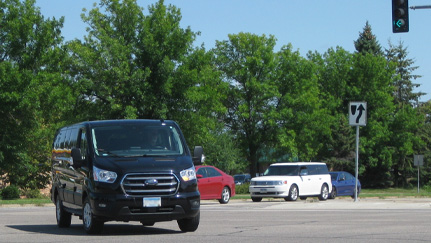
Left-turn accidents are frequently severe as they often result in near head-on or T-bone type collisions, often at high speeds. Second to only rear-end collisions,1 left-turn accidents are the most frequent high-severity type of auto claim that Nationwide receives. They can involve multiple vehicles and significant injury or death. Because of the frequency and severity of left-turn accidents, organizations should educate their drivers annually on left-turn hazards and ways to prevent them.
Turning at intersections with green left-turn arrows
When determining fault for intersection accidents the first question to ask is: who had the right-of-way? When a driver has a green arrow, they have the right-of-way. This is the safest situation as oncoming traffic has a red light.
When a driver has options as to where they can turn left, best practice is to choose an intersection with a green left-turn arrow. Route planners should make this a primary consideration when creating designated routes.
Understanding yellow turn arrows
The introduction of flashing yellow arrows in many states over the last 10 years has created confusion for many drivers. Make sure your drivers understand the differences between these caution lights:
- Steady yellow arrow: light is about to turn red. Only finish a turn that has already been started if there is an adequate gap in traffic.
- Flashing yellow arrow (new): Use extreme caution as oncoming traffic has a green light and full right-of-way.
Most left-turn crashes occur at the end of a green light when the light changes to yellow and drivers turn, assuming oncoming traffic will stop.2
Risk taking
No one wants to miss a light and wait for another series of light changes. So, they move to the middle of the intersection feeling, at a minimum, they can race through the turn when the light turns yellow. This can be extremely dangerous as:
- Oncoming drivers may have the same plan and not stop
- If the light turns red while waiting, the driver must turn against a red light or back up, both extremely dangerous and illegal maneuvers
Drivers should be educated on the importance of not moving into the intersection until there is an adequate gap in traffic to completely make the turn safely. Drivers should not wait in the middle of an intersection!
Judging distances and obstructed views
Left-turn collisions often occur when the turning driver misjudges the speed or distance of oncoming traffic, or their view is obstructed by oncoming vehicles waiting to turn left.
- Before making a left turn, drivers should always use caution by ensuring the gap in traffic is large enough. Poor judgement often involves:
- Drivers not increasing the gap needed for faster speeds limits, often using the same gap for all speeds3
- Believing larger objects are not moving as fast as smaller vehicles. This phenomenon is referred to as speed-size illusion; larger vehicles appear to be moving slower than they really are. The speed-size illusion is often a factor in train/vehicle or semi-truck/vehicle collisions when a driver thinks the train or semi is moving slower than it is.3
- If the view is obstructed by another oncoming vehicle, wait until the vehicle has passed or turned
- In 2019, 41% of motorcycle fatalities involved another vehicle turning left into the oncoming motorcycle.4 It is difficult to judge a motorcycle’s speed or distance from an intersection and they are easily obstructed by other vehicles.
Multiple left-turn lanes
When making a turn at an intersection with multiple left turn lanes, larger vehicles and vehicles with trailers should use the lane furthest to the right. This lane provides the largest turn radius, thus affording more room to make the turn. The far-right turn lane also allows a driver to easily monitor the location of vehicles turning next to them as there are fewer blind spots.
Importance of turn signals
Turn signals perform an important function by notifying others of a driver’s intention. Not using a turn signal when required will often increase a driver’s liability in an accident, even if it is not a major causal factor, as they have violated the law.
Elimination of distractions
Intersections are complicated, with multiple changing variables: oncoming and cross traffic, pedestrians, bicyclists, changing traffic signals, etc. A driver must be 100% focused visually and cognitively when navigating any intersection.
- Pedestrians and cyclists are often struck at intersections when a driver is distracted
- When drivers are distracted, they often drive with the flow of traffic, relying on the movement of other vehicles in their periphery to indicate when it is time to proceed. Blindly following another vehicle through an intersection is very dangerous.
Driving defensively
Right-of-way is an interesting concept. A green light may give a driver the right-of-way at an intersection, but they shouldn’t count on other drivers or pedestrians to correctly follow traffic controls.
- When approaching an intersection with a green light a driver should:
- Scan sidewalks for pedestrians and bicyclists
- Scan traffic for signs a vehicle might not stop
- Anticipate the light being “stale”, or about to turn to yellow, then red
- Before proceeding after your light changes ensure that all cross traffic has stopped and pedestrians have made it through the intersection
- Practice situational awareness, which is the process of perceiving what is happening around you and taking precautions:
- “That car may pull out in front of me, I should cover my brake”
- “That jogger may try to cross against the light, I need to wait before proceeding”
- “That truck is going too fast to stop, I better brake”
- Drivers need to drive defensively – adjusting their driving to protect themselves from the mistakes of others
Training assistance
Our Left-turn collisions infographic (PDF) addresses many of these key topics and can assist with driver education and training. Use it:
- As an awareness piece for poster boards or driver mailings
- As a training topic in driver safety meetings or toolbox talks
- As a guide for managers when conducting safety ride-alongs with drivers
[1] Nationwide Loss Control Services, Review of a sample of auto accidents over $250,000, December 2021.
[2] WYDOT Quick Facts: Traffic Signals, WYDOT’s Public Affairs Office, March 2012
[3] Speed–size illusion correlates with retinal-level motion statistics. Zixin Yong; Po-Jang Hsieh. Arvo Journal of Vision, August 2017
[4] Traffic Safety Facts, 2019, Motorcycles DOT HS 813 112, National Highway Transportation Administration, September 2021