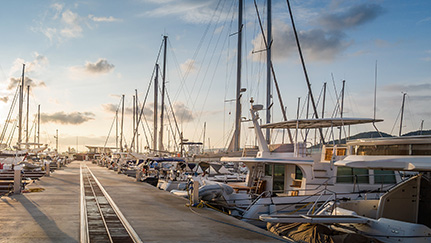
From shifting weather patterns to evolving customer expectations, today’s recreational marine environment is more dynamic than ever. For program administrators and distribution partners, understanding the exposures shaping this market is key to helping clients protect their operations. According to John Logothetis, President at Clear Marine Risk Solutions and Maurice Lee, Senior Consultant at Nationwide, success today hinges on specialization, strong claims support and a holistic view of risk across the recreational marine sector.
The unique nature of recreational ocean marine risks
Recreational marine insurance programs are solutions tailored specifically to commercial entities operating in the recreational boating sector, not private boat owners. As Maurice Lee explains, “We provide specialized coverage for businesses that manufacture, store, service, rent or support recreational vessels.”
This includes marinas, boat dealers, yacht clubs, boat builders, vessel rental operations and more. It’s a niche space, and one with centuries-old roots. “The ocean marine market is one of the oldest lines of business … it’s a badge of honor as marine insurers,” says John Logothetis. Clear Marine’s expertise lies in understanding how today’s marine businesses operate — and tailoring policies specifically to their realities.
An evolving landscape: Weather, demand and social pressures
Few lines of business have changed as quickly in recent years as recreational marine. Logothetis notes that “the risk landscape has definitely changed dramatically on multiple fronts.” Chief among those changes:
More severe and unpredictable weather
Marine businesses face longer hurricane seasons, increasingly intense storms and more frequent major weather events. Even in years with muted seasons, the long-term trend has been unmistakable. “Severity is the big issue,” Logothetis emphasizes.
A surge in boating participation
Post-COVID, recreational boating has boomed. With more vessel traffic comes more congestion, new boaters and greater potential for accidents both on and off the water. “More inexperienced operators” raise liability concerns for marinas and boat dealers alike, Logothetis says.
Rising costs and inflationary pressures
Vessel values, repair costs and parts delays all drive up exposure. When a marina holds boats for longer due to supply chain issues, their legal liability grows. “The cost to repair or replace standard production boats has increased,” Logothetis shares.
Social inflation and nuclear verdicts
Lee notes that “venues that weren’t plaintiff-oriented all of a sudden are,” creating heavier liability exposure for marine operations. Nuclear verdicts, once rare in this sector, are now an emerging concern.
Why standard commercial policies leave gaps
Marine businesses face exposures that typical commercial policies weren’t built to handle. For example, boat dealers often perform sea trials or demos, activities explicitly excluded in many CGL or BOP policies. “It’s a bad idea to think everything you do is covered there,” Logothetis warns. “We have the forms to cover the exposure.”
Some of the most critical coverage gaps for marine businesses include but are not limited to:
Marina operators legal liability
This covers property in an operator’s care, custody and control — something excluded under general liability. As Lee notes, marinas “are launching boats, pulling them out of the water, storing them, providing winterization and de-winterization services” and need tailored protection.
Protection & indemnity (P&I)
It provides liability coverage for vessel-related third-party bodily injury and property damage, which standard policies do not include.
Sudden and accidental pollution
Fueling operations and spill exposures are routine in marine environments. Even a small fuel spill event is very costly, Logothetis explains, making dedicated pollution coverage essential.
The impact of exposure gaps on marine businesses
When limits or coverages are insufficient, the financial consequences can be severe. For example, without adequate excess coverage, a marina facing a multivessel loss after a storm could be responsible for hundreds of thousands of dollars. “They can be looking at paying out of their own pocket if they don’t have sufficient excess limits,” Logothetis stresses.
Pollution incidents, improperly secured vessels and fire events can all lead to significant first-party and third-party losses. As vessel values continue to rise, so does the potential impact of any single claim.
Why specialization matters more than ever
Both Logothetis and Lee emphasize that addressing these modern marine risks requires a specialist’s touch. Nationwide leverages data-driven tools, such as catastrophe models, valuation tools and loss control reports, to make informed underwriting decisions. “We obtain loss control reports to help identify possible risks and suggest ways to reduce losses,” Lee explains.
Equally critical is claims expertise. Marine claims require knowledge of admiralty law, salvage operations and state-by-state regulatory environments. “Our claims partnership ensures that when something does happen, our insureds have experts in their corner,” Logothetis says.
Clear Marine also prioritizes continuous product modernization: updating forms, revisiting appetite and integrating digital-friendly processes to align with how today’s marinas and dealers operate.
Looking ahead: The next 3 to 5 years
The biggest future shifts, according to Logothetis, will involve improved risk transfer practices and proper insurance-to-value. Rental agreements, contractor requirements and accurate property and vessel valuations will become even more central to managing loss potential.
For example, rental agreements between marina operators and customers are coming under increased scrutiny after losses. Ensuring that those agreements include appropriate indemnification language and insurance requirements is crucial. Similarly, with vessel values still elevated from post-pandemic demand, getting accurate valuations at renewal has become more critical than ever.
A partnership built for modern marine challenges
Clear Marine and Nationwide share a long-standing, collaborative relationship that strengthens underwriting, product and claims capabilities across the board. “One of the drivers of our success over the past 12 years has been the mutual respect and trust between Clear Marine and Nationwide,” Lee says.
Together, the collaboration offers a stable, intentional and specialized approach designed to help marine businesses remain resilient in an ever-changing marketplace. To learn more about Clear Marine Risk Solutions, visit clearmarinerisk.com.
Discover more insurance insights from Nationwide Programs at nationwide.com/programs.