Mark Hackett, CFA, CMT


Markets and economy
Markets and economy
After climbing a wall of worry,
how will stocks finish 2025?
Key takeaways:
- Seasonal strength plays a key role. Historically, November and December have delivered solid returns—especially when markets enter year-end with strong momentum.
- Technical signals reinforce the trend. It’s not just seasonality; indicators point to continued strength as the bull market moves into its fourth year.
11/12/2025 – In 2025, investors have faced a familiar “wall of worry”—from uncertain tariff policies to negative sentiment and mixed economic signals. Despite these headwinds, the S&P 500® Index has climbed 17.5% through October, reminding advisors that markets can rally even when the backdrop looks challenging.
Volatility has remained brief and limited this year—a reassuring trend for advisors concerned about market swings. Still, client anxiety is rising: Nationwide’s annual Economic Impact Survey shows that 25% of consumers believe the market is overvalued, and nearly one-third expect managing volatility to be a top challenge in 2026. These perceptions highlight an opportunity for advisors to address risk and reinforce portfolio strategies.
Before the year closes, advisors still have two months of market activity to navigate. Historically, stocks tend to perform well in November and December, averaging gains of 1.9% and 1.4%, with positive returns nearly 70% of the time. November stands out as the strongest month on average since 1950, second-best over the past 20 years, and the top performer over the past decade—insights that can help frame client expectations as the year wraps up.
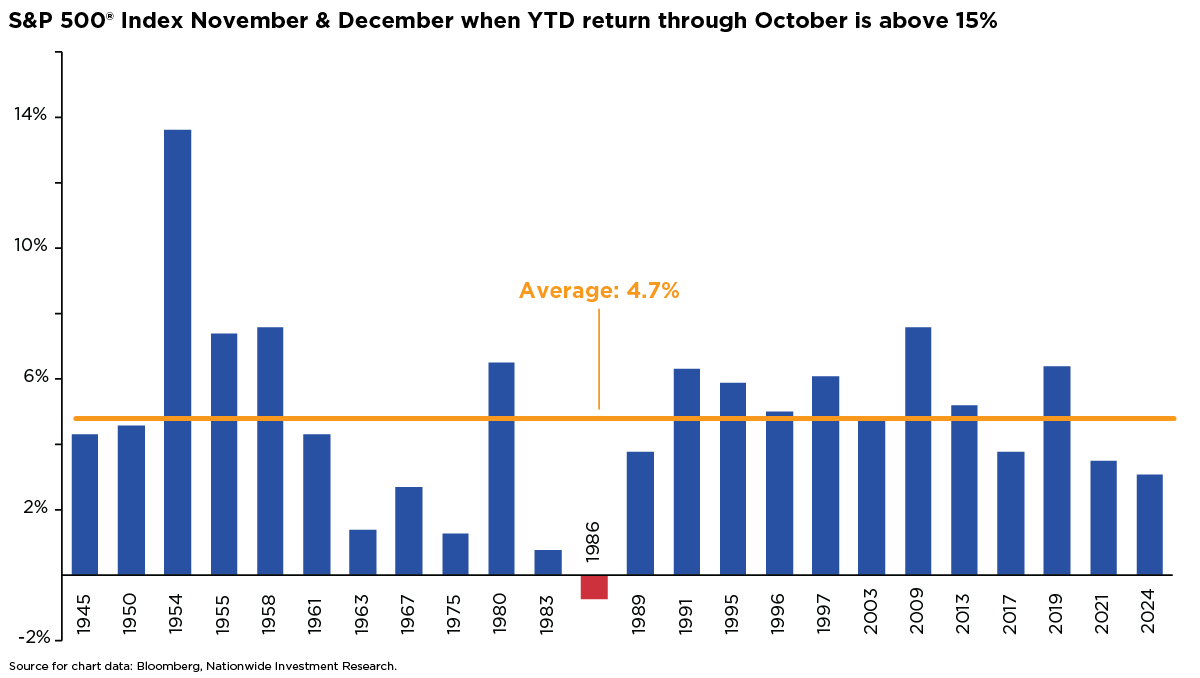
Historically, when the S&P 500 gains over 15% through October—as it has this year—the market tends to add another 4.7% on average before year-end (see chart). That momentum often carries into the final two months, creating a seasonal tailwind that supports a bullish outlook for 2025. For advisors, this trend can help frame client expectations around year-end positioning and reinforce confidence in staying invested.
This isn’t just about seasonal trends pushing markets higher into year-end—there are strong technical signals supporting this rally. The current bull market is entering its fourth year on the back of a powerful rebound: the S&P 500’s bounce from the April 8 low ranks as the sixth strongest on record. Historically, that kind of momentum often leads to gains over the next year, though short-term volatility is still likely.
As you prepare for year-end client conversations, expect some concerns that echo today’s cautious consumer sentiment. Remember, though, that caution often serves as a contrarian signal in markets. Several tailwinds could help equities keep climbing the “wall of worry” and limit any volatility to short-lived bouts. Among them: the Federal Reserve’s shift toward monetary easing, anticipated fiscal support in 2026, and continued strength in corporate earnings and margin expansion.
Get timely market insights
Author(s)

Mark Hackett, CFA®, CMT®, CFP®
Chief Market Strategist, Nationwide Investment Management Group
Mark Hackett is the Chief Market Strategist for Nationwide’s Investment Management Group, bringing more than 20 years of experience in the asset management industry to the role.
Trending articles
What could matter most for bond investors in 2026? Income, flexibility, and a disciplined approach to security selection.
As sports betting gains popularity, investors may blur the line between gambling and investing. Here's why time and compounding matter.
Looking beyond rates reveals what's historically fueled small-cap gains most: stronger earnings and a growing economy.
Disclaimers
This material is not a recommendation to buy or sell a financial product or to adopt an investment strategy. Investors should discuss their specific situation with their financial professional.
Except where otherwise indicated, the views and opinions expressed are those of Nationwide as of the date noted, are subject to change at any time and may not come to pass.
S&P 500® Index: An unmanaged, market capitalization-weighted index of 500 stocks of leading large-cap U.S. companies in leading industries; it gives a broad look at the U.S. equities market and those companies’ stock price performance.
S&P Indexes are trademarks of Standard & Poor’s and have been licensed for use by Nationwide Fund Advisors LLC. The Products are not sponsored, endorsed, sold or promoted by Standard & Poor’s and Standard & Poor’s does not make any representation regarding the advisability of investing in the Product.
Nationwide Funds are distributed by Nationwide Fund Distributors LLC, member FINRA, Columbus, Ohio. Nationwide Investment Services Corporation, member FINRA, Columbus, Ohio. Nationwide Retirement Institute is a division of NISC.