Mark Hackett, CFA®, CMT®, CFP®


Markets and economy
Markets and economy
Broader leadership helps keep the market on track
Key takeaways:
- Market leadership is expanding beyond mega-cap technology, supported by broader earnings growth across sectors and industries.
- Rotation beneath the surface suggests investors are seeking opportunities beyond the market's most crowded trades, helping diversify sources of return.
07/16/2026 – A defining characteristic of the stock market in the first half of 2026 has been the shifting nature of volatility. Leadership changed frequently as investors alternated between macroeconomic concerns and company-specific developments, yet the broader market remained remarkably resilient. In many ways, sector rotation acted as the market's shock absorber, helping sustain gains amid uncertainty and supported by strong corporate earnings.
During the first half of the year, 8 of the 11 sectors in the S&P 500® Index experienced drawdowns of more than 10%, and 5 declined by over 15%. Yet the S&P 500 itself never entered correction territory, with its largest pullback reaching just under 9%. Selling pressure in one area of the market was often offset by buying interest in another, helping suppress Index-level volatility despite significant turbulence beneath the surface.
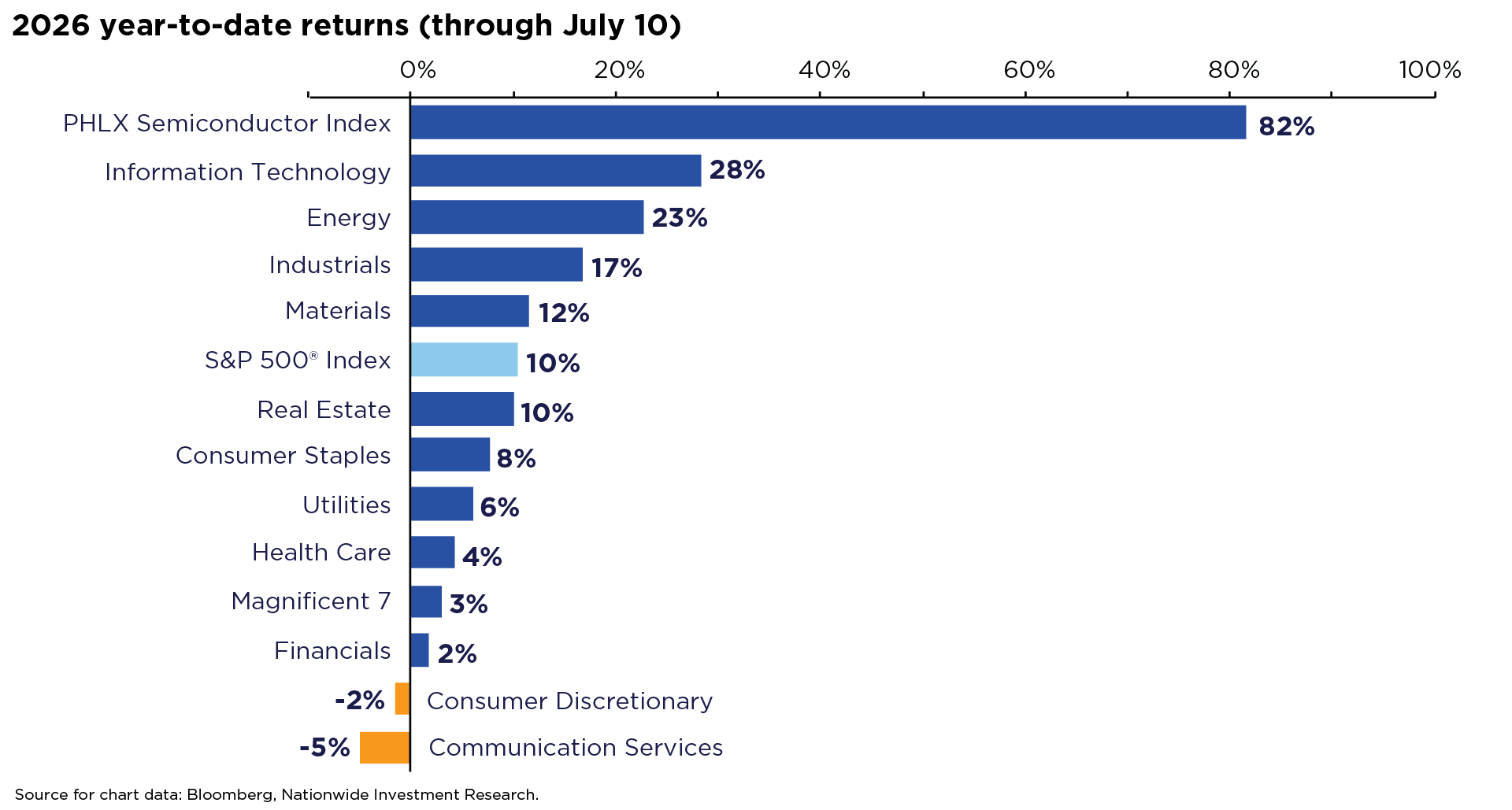
The broadening of market leadership beyond the mega-cap technology stocks has been one of the most encouraging trends of 2026. While momentum-driven leadership remains a dominant force, earnings growth has become more widespread across sectors, industries, and market capitalizations. Supported by a resilient economy and solid corporate fundamentals, this expansion in earnings strength is evident in the data. Eight of the 11 S&P 500 sectors delivered double-digit earnings growth in the first quarter, and 10 sectors are expected to generate positive year-over-year earnings growth in the second quarter.
Skeptics will point out—correctly—that a disproportionate share of second-quarter earnings growth is expected to come from companies tied to the AI infrastructure buildout. However, focusing solely on the largest contributors to Index-level earnings risks overlooking a more important trend. Earnings revisions, earnings growth, and relative price performance have improved across a broader range of sectors and asset classes. Yes, the technology sector is expected to deliver the strongest revenue growth in the second quarter, but the median stock is projected to generate nearly 9% EPS growth, underscoring the breadth of earnings strength across the market.
The improving fundamental backdrop extends beyond corporate earnings. Recent signs of stabilization in manufacturing activity point to a more supportive environment for cyclical sectors, including industrials, materials, and energy. If that recovery gains momentum in the second half of the year, market leadership could broaden further beyond technology, creating a wider set of opportunities across the equity market.
That said, the path has been anything but smooth. Leadership rotations have occurred in waves, often marked by sharp reversals and short-term positioning-driven volatility. Even so, the broader trend has been toward a market supported by multiple sources of leadership rather than a single dominant theme—even as investors remain focused on the remarkable run in semiconductor stocks.
Despite strong earnings momentum, investors appear to be taking profits in some of the market's most crowded trades and shifting toward areas where valuations, expectations, and positioning are more balanced. The result is a healthier market, with a broader range of sectors and asset classes contributing to returns despite ongoing volatility.
Author(s)

Mark Hackett, CFA®, CMT®, CFP®
Chief Market Strategist, Nationwide Investment Management Group
Mark Hackett is the Chief Market Strategist for Nationwide’s Investment Management Group, bringing more than 20 years of experience in the asset management industry to the role.
Trending articles
What could matter most for bond investors in 2026? Income, flexibility, and a disciplined approach to security selection.
As sports betting gains popularity, investors may blur the line between gambling and investing. Here's why time and compounding matter.
Looking beyond rates reveals what's historically fueled small-cap gains most: stronger earnings and a growing economy.
Disclaimers
This material is not a recommendation to buy or sell a financial product or to adopt an investment strategy. Investors should discuss their specific situation with their financial professional.
Except where otherwise indicated, the views and opinions expressed are those of Nationwide as of the date noted, are subject to change at any time and may not come to pass.
S&P 500® Index: An unmanaged, market capitalization-weighted index of 500 stocks of leading large-cap U.S. companies in leading industries; it gives a broad look at the U.S. equities market and those companies’ stock price performance.
S&P Indexes are trademarks of Standard & Poor’s and have been licensed for use by Nationwide Fund Advisors. The Products are not sponsored, endorsed, sold or promoted by Standard & Poor’s and Standard & Poor’s does not make any representation regarding the advisability of investing in the Product.