Mark Hackett, CFA®, CMT®, CFP®


Markets and economy
Markets and economy
Could rising earnings expectations be the next
source of stock market risk?
Key takeaways:
- Earnings growth for the S&P 500® Index is on pace to make 2026 one of the strongest calendar years in recent history, but the next challenge may be whether future earnings can continue to exceed increasingly elevated expectations.
- Periods of exceptional earnings growth have typically occurred as the economy emerges from a recession, not in the middle of the business cycle, where we are today.
08/12/2026 – As we look ahead to the end of 2026 and into 2027, what could be the biggest equity market risk investors should watch for? At first blush, the fundamental backdrop doesn't seem like a likely source of risk, given record-level earnings growth. But despite impressive Q2 earnings, the next challenge may not be whether earnings remain strong, but whether they can continue to exceed increasingly elevated expectations.
Earnings growth for the S&P 500® Index is on pace to make 2026 one of the strongest calendar years in recent history. That could make 2026 an exceptionally difficult benchmark against which to measure future results. The real challenge may deliver growth that remains impressive compared with today's elevated levels.
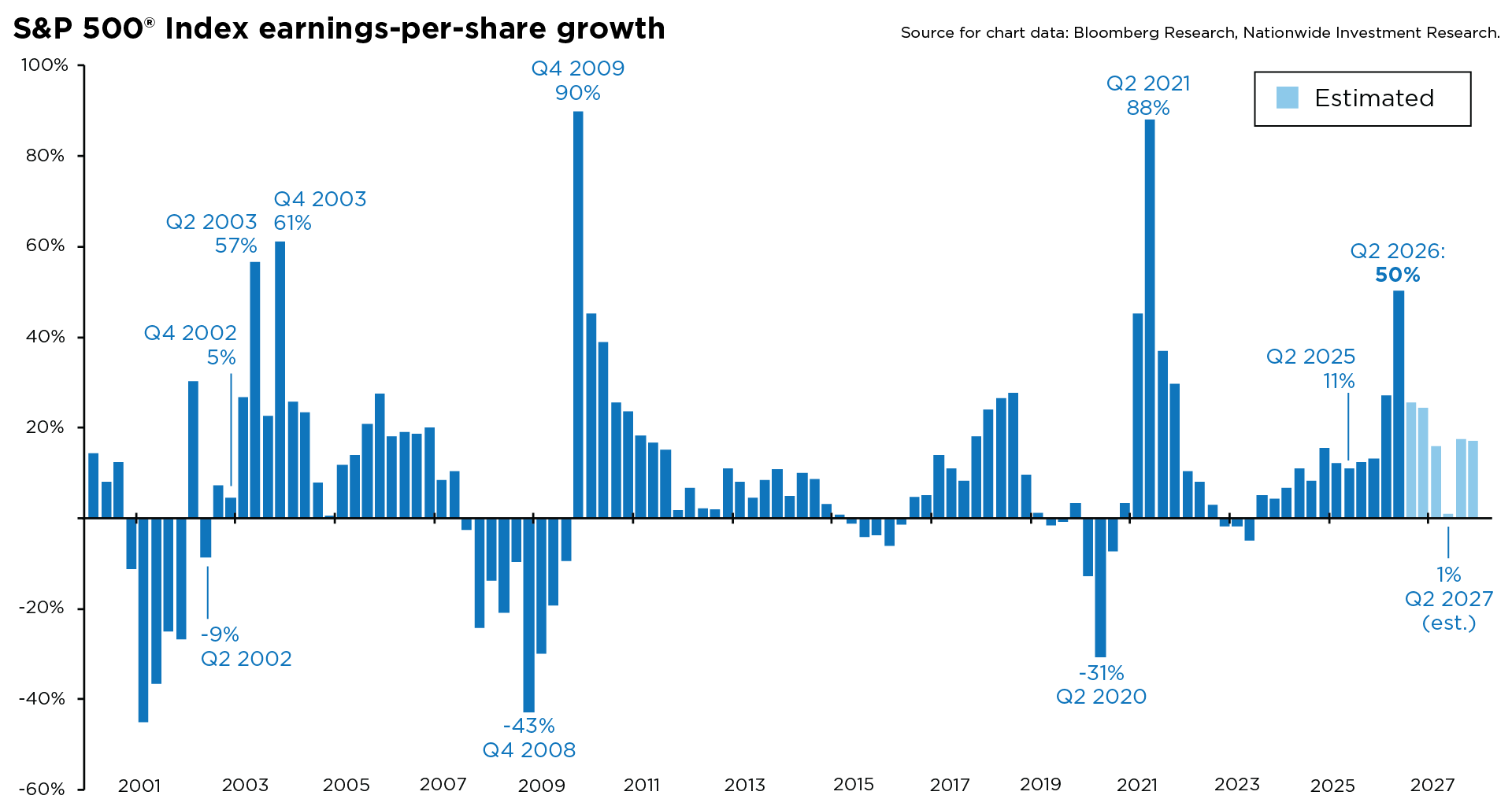
Let's start with the second quarter as a baseline. It appears likely that S&P 500 earnings growth will exceed 50% once Q2 results are fully reported. That would mark the seventh consecutive quarter of double-digit earnings growth. Analysts have also continued to raise earnings forecasts for subsequent quarters. For instance, EPS estimates are typically trimmed in the third quarter. Yet in July, analysts increased estimates for Q3. That marks the second consecutive quarter and the fourth time in the past five quarters that analysts have raised EPS estimates during the first month of a quarter.
Earnings expectations for both 2026 and 2027 are inflecting higher, with consensus estimates now at $359 and $405, respectively. These projections imply earnings growth of over 30% this year and nearly 13% next year. Since 2013, there have been only two periods in which full-year earnings growth exceeded 20%: first, in 2018 following the Tax Cuts and Jobs Act; and second, in 2021 during the pandemic recovery, supported by an unprecedented wave of fiscal stimulus. (See chart.)
Periods of exceptional earnings growth have typically occurred as the economy emerges from a recession, not in the middle of the business cycle, where we are today. In that context, the question may be how much further earnings can reasonably grow from here.
Broadening earnings growth is certainly welcome. All S&P 500 sectors are expected to report positive earnings growth in FY 2026, which would mark the first time since 2009. But the more important metric to watch may be the magnitude of earnings surprises. For Q2 2026, earnings surprises are tracking close to 30%, making this one of the strongest earnings seasons of the post-pandemic era.
The debate may shift from the level of earnings growth to the sources of that growth. Importantly, one-time gains from "other income" are contributing meaningfully to Q2 earnings growth. Roughly 19 percentage points of Q2 earnings growth stem from Alphabet's and Amazon's combined $151 billion in investment-related gains, with Microsoft contributing an additional $3 billion. Excluding the contributions from Alphabet and Amazon, S&P 500 EPS growth is still tracking a robust 28%, the fastest pace of earnings growth since 2021.
This earnings season has been grounded in strong fundamentals, but the outlook for future quarters is less clear. Yes, hyperscale technology companies continue to signal sustained capital spending, and resilient economic activity may support higher earnings in absolute terms. But for equity investors, the more relevant question may be whether future results can continue to exceed expectations that have already been revised substantially higher.
Author(s)

Mark Hackett, CFA®, CMT®, CFP®
Chief Market Strategist, Nationwide Investment Management Group
Mark Hackett is the Chief Market Strategist for Nationwide’s Investment Management Group, bringing more than 20 years of experience in the asset management industry to the role.
Trending articles
What could matter most for bond investors in 2026? Income, flexibility, and a disciplined approach to security selection.
As sports betting gains popularity, investors may blur the line between gambling and investing. Here's why time and compounding matter.
Looking beyond rates reveals what's historically fueled small-cap gains most: stronger earnings and a growing economy.
Disclaimers
This material is not a recommendation to buy or sell a financial product or to adopt an investment strategy. Investors should discuss their specific situation with their financial professional.
Except where otherwise indicated, the views and opinions expressed are those of Nationwide as of the date noted, are subject to change at any time and may not come to pass.
S&P 500® Index: An unmanaged, market capitalization-weighted index of 500 stocks of leading large-cap U.S. companies in leading industries; it gives a broad look at the U.S. equities market and those companies’ stock price performance.
S&P Indexes are trademarks of Standard & Poor’s and have been licensed for use by Nationwide Fund Advisors. The Products are not sponsored, endorsed, sold or promoted by Standard & Poor’s and Standard & Poor’s does not make any representation regarding the advisability of investing in the Product.