Mark Hackett, CFA®, CMT®, CFP®


Markets and economy
Markets and economy
Despite recession fears, many indicators point in the opposite direction
Key takeaways:
- Many economic signals continue to point to resilience: GDP growth remains healthy, financial conditions are not especially restrictive, and labor market data reflect durable job and wage growth that support consumer spending.
- Improving manufacturing activity has coincided with stronger earnings revisions, reinforcing the long-standing relationship between broadening economic activity and expanding earnings growth.
07/28/2026 – Recession fears have remained stubbornly persistent—and understandably so. Investors have spent the past several years navigating inflation shocks, aggressive Federal Reserve tightening, geopolitical uncertainty, and a near-constant stream of recession warnings. As a result, a recent Nationwide Retirement Institute® survey found that 77% of investors and 75% of advisors remain concerned about a U.S. recession over the next 12 months.
Yet history suggests investors may overestimate the likelihood of a recession. Since 2011, the U.S. economy has spent just two months in recession—during the extraordinary circumstances of the 2020 pandemic. Throughout that period, the economy has shown remarkable resilience and adaptability.
That resilience remains on display today. While investor sentiment remains cautious, the indicators that have historically signaled recession are pointing in the opposite direction. Nominal GDP growth remains healthy, financial conditions are not especially restrictive, and labor market data continue to reflect durable job and wage growth, all of which support consumer spending.
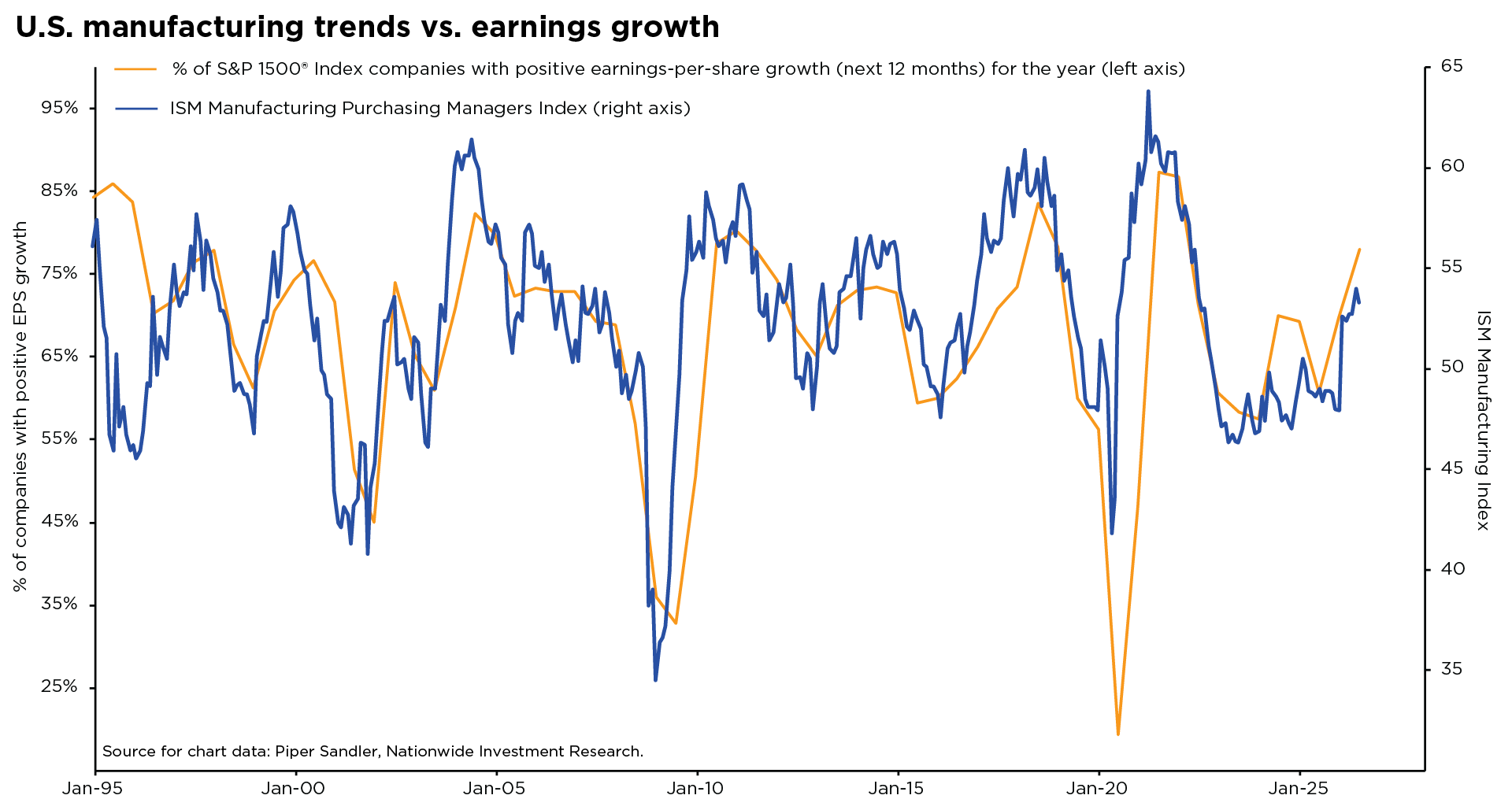
Manufacturing, long viewed as the economy’s weakest link, has quietly become a source of strength in recent months. For example, the ISM Manufacturing Purchasing Managers Index (PMI) recently reached its highest level since 2022. Moreover, global PMIs have moved decisively higher, with roughly 80% of countries now in expansion territory, while every major U.S. manufacturing and services PMI is expanding or stable.
Equally important, the recent improvement in the ISM Manufacturing Index has coincided with a meaningful acceleration in earnings revisions, reinforcing a relationship that has persisted for decades (see chart). As economic activity broadens, earnings growth tends to broaden as well. Economies approaching recession typically exhibit the opposite pattern.
The banking sector may provide the clearest reality check for anxious investors. Banks sit closest to the flow of economic activity and often detect signs of weakness before they appear in headline economic data. Yet little evidence of weakness has emerged from second-quarter results at the largest U.S. banks. Credit quality remains healthy, loan growth trends are constructive, and management commentary continues to describe an economy marked by resilience rather than retrenchment.
If a recession were imminent, investors would likely expect to see a very different set of signals: weakening credit demand, rising delinquencies, shrinking loan portfolios, deteriorating earnings expectations, and increasingly defensive lending behavior. Instead, households and businesses continue to spend, invest, and borrow.
Taken together, these factors paint a picture that is far more consistent with economic expansion than contraction. Recession fears may remain elevated, and growth may continue to be uneven, but the widening gap between sentiment and fundamentals is becoming increasingly difficult to ignore.
Author(s)

Mark Hackett, CFA®, CMT®, CFP®
Chief Market Strategist, Nationwide Investment Management Group
Mark Hackett is the Chief Market Strategist for Nationwide’s Investment Management Group, bringing more than 20 years of experience in the asset management industry to the role.
Trending articles
What could matter most for bond investors in 2026? Income, flexibility, and a disciplined approach to security selection.
As sports betting gains popularity, investors may blur the line between gambling and investing. Here's why time and compounding matter.
Looking beyond rates reveals what's historically fueled small-cap gains most: stronger earnings and a growing economy.
Disclaimers
This material is not a recommendation to buy or sell a financial product or to adopt an investment strategy. Investors should discuss their specific situation with their financial professional.
Except where otherwise indicated, the views and opinions expressed are those of Nationwide as of the date noted, are subject to change at any time and may not come to pass.
S&P 1500® Index: The Index is a combination of the securities from the following three indexes: the S&P 500® Index, S&P MidCap 400, and S&P SmallCap 600 to cover about 90% of U.S. stock market value.
S&P Indexes are trademarks of Standard & Poor's and have been licensed for use by Nationwide Fund Advisors. The Products are not sponsored, endorsed, sold or promoted by Standard & Poor's and Standard & Poor's does not make any representation regarding the advisability of investing in the Product.
ISM Manufacturing Purchasing Managers Index (PMI): A monthly economic indicator that measures the level of activity in the U.S. manufacturing sector.