Mark Hackett, CFA®, CMT®, CFP®


Markets and economy
Markets and economy
Gambling vs. investing:
Don't bet against compounding
Key takeaways:
- Unlike gambling, long-term investing puts the power of compounding to work in an investor’s favor.
- Viewing betting or prediction markets as wealth-building strategies can pull capital away from long-term investment goals.
08/25/2026 – Why do casino floors have no windows, no visible clocks and no straight line to the exit? Every element of the floor plan serves a purpose: to keep players engaged long enough for the mathematics of the game to extract as much value as possible. To paraphrase an investment adage, it’s about time in the casino; the longer the game continues, the more likely the outcome is to favor the house. The same purpose also drives the design of modern gaming apps on smartphones (e.g., sports betting, online casinos, prediction markets), which use behavioral stimuli such as user interfaces, reward mechanisms, notifications and promises of profit to keep users engaged longer.
Investing and gambling are fundamentally different forms of risk-taking. With investing, time is on the investor’s side as capital compounds when channeled through a well-diversified portfolio. But time works against the gambler; gambling is structured so that a statistical edge against the player compounds through repetitive activity. The difference between the two may seem linguistic rather than mathematical, but the danger arises when speculation is mistaken for an investment opportunity and gambling becomes a long-term financial strategy. The math behind gambling all but guarantees that, on average, the participant falls behind and the house always wins.
What would you say to investors who view gambling, sports betting and prediction markets as legitimate wealth-building tools or part of a long-term financial plan?
When people view prediction markets, sports betting or other speculative activities as wealth-building tools, they’re often not adding a new source of capital. They’re reallocating capital away from traditional investments. One study of roughly 230,000 households between 2010 and 2022 found that when states legalized online sports betting, the money being wagered didn’t come primarily from entertainment budgets. Instead, it came from savings and investment accounts. (See the chart below.) To me, that’s the real concern. Money that should be compounding over time in a diversified portfolio is redirected toward activities that depend on accurately forecasting short-term outcomes.
In our age of instant gratification, many people may worry that if they don’t act fast on opportunities, they won’t be able to build wealth. This fear of missing out can lead investors to ask the wrong question. It shouldn’t be, “What are the odds of this bet?” but rather, “What game am I playing with my financial well-being?” Financial independence is rarely achieved by making a series of brilliant predictions but rather by putting time and the power of compounding to work. Before worrying about the odds of the next wager, investors should make sure they’re playing the right game. One game (gambling) is built around prediction and is often marketed or perceived as a path to wealth creation. The other (investing) is built around economic ownership and long-term wealth creation. History suggests the latter has been the far more reliable path.
Gambling has become extremely popular among younger investors. How can advisors help them understand the difference between gambling and long-term investing?
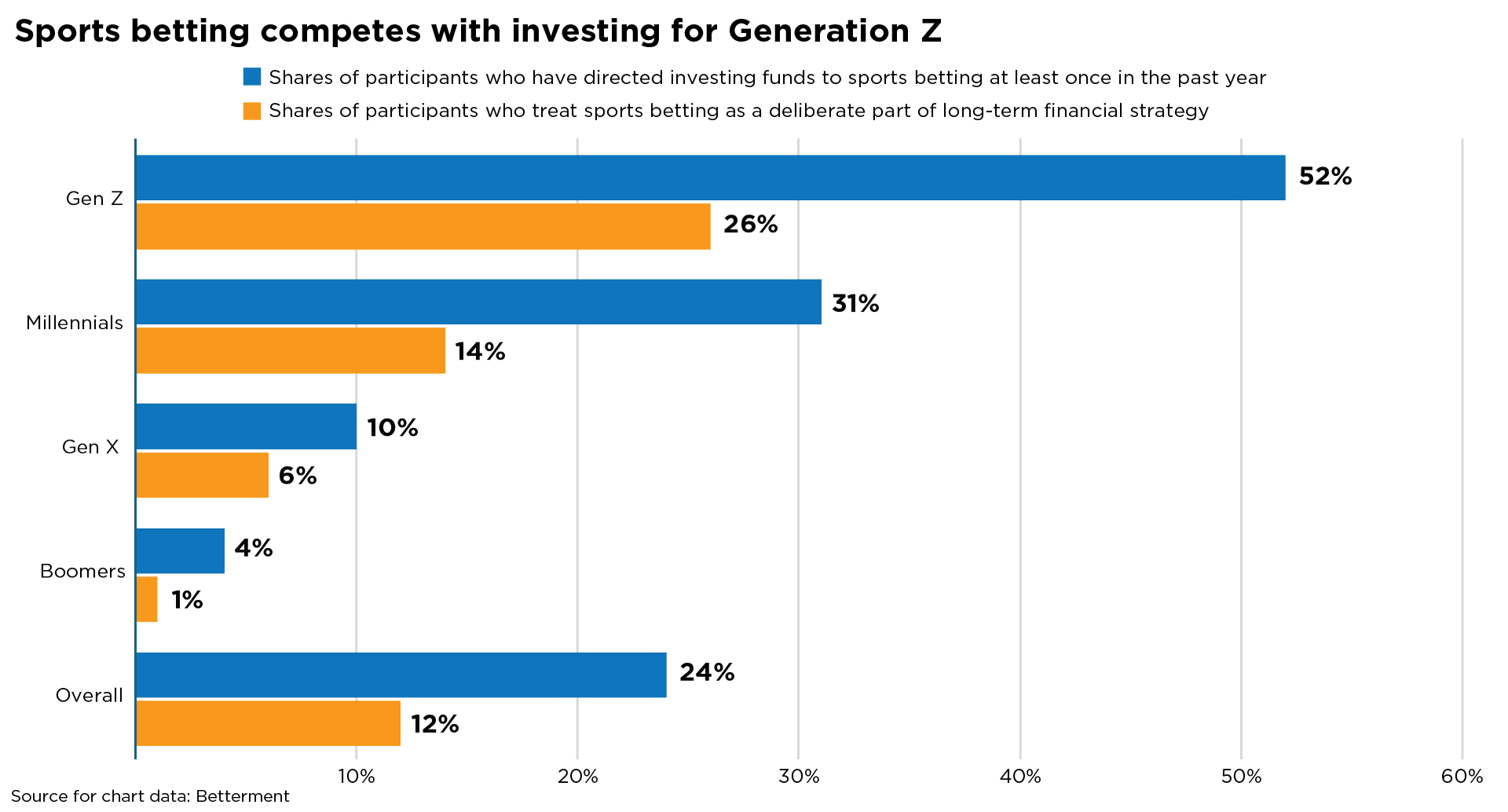
Gambling’s allure for younger generations is real. A Betterment survey found that 26% of Gen Z respondents said they view sports betting as a deliberate part of their long-term financial strategy, and just over half said they’ve redirected money that otherwise would have gone to investing toward sports betting at least once in the past year. Those numbers suggest that for many young Americans, the distinction between gambling and investing has become increasingly blurred, potentially creating a vicious cycle of financial loss.
The reason investing and gambling are fundamentally different comes down to how time affects the odds of success. As mentioned, in a casino or on a gambling app, the odds are stacked against the player; the longer you play, the more likely it is that you will lose. In the stock market, historically, time has worked in investors’ favor. That may not be obvious when looking at the short term, but over longer periods economic growth, corporate earnings and compounding have tended to reward patient investors. Just look at the historical record of the S&P 500® Index. When looking at monthly returns, stocks have been positive about 64% of the time. Extend that period to a year and the probability of positive returns rises to roughly 79%. Over even longer periods, stocks have been positive for every rolling 16-year period since 1928. That’s the exact opposite of gambling.
Author(s)

Mark Hackett, CFA®, CMT®, CFP®
Chief Market Strategist, Nationwide Investment Management Group
Mark Hackett is the Chief Market Strategist for Nationwide’s Investment Management Group, bringing more than 20 years of experience in the asset management industry to the role.
Trending articles
What could matter most for bond investors in 2026? Income, flexibility, and a disciplined approach to security selection.
As sports betting gains popularity, investors may blur the line between gambling and investing. Here's why time and compounding matter.
Looking beyond rates reveals what's historically fueled small-cap gains most: stronger earnings and a growing economy.
Disclaimers
This material is not a recommendation to buy or sell a financial product or to adopt an investment strategy. Investors should discuss their specific situation with their financial professional.
Except where otherwise indicated, the views and opinions expressed are those of Nationwide as of the date noted, are subject to change at any time and may not come to pass.
S&P 500® Index: An unmanaged, market capitalization-weighted index of 500 stocks of leading large-cap U.S. companies in leading industries; it gives a broad look at the U.S. equities market and those companies’ stock price performance.
S&P Indexes are trademarks of Standard & Poor’s and have been licensed for use by Nationwide Fund Advisors. The Products are not sponsored, endorsed, sold or promoted by Standard & Poor’s and Standard & Poor’s does not make any representation regarding the advisability of investing in the Product.