

Markets and economy
Leadership rotates as Mag 7
earnings growth cools
Key Takeaways:
- Investors should not confuse moderating Mag 7 earnings growth with a weakening bull market, particularly as leadership has broadened across the other 493 S&P 500® Index stocks.
- A rotation in sector leadership and broader market participation has more than offset weakness in the Mag 7 and the AI trade more broadly.
11/11/2026 —Over the past month, the AI “hyperscalers” among the Magnificent 7 stocks (e.g., Alphabet, Amazon, Meta, and Microsoft) came under acute selling pressure as investors questioned the economics of their capital expenditure targets, the viability of their monetization plans and, more concerning, whether the very AI technologies these firms are investing so aggressively to build could ultimately disrupt their core businesses.
As a case in point, Alphabet’s Q3 earnings report revealed slowing growth in Google Search advertising revenue, a possible indicator that AI Mode is eroding the company’s traditional engine of free cash flow. The deterioration in free cash flow among the hyperscalers may be the clearest sign of growing investor skepticism. According to Ned Davis Research, operating cash flows for the hyperscalers over the past four quarters ($677 billion) covered only 78% of their investing cash flow ($869 billion). These figures suggest many hyperscalers may no longer fund all of their investment ambitions through operating cash flow alone. That could lead investors to scrutinize valuations and profitability more closely.
One subtle development that is often lost in the debate surrounding hyperscaler AI capex and free cash flow is the narrowing of earnings leadership beyond the Mag 7. At the start of Q3, FactSet expected the Mag 7 to grow earnings by 33.6%, compared with 27.8% for the other 493 companies in the S&P 500® Index. As of this writing, those figures stand at 22.6% and 32.6%, respectively. If realized, it would mark the first quarter since Q4 2022 in which earnings growth for the other 493 companies exceeded that of the Mag 7.
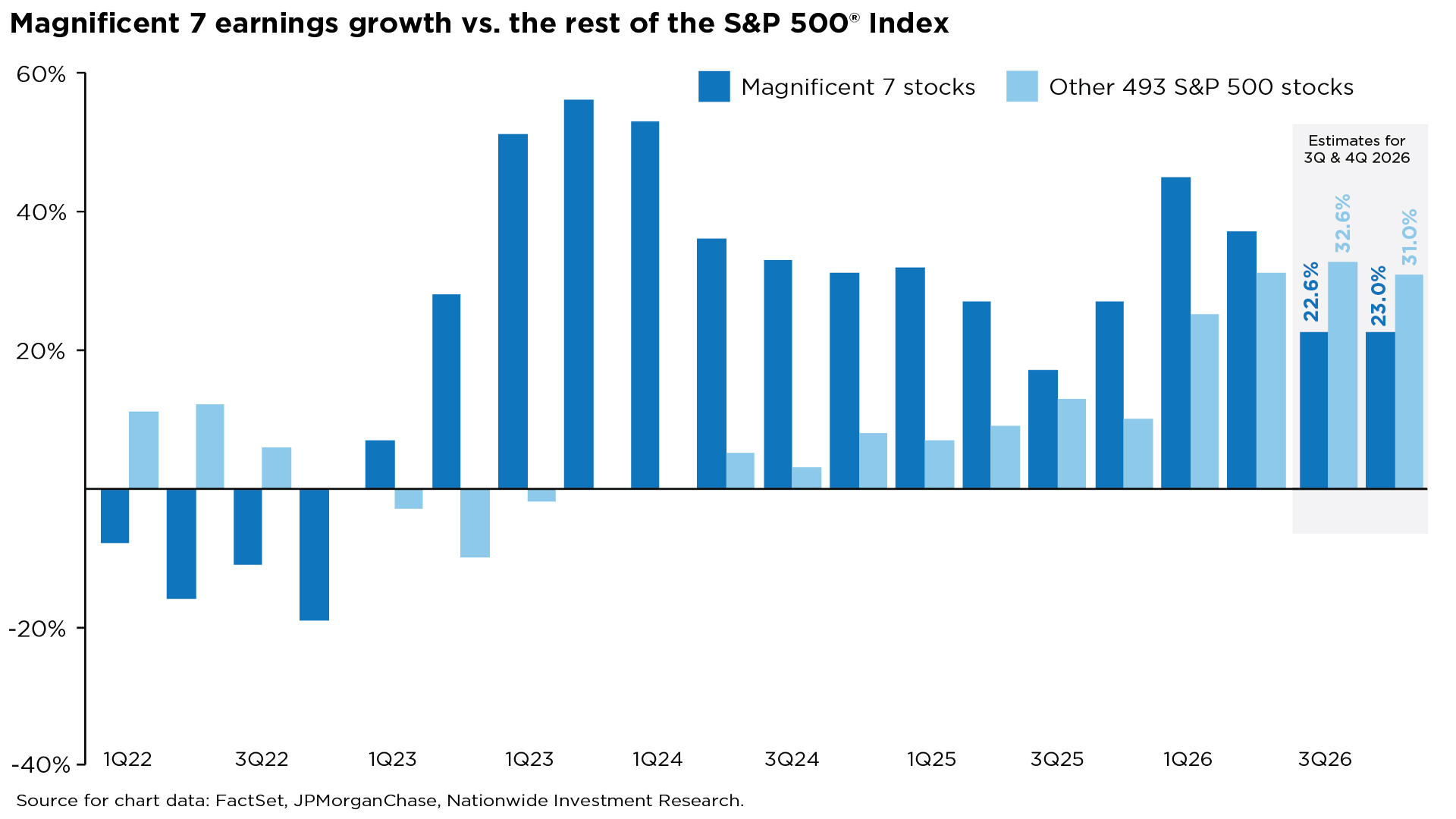
Investors in the bearish camp often assert that the S&P 500 will struggle to withstand the drag created by a failure of the Mag 7 to deliver positive performance. Thus far, the market has proven surprisingly indifferent to the arguments of both bulls and bears. Periods of intense sector rotation have repeatedly absorbed pockets of weakness, frustrating bears looking for a broad-based capitulation at the Index level while denying bulls the catalyst needed for a sustained breakout. As a result, the S&P 500 has remained largely range-bound since early June.
October offered a live test of the bearish thesis as Alphabet, Amazon, Meta, and Nvidia collectively shed hundreds of billions of dollars in market capitalization, contributing to a roughly 6.7% decline in the Nasdaq 100® Index. However, the S&P 500 fell by less than 1% as market participation broadened. In fact, 381 companies in the S&P 500 outperformed the Index in October, and the median stock returned nearly 7%, helping the S&P 500® Equal Weight Index outperform its market-cap-weighted counterpart by 5%. This broadening in market leadership more than offset the weakness in the Mag 7 and the AI trade.
While the leadership rotation and broadening market breadth are encouraging, investors should be careful not to anchor to a single outcome as 2027 approaches. History suggests that inflection points during transformative investment cycles rarely follow a linear path. For instance, a politically driven moderation in the AI growth curve could ultimately prove beneficial by limiting speculative excesses and improving the long-term sustainability of the data center buildout. Likewise, if computer capacity remains scarce, the resulting supply constraints could reinforce the competitive advantages of incumbent hyperscalers, many of which were early movers and continue to control a significant share of the industry’s most valuable compute resources.
A deceleration in Mag 7 earnings should not be conflated with broader market weakness. The more consequential question is whether the AI investment thesis faces a fundamental impairment. For now, that question remains largely unanswered.
Author(s)

Mark Hackett, CFA®, CMT®, CFP®
Chief Market Strategist, Nationwide Investment Management Group
Mark Hackett is the Chief Market Strategist for Nationwide’s Investment Management Group, bringing more than 20 years of experience in the asset management industry to the role.