Mark Hackett, CFA®, CMT®, CFP®


Markets and economy
Markets and economy
Should investors cheer or fear
when markets hit all-time highs?
Key takeaways:
- Avoiding equities when markets are near all-time highs can carry a meaningful long-term cost.
- New highs don’t guarantee further gains or signal an imminent peak—but they highlight a wide range of potential outcomes.
06/03/2026 – The velocity of the stock market’s rebound from the late-March low has been nothing short of remarkable. The S&P 500® Index returned to an all-time high in just 11 trading days—marking the fastest recovery from a drawdown of at least 8% in 75 years. Over the 40 trading days from that low, the Index climbed nearly 18%, placing this rally among the strongest over a comparable period since the 1950s.
Beneath the surface, the strength of the move is even more striking. Some of the leading names in the AI complex—particularly semiconductor stocks—are trading over 100% above their 200-day moving averages. That kind of extension reflects not just strong fundamentals, but also the role of positioning and momentum in driving the rally.
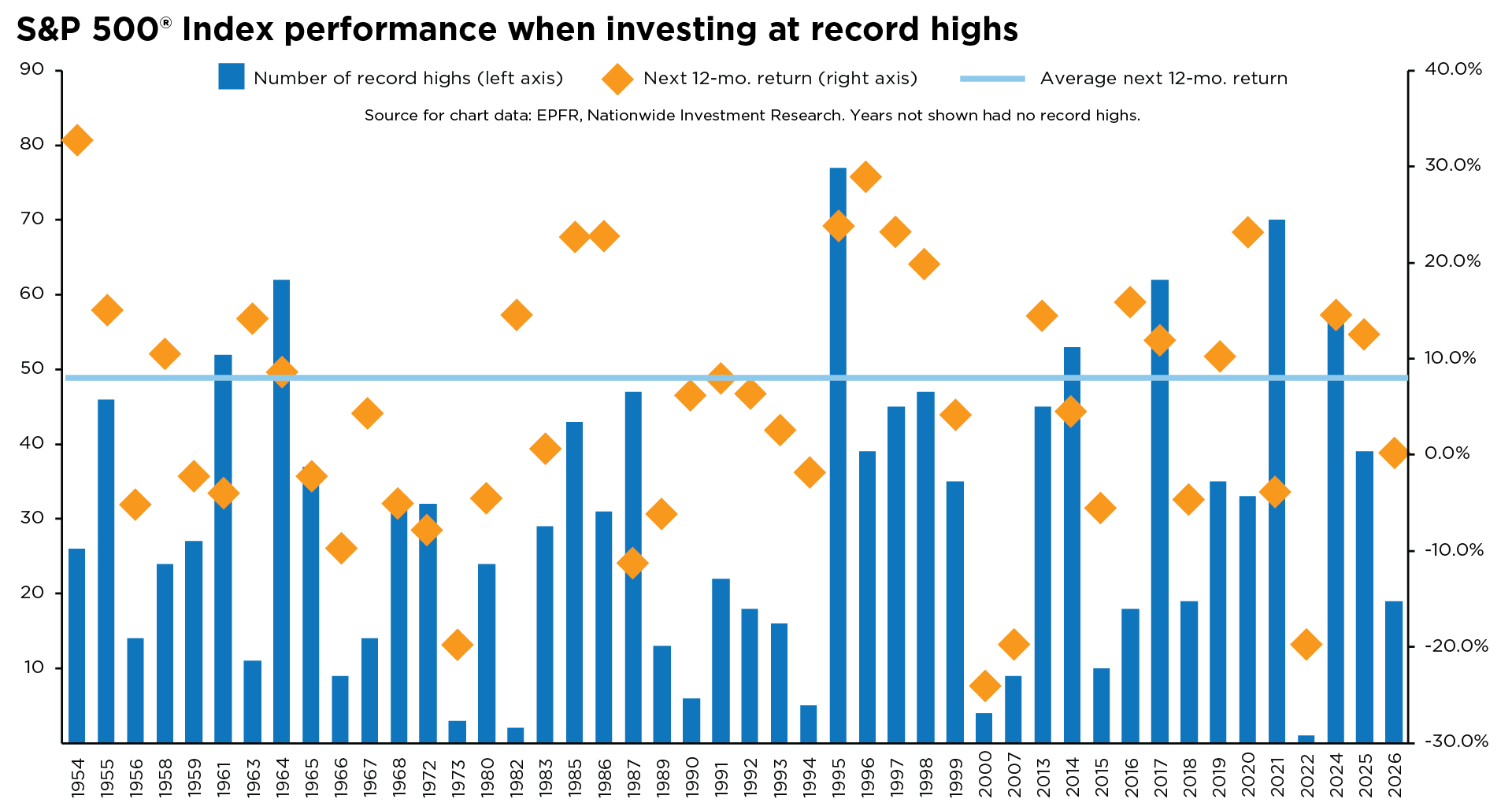
Conviction has risen alongside the benchmark, with analysts steadily lifting their year-end targets for the S&P 500. That leaves investors weighing opportunity against discipline, grappling with whether to add exposure to elevated levels as the Index continues to climb toward new highs, even as leadership narrows and price action in key areas takes on a more momentum-driven, and potentially less sustainable, character. Avoiding equities simply because markets are at or near all-time highs can carry a meaningful long-term cost. Historical data reinforces this point: since 2013, the S&P 500 has recorded roughly 461 new highs, yet over that same period has delivered cumulative returns of over 400%—with average annual gains near 15%.
This track record also highlights an important nuance that can be lost to recency bias. A new all-time high for the S&P 500 neither guarantees further gains nor signals an imminent peak. Instead, it underscores a wide range of potential outcomes—where forward returns can vary meaningfully, even as the overall bias remains to the upside, as reflected in the average forward return of roughly 10% (see chart).
Investors should view all-time highs as part of the market’s price discovery process, where expectations are continually recalibrated in response to evolving fundamentals and valuation dynamics, and the broader macro backdrop. In this environment, delaying investment decisions can quickly turn into market timing. A more effective approach is to maintain a disciplined, diversified rebalancing strategy—helping investors stay aligned with long-term goals.
Author(s)

Mark Hackett, CFA®, CMT®, CFP®
Chief Market Strategist, Nationwide Investment Management Group
Mark Hackett is the Chief Market Strategist for Nationwide’s Investment Management Group, bringing more than 20 years of experience in the asset management industry to the role.
Trending articles
What could matter most for bond investors in 2026? Income, flexibility, and a disciplined approach to security selection.
As sports betting gains popularity, investors may blur the line between gambling and investing. Here's why time and compounding matter.
Looking beyond rates reveals what's historically fueled small-cap gains most: stronger earnings and a growing economy.
Disclaimers
This material is not a recommendation to buy or sell a financial product or to adopt an investment strategy. Investors should discuss their specific situation with their financial professional.
Except where otherwise indicated, the views and opinions expressed are those of Nationwide as of the date noted, are subject to change at any time and may not come to pass.
S&P 500® Index: An unmanaged, market capitalization-weighted index of 500 stocks of leading large-cap U.S. companies in leading industries; it gives a broad look at the U.S. equities market and those companies’ stock price performance.
S&P Indexes are trademarks of Standard & Poor’s and have been licensed for use by Nationwide Fund Advisors. The Products are not sponsored, endorsed, sold or promoted by Standard & Poor’s and Standard & Poor’s does not make any representation regarding the advisability of investing in the Product.