Mark Hackett, CFA®, CMT®, CFP®


Markets and economy
Markets and economy
Vital signs in the stock market point to
broader leadership
Key takeaways:
- The equity market may exhibit greater resilience than the sharp drawdowns in technology and momentum stocks would suggest.
- That resilience may be a sign that investors are reallocating to other parts of the market rather than exiting equities altogether.
08/07/2026 – The stock market looks very different today than it did just a week ago. The S&P 500® Index has returned to all-time highs, while the semiconductor sector has surged roughly 16% from its July lows as investors rotated into areas of the market that had previously lagged.
Yet July's sharp market swings still offer an important lesson for investors. Volatility is likely to remain a feature of the current market environment rather than a temporary condition. What appeared to be weakness was often rotation in disguise, with investors moving between sectors rather than leaving the market altogether.
While the momentum unwind was intense, the S&P 500 spent much of the past three months moving sideways as the S&P 500® Equal Weight Index (EWI) quietly pushed to new highs in July. That divergence may have been one of the market's most important signals. When investors were focused on sharp declines in a narrow group of AI and momentum stocks, the EWI suggested that leadership was broadening throughout the market. Volatility wasn't undermining the bull market; it was helping redistribute leadership across it.
It's notable that a large and influential corner of the market, like semiconductors, can undergo a meaningful reset without materially disrupting the broader Index. This is precisely what occurred during last month's momentum-led sell-off.
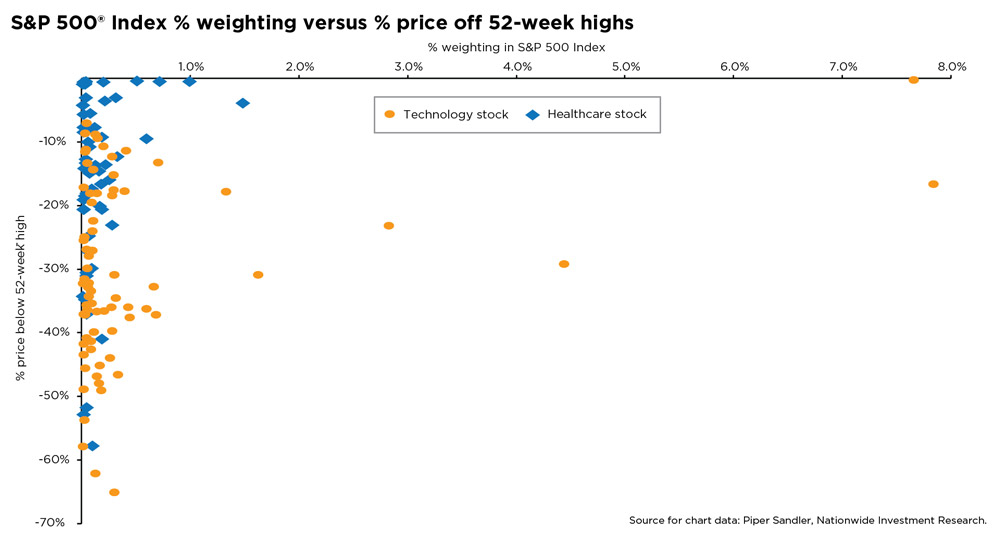
The accompanying chart captures this dynamic as of July 31, before this week's sharp rebound in semiconductor and other technology stocks. Much of the weakness was concentrated in the tech sector, while healthcare quietly emerged as a source of strength. In many respects, healthcare acted as a shock absorber, helping offset weakness in momentum stocks and limiting spillover to the broader market.
Viewed through that lens, the market showed more resilience than the drawdowns in a narrow group of winners would otherwise suggest. In fact, healthcare was the top-performing sector in the S&P 500 over the past three months, underscoring how capital rotated into overlooked areas of the market as sentiment toward technology deteriorated.
While the recent recovery in semiconductors and other tech leaders has been impressive, it does not diminish what July revealed. Market weakness was ultimately absorbed rather than amplified, allowing breadth to improve beneath the surface while earnings growth and corporate fundamentals remained intact. That combination is more consistent with a reset in leadership than a change in the broader bull market trend. It may suggest that the current advance has more room to run than headline volatility alone would imply.
Author(s)

Mark Hackett, CFA®, CMT®, CFP®
Chief Market Strategist, Nationwide Investment Management Group
Mark Hackett is the Chief Market Strategist for Nationwide’s Investment Management Group, bringing more than 20 years of experience in the asset management industry to the role.
Trending articles
What could matter most for bond investors in 2026? Income, flexibility, and a disciplined approach to security selection.
As sports betting gains popularity, investors may blur the line between gambling and investing. Here's why time and compounding matter.
Looking beyond rates reveals what's historically fueled small-cap gains most: stronger earnings and a growing economy.
Disclaimers
This material is not a recommendation to buy or sell a financial product or to adopt an investment strategy. Investors should discuss their specific situation with their financial professional.
Except where otherwise indicated, the views and opinions expressed are those of Nationwide as of the date noted, are subject to change at any time and may not come to pass.
S&P 500® Index: An unmanaged, market capitalization-weighted index of 500 stocks of leading large-cap US companies in leading industries; it gives a broad look at the US equities market and those companies' stock price performance.
S&P 500® Equal Weight Index (EWI): The equal-weight version of the widely-used S&P 500 Index that includes the same constituents as the capitalization weighted S&P 500, but each company in the S&P 500 EWI is allocated a fixed weight - or 0.2% of the Index total at each quarterly rebalance.
S&P Indexes are trademarks of Standard & Poor's and have been licensed for use by Nationwide Fund Advisors. The Products are not sponsored, endorsed, sold or promoted by Standard & Poor's and Standard & Poor's does not make any representation regarding the advisability of investing in the Product.