Mark Hackett, CFA, CMT


Markets and economy
Markets and economy
What elevated volatility has historically meant for long-term stock returns
Key takeaways:
- Elevated volatility reinforces the importance of discipline—staying grounded in fundamentals, diversified in portfolios, and aligned with client risk tolerance.
- History suggests that trying to time volatility, trade headlines, or react emotionally during market stress often works against capturing long-term equity returns.
03/25/2026 – Markets are rarely unsettled by a single risk. Instead, advisors face a growing mix of pressures—from emerging cracks in private credit and rapid AI disruption to stubborn inflation and a geopolitical backdrop that continues to cloud economic forecasts.
As these risks accumulate, they’ve begun to weigh on market psychology. After entering 2026 with broadly positive sentiment, investors have grown more cautious as multiple indicators point to a reset in the market’s mood. The CNN Fear & Greed Index has moved into extreme fear territory; the AAII Sentiment Poll has shown more bears than bulls for four consecutive weeks; the NAAIM Exposure Index has fallen to its lowest level since last April; and the Bank of America Global Fund Manager Survey has dropped to a six-month low. Volatility has followed suit, with the VIX Index spending much of March above 20.
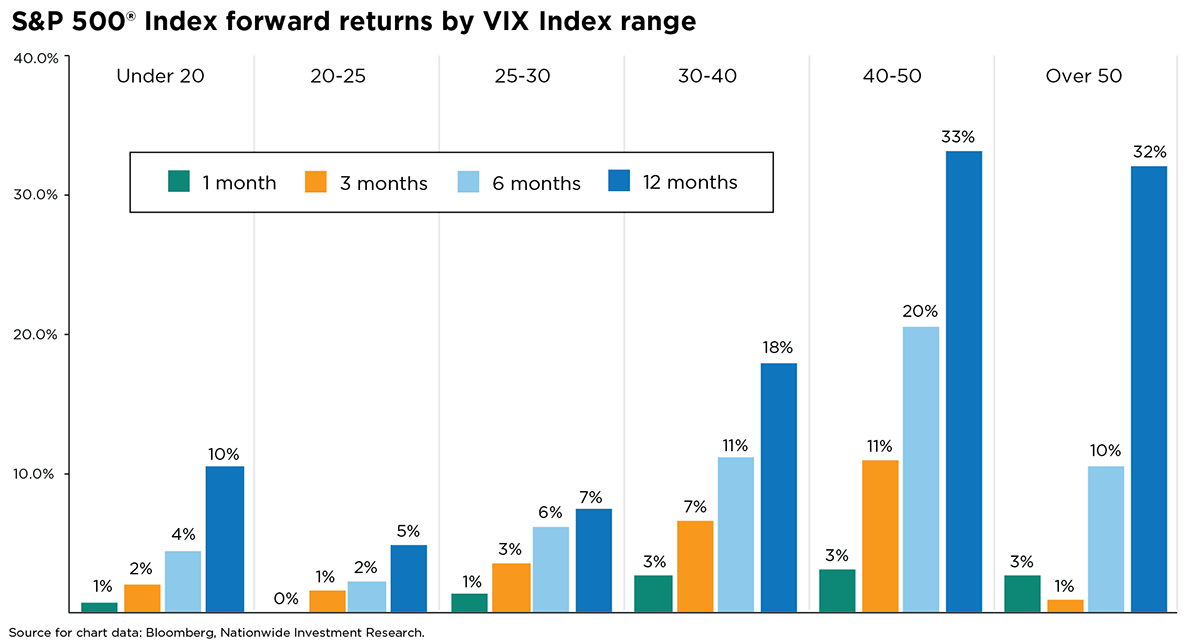
For now, market bears are driving the sentiment narrative. The swift pivot from optimism to defensiveness has caught many investors off guard and searching for perspective. As uncertainty rises and risk appetite fades, history offers a useful reference point. During past periods of elevated volatility, moments of peak fear—as measured by the VIX—have often preceded compelling forward returns for patient, diversified investors.
History paints a clear picture when comparing S&P 500® Index 12-month forward returns across different levels of market volatility. When the VIX has surged into the 40–50 range—periods that often feel, in real time, as though something has fundamentally broken—subsequent 12-month returns have averaged gains north of 30%. That stands in sharp contrast to the roughly 10% average 12-month return historically associated with a VIX below 20.
Investors who tried to time volatility peaks, trade headlines, or react emotionally during periods of extreme market stress rarely captured these outcomes. Those who did were investors who stayed disciplined—maintaining diversified portfolios to manage turbulence and remaining invested through the cycle to fully participate in the recovery.
While historical data can help frame expectations, it offers no guarantees. Market history provides context—not destiny. In periods of uncertainty, investors are best served by staying anchored to long-term fundamentals, maintaining disciplined portfolio allocations, and making decisions aligned with their risk tolerance. The market backdrop may be shifting, but the principles that underpin investment resilience remain unchanged.
Author(s)

Mark Hackett, CFA®, CMT®, CFP®
Chief Market Strategist, Nationwide Investment Management Group
Mark Hackett is the Chief Market Strategist for Nationwide’s Investment Management Group, bringing more than 20 years of experience in the asset management industry to the role.
Trending articles
What could matter most for bond investors in 2026? Income, flexibility, and a disciplined approach to security selection.
As sports betting gains popularity, investors may blur the line between gambling and investing. Here's why time and compounding matter.
Looking beyond rates reveals what's historically fueled small-cap gains most: stronger earnings and a growing economy.
Disclaimers
This material is not a recommendation to buy or sell a financial product or to adopt an investment strategy. Investors should discuss their specific situation with their financial professional.
Except where otherwise indicated, the views and opinions expressed are those of Nationwide as of the date noted, are subject to change at any time and may not come to pass.
CNN Fear & Greed Index: A compilation of seven different indicators that measure some aspect of stock market behavior. They are market momentum, stock price strength, stock price breadth, put and call options, junk bond demand, market volatility, and safe haven demand.
AAII Sentiment Poll: A weekly survey conducted by the American Association of Individual Investors since 1987, measuring the percentage of individual investors who are bullish, bearish, or neutral on the stock market over the next six months. It offers insight into retail investor sentiment and is often used as a contrarian indicator.
National Association of Active Investment Managers (NAAIM) Exposure Index: A valuable tool that helps investors gauge the sentiment of active investment managers in the stock market. The NAAIM Exposure Index shows how active risk managers have changed their clients’ accounts over the past two weeks.
Bank of America (BofA) Global Fund Manager Survey: A widely followed monthly report that gauges the market sentiment, asset allocation, and risk positioning of hundreds of institutional investors, hedge funds, and mutual funds managing hundreds of billions of dollars globally. It acts as a key sentiment indicator, offering real-time insights into how managers are allocating capital across regions, sectors, and asset classes.
CBOE Volatility Index (VIX): A real-time market index representing the market’s expectations for volatility over the coming 30 days.
S&P 500® Index: An unmanaged, market capitalization-weighted index of 500 stocks of leading large-cap U.S. companies in leading industries; it gives a broad look at the U.S. equities market and those companies’ stock price performance.
S&P Indexes are trademarks of Standard & Poor’s and have been licensed for use by Nationwide Fund Advisors. The Products are not sponsored, endorsed, sold or promoted by Standard & Poor’s and Standard & Poor’s does not make any representation regarding the advisability of investing in the Product.
Nationwide Funds are distributed by Nationwide Fund Distributors LLC, member FINRA, Columbus, Ohio. Nationwide Investment Services Corporation, member FINRA, Columbus, Ohio.