Mark Hackett, CFA®, CMT®, CFP®


Markets and economy
Markets and economy
What the Fed’s return to data dependence
means for markets
Key takeaways:
- The shift in Fed communication isn’t about what markets see—it’s about how much they need to interpret. With less forward guidance, markets will rely more on incoming data and independent analysis.
- A less prescriptive Fed creates both friction and opportunity. Expectations may be more dispersed, but markets move toward stronger price discovery—and policymakers have more flexibility to adjust as conditions change.
06/24/2026 – In his first press conference as Federal Reserve chair following the June 17 FOMC meeting, Kevin Warsh outlined planned changes to the central bank’s communication framework. At first glance, the renewed emphasis on “data dependence” may signal a return to first principles. In reality, markets never stopped interpreting economic data—they simply adapted to viewing it through a highly curated Fed lens, shaped—and overdetermined—by forward guidance.
The real shift may not be in what markets watch, but in how much interpretation the Fed provides. For years, central bank communication aimed to minimize surprises, introducing tools like the “dot plot” to signal each FOMC member’s rate expectations. Over time, markets became fixated on these projections, and monetary policy evolved into a discipline of tightly managed expectations—where future decisions were largely priced in and deviations kept to a minimum. By the time the FOMC convened, the decision itself often mattered less than the signal it confirmed.
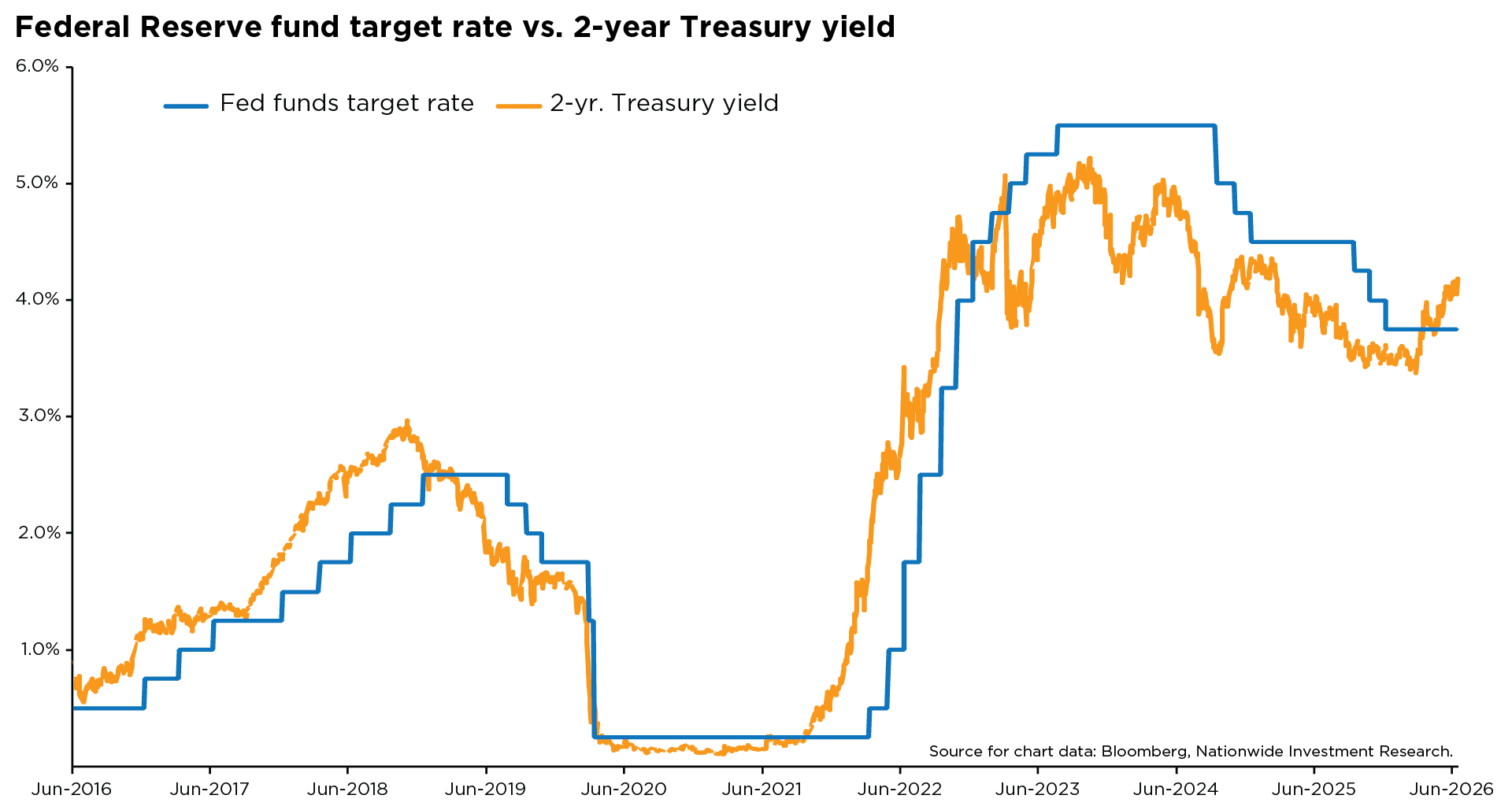
Stability, in this sense, was carefully cultivated—but like any engineered equilibrium, it carried inherent fragility. When the rate narrative faltered or real-time data shifted meaningfully, market repricing tended to be abrupt, precisely because so little ambiguity had been left in the system.
Warsh’s evolving approach nods to an earlier tradition, most closely associated with former Fed Chair Alan Greenspan’s strategic restraint. The distinction is important: ambiguity is not a lack of clarity, but an avoidance of false precision. By declining to map an explicit path for future rate moves, the Fed preserves the flexibility a complex economy demands. In this framework, forward guidance becomes conditional rather than declarative—a set of guardrails, not a rigid script.
This recalibration has the potential to reshape how markets respond to incoming data. Economic releases may carry greater marginal weight—not because they’re inherently more informative, but because they’re less pre-interpreted. Speeches from Warsh and other Fed officials become part of an evolving narrative rather than definitive signals. The result is a market dynamic that is less episodic and more continuous, with volatility potentially diffused over time rather than concentrated in moments of surprise.
There is a cost, however. A less prescriptive Fed invites greater disagreement—and wider dispersion in expectations. Investors must place more weight on marginal data and their own interpretation of how policy may evolve. But there is a benefit: markets are pushed toward more robust price discovery—synthesizing information rather than simply extrapolating from FOMC statements or Fed speeches. In turn, reduced forward guidance can enhance the Fed’s flexibility, allowing policy to adapt more readily as economic conditions change.
A Fed that leans more on high-frequency data—rather than backward-looking indicators—should be better positioned to calibrate policy in real time. The shift is not a retreat from its role, but a refinement of it. The burden of interpretation returns to where it arguably belongs: the markets—along with all the discipline, and discomfort, that entails.
Author(s)

Mark Hackett, CFA®, CMT®, CFP®
Chief Market Strategist, Nationwide Investment Management Group
Mark Hackett is the Chief Market Strategist for Nationwide’s Investment Management Group, bringing more than 20 years of experience in the asset management industry to the role.
Trending articles
What could matter most for bond investors in 2026? Income, flexibility, and a disciplined approach to security selection.
As sports betting gains popularity, investors may blur the line between gambling and investing. Here's why time and compounding matter.
Looking beyond rates reveals what's historically fueled small-cap gains most: stronger earnings and a growing economy.
Disclaimers
This material is not a recommendation to buy or sell a financial product or to adopt an investment strategy. Investors should discuss their specific situation with their financial professional.
Except where otherwise indicated, the views and opinions expressed are those of Nationwide as of the date noted, are subject to change at any time and may not come to pass.
S&P 500® Index: An unmanaged, market capitalization-weighted index of 500 stocks of leading large-cap U.S. companies in leading industries; it gives a broad look at the U.S. equities market and those companies’ stock price performance.
S&P Indexes are trademarks of Standard & Poor’s and have been licensed for use by Nationwide Fund Advisors. The Products are not sponsored, endorsed, sold or promoted by Standard & Poor’s and Standard & Poor’s does not make any representation regarding the advisability of investing in the Product.