

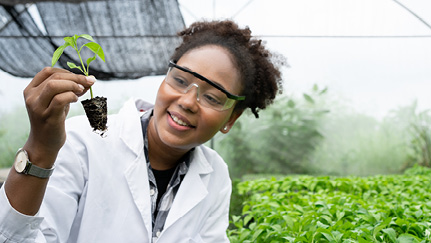
Female researcher holding a plant

At Nationwide, innovation drives our mission to deliver advanced solutions that protect our customers. Since starting as a mutual auto insurer in 1926, we've seen farms evolve from horses and plows to drones and autonomous machinery. As agriculture progressed, so did we, becoming the nation’s leading farm insurer.

The AgTech Innovation Hub continues this legacy. Launched in fall 2022 by Nationwide, The Ohio State University College of Food, Agricultural, and Environmental Sciences (CFAES) and Ohio Farm Bureau Federation, the AgTech Innovation Hub uses advanced research and technology to address some of agriculture’s biggest challenges, including weather and climate change.

“Weather and climate disasters cause significant losses in agriculture each year, and these risks grow with climate change,” said Devin Fuhrman, Nationwide’s Chief Agriculture and Sponsor Relations Officer. “The Hub not only develops new solutions but also inspires others to create strategies to futureproof agriculture. We’re fostering ideas that can positively transform agriculture for generations to come.”
Advancing technology and innovation with the AgTech Innovation Hub

Five Hub-funded research projects

In June 2023, five research initiatives funded by the Hub were launched, targeting key challenges in agriculture. These projects focused on drought risk, precision management, pathogen prevention and climate risk mapping, all aimed at developing practical solutions to real-world problems within the agricultural ecosystem.

Pulling the plug on drought risks: Automated drainage water management

Agricultural drainage is essential for farmers to manage field water levels. Dr. Vinayak Shedekar and Dr. Steve Lyons are developing an automated system that enables remote water management via cellphone and computer, increasing efficiency and precision.

Artificial intelligence for farming: Harvesting insights from data and drones

PhD student Luke Waltz and Dr. Sami Khanal are working together on an innovative project that merges weather, soil and plant data to generate high-quality information. This improved data seeks to enhance crop risk identification accuracy, helping farmers make better management decisions.

Considering climate change: Mapping climate risk perceptions

Dr. Cara Lawson has launched a national survey to explore how community and personal values influence perceptions of climate risks such as hurricanes and droughts. The findings will help craft tailored messages for responding to natural disasters or crises.

It starts and ends with seeds: Protecting soybeans from pathogens

Ohio's extended planting season poses challenges for soybean farmers, worsened by the Soybean Cyst Nematode. Dr. Horacio Lopez-Nicora and Dr. Alex Lindsay's team at CFAES, with AgTech Innovation Hub's support, research seed health and soybean resilience against extreme weather to protect Ohio's vital agricultural product.

Boosting plant defenses: Improving biostimulants and biopesticides with a new protein

Dr. Guo-Liang Wang and other researchers are studying a unique protein that enhances biopesticides and biostimulants, potentially offering tomato farmers a new tool to enhance plants’ natural defenses and growth mechanisms. This project highlights innovative approaches to boosting plant health in greenhouses and fields.

Research shows promising results

  • Addressing drought risk: Research shows that drainage water management can help alleviate water shortages, providing approximately 1 inch of the 5-inch deficit typically required during the growing season.
  • Using AI to accurately predict crop yield: The team gathered data and developed AI models to predict crop yields by analyzing soil moisture, weather conditions and images of plant growth stages.
  • Climate risk perceptions: A national study revealed that 68% of people believe climate change is occurring, at least partially due to human activity. However, many participants admitted to feeling uncertain about the mechanics of climate change science.
  • Data on soybean growing conditions: Researchers have made significant progress in studying how cold temperatures and precipitation impact soybeans. Their findings offer valuable insights into planting strategies and disease management, particularly in the context of earlier planting practices.
  • Nature-based crop management improved with novel plant protein: Researchers discovered that combining a commonly used bacterial product with a novel plant protein could cut disease severity in tomatoes and cucumbers by 50%. This innovative approach not only enhances plant growth but also strengthens their natural defenses against bacteria and fungi.

Check out this YouTube video to learn more about the AgTech Hub, meet the researchers and explore their groundbreaking projects and results.

In partnership with...

The Ohio State University College of Food, Agricultural, and Environmental Sciences and Ohio Farm Bureau

Get more information

Tractor icon

Learn about Nationwide agribusiness insurance

Person icon

Find a farm agent

Email icon

Subscribe to the Ag Insight Center email newsletter