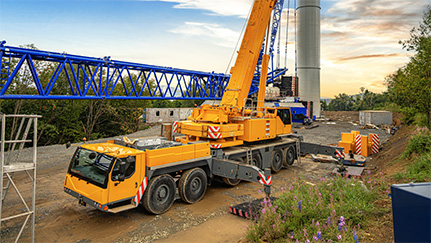
Mobile cranes are essential to modern construction and industrial projects, but they also represent some of the industry’s most complex and high severity risks. As jobsites become more congested, schedules become more compressed, and lift complexity increases, the margin for error continues to narrow.
For insurance professionals, crane risk is not simply an operational concern. It is a severity-driven exposure that tests underwriting discipline, contract language, risk transfer structures and claims response across multiple coverage lines.
“Crane work will never be a low-hazard activity,” said Eric Matthias, Director, Program Underwriting at Nationwide®. “But it doesn’t have to be unpredictable.”
Crane risk assessment
From an underwriting perspective, crane losses rarely result from a single failure. Instead, they emerge from a convergence of technical, environmental and human factors, often compounded by contractual or governance gaps.
“Beyond the obvious risk of a dropped load or crane tip-over, the real nuance in crane operations lies in how many variables must align for a lift to be successful,” Matthias explained.
Those variables include ground bearing pressure, outrigger configuration, load radius, underground and overhead utilities, and lift path exposure over people, traffic or adjacent property. Also adding layers of exposure are the rigging selection and condition, and communication between the lift director, operator, signalperson and supervisor.
For underwriters, these variables help explain why crane losses skew toward low frequency, high-severity outcomes — and why traditional safety program checklists alone often fail to predict loss potential.
“Cranes that travel between jobsites introduce risks related to vehicle size and weight, route selection, load securement and interaction with the motoring public,” Matthias said. These auto liability exposures, while operationally separate from lifting activities, can be just as severe.
For insurers, this creates operationally distinct but financially connected exposures across auto, general liability and umbrella programs. Accounts with strong lifting controls but weak transport governance may still present unacceptable aggregate severity risk.
The business impact of a single incident
From an insurance standpoint, crane losses often reshape accounts long after the claim is closed.
“A single crane loss can be company defining,” Matthias noted.
Beyond the immediate consequences of serious injury, fatalities or property damage, crane incidents can trigger cascading impacts, including project delays, liquidated damages, increased insurance costs and lost future work. Deductibles, self-insured retentions and excess layer attachments may all be stressed simultaneously. Reputational impact frequently follows, influencing how owners, brokers and carriers evaluate the account’s risk profile in future placements.
For insurers managing crane-heavy books, these events can materially affect loss ratios, capacity decisions and underwriting appetite for years, not just quarters.
What disciplined crane risk looks like to underwriters
Leading crane accounts demonstrate a level of operational discipline that aligns closely with underwriting expectations.
“That begins with formal lift planning — particularly for critical or non-routine lifts — using accurate load charts, documented ground assessments and engineered calculations, where required,” Matthias said.
Underwriters also look for evidence that:
- Operator and rigger competency is verified, current and aligned with the crane type and lift complexity
- Preventive maintenance and inspection programs are consistently executed and documented
- Stop-work authority is embedded and actively exercised when conditions change
- Near misses and minor incidents are tracked and reviewed, including driving-related events
“These organizations treat lifting operations as a controlled process, not a routine task,” Matthias said.
Tracking near misses and minor incidents, whether lift-related or driving-related, provides another layer of insight. “It allows firms to identify trends and intervene before a high-severity loss occurs,” Matthias added.
Underwriting as a second set of eyes for crane operations
While underwriting is often framed as pricing and capacity allocation, effective crane underwriting plays a broader role.
“Effective underwriting serves as a second set of expert eyes on crane risk and extends well beyond pricing,” Matthias explained. “It evaluates whether a company’s operational controls, governance and contractual practices meaningfully reduce both the likelihood and severity of losses.”
Underwriters commonly assess:
- Certifications, such as National Commission for the Certification of Crane Operators credentials, and whether they align with the crane type and lift complexity
- Training programs, including original equipment manufacturer-specific instruction, site orientation and refresher training
- Hiring practices, from experience thresholds and motor vehicle report criteria to mentoring or probationary periods
- Governance and oversight, including lift leadership, stop-work authority and review of critical lifts
Another underwriting focus that often carries outsize impact is risk transfer.
“When risk transfer is poorly structured or inconsistent with how work is performed, crane losses can quickly expand in scope and severity,” Matthias cautioned. Reviewing contracts for clarity around lift control, rigging responsibility, indemnity provisions and insurance alignment helps prevent unintended liability retention.
Choosing the right mobile crane insurance partner
For brokers, underwriters and claims professionals, crane risk demands specialization.
“Business owners should prioritize insurers with deep and sustained experience in crane operations, not just general construction or fleet exposure,” Matthias advised.
Megan Rose, President of New Heights Insurance Solutions, echoed this sentiment, emphasizing the importance of long-term commitment over short-term savings. “Choosing an insurance partner in this industry isn't just about today's premium; it's about who will still be at the table when a loss happens or the market tightens,” Rose said.
From an insurance standpoint, that experience shows up in specialized endorsements, informed claims handling and risk engineering support that reflects how crane losses occur. Rose highlighted the risks of prioritizing price over expertise, noting, “We see it too often — insureds chasing the lowest premium, only to find they've sacrificed critical coverage or landed with a carrier that lacks the experience to litigate and manage complex claims.”
Early claims decisions, often made before full facts emerge, can influence liability posture across multiple coverage towers. The strongest carrier–insured relationships are built not on premium negotiation alone but on shared understanding of crane operations, loss mechanics and risk transfer realities. “In crane and rigging, coverage breadth and claims-handling expertise are just as important as price — and in many cases, far more so. Price alone should never dictate where you place this risk,” Rose explained.
New Heights Insurance Solutions has built its practice on over 25 years of unwavering commitment, high-quality service and reliable product placement in the crane and rigging sector. “We've stayed the course because our clients deserve a partner, not a market of convenience,” Rose concluded.
A partnership model for a higher risk environment
As lift complexity and jury verdict severity continue to rise, crane risk increasingly tests the limits of traditional insurance models.
“The best outcomes occur when contractors, safety professionals and underwriters operate as true partners,” Matthias said.
For insurance professionals, that partnership is foundational to underwriting performance. When operational discipline, underwriting judgment and claims expertise align, the industry is better positioned to manage one of construction’s most challenging severity risks while sustaining long term portfolio stability.
To learn more about New Heights, a division of Specialty Program Group, visit https://www.newheightsinsurance.com.
Discover more insurance program insights from Nationwide Programs at nationwide.com/programs.