

Markets and economy
Can seasonality and earnings
help lift stocks higher?
Key Takeaways:
- Favorable seasonality and strong corporate earnings may provide a supportive backdrop for stocks in the months ahead.
- While risks remain, the path forward for stocks is unlikely to be linear, and volatility may persist.
10/07/2026 — The stock market absorbed one macroeconomic shock after another in September: surging oil prices, rising Treasury yields, tighter monetary policy, and souring AI sentiment, to name a few. Despite this wall of worry, the S&P 500® Index finished the seasonally weak month down a modest 0.4%, outperforming the average September decline of 1.1% dating back to 1928.
With the market demonstrating resilience in the face of significant headwinds, investors may begin to ask what tailwinds could help stocks break out of their recent narrow trading range.
First, seasonality tilts in favor of the bulls. Forward returns from September 30 have historically been stronger during midterm election years. (See chart.) Notably, the S&P 500 has outperformed the typical year-two presidential cycle pattern, which has historically been marked by weakness leading into midterm elections.
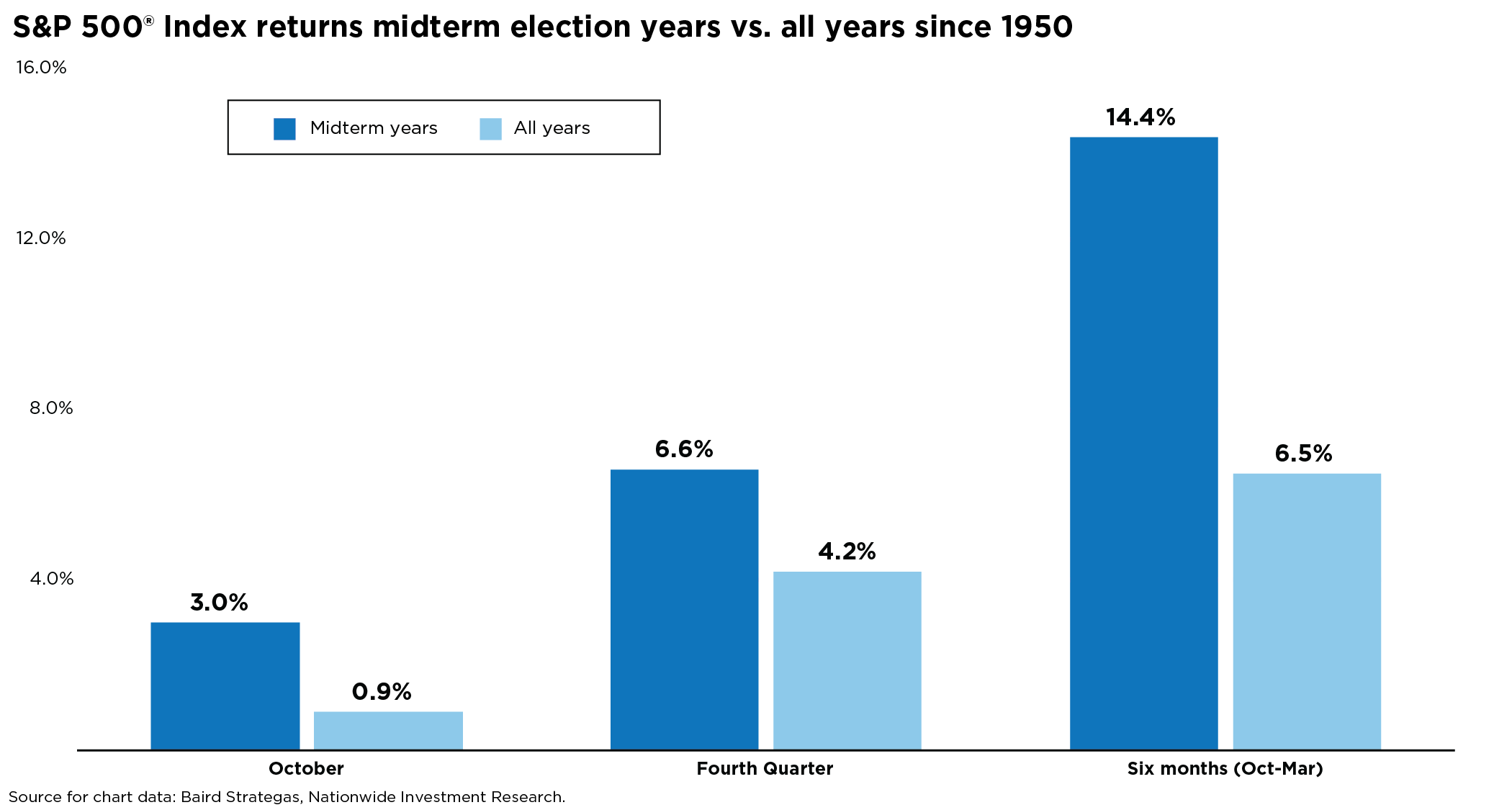
The approaching midterm election in November also marks what has historically been the strongest six-month stretch of the four-year presidential cycle. The S&P 500 has averaged a 14% gain during this post-midterm period, double the 7% average across all years.
Second, economic growth remains resilient. Nominal GDP growth was reported at an annualized 8.5% in the second quarter, reinforcing the strength highlighted by recent manufacturing Purchasing Managers Index (PMI) readings. That strength also suggests corporate fundamentals should remain solid as we approach third-quarter earnings season. Current estimates call for Q3 earnings growth of roughly 29%, which would mark the third consecutive quarter of earnings growth above 25% for S&P 500 companies.
Lastly, while investors may assume that Fed rate hikes automatically slow future earnings growth, history suggests the relationship is more nuanced. In recent tightening cycles, next-12-month earnings per share for the S&P 500 has continued to increase. While the effects of higher rates often emerge with a lag, the evidence suggests today's rate environment is not yet restrictive enough to meaningfully weaken the earnings outlook.
While the market's path forward is unlikely to be linear, many of the risks that have weighed on investors recently are likely to continue fueling volatility. However, favorable seasonality and strong corporate earnings could help support a more bullish trend for stocks in the months ahead.
Author(s)

Mark Hackett, CFA®, CMT®, CFP®
Chief Market Strategist, Nationwide Investment Management Group
Mark Hackett is the Chief Market Strategist for Nationwide’s Investment Management Group, bringing more than 20 years of experience in the asset management industry to the role.