Mark Hackett, CFA®, CMT®, CFP®


Markets and economy
Markets and economy
Competition for capital may be driving rates higher
Key takeaways:
- U.S. dollar-denominated investment-grade bond issuance has exceeded $1.5 trillion this year and is on pace to surpass the pandemic-era record, while the average new offering has climbed to a post-Global Financial Crisis high of $1.7 billion.
- Investors should consider that competition for global savings from both governments and corporations may contribute to higher required returns and upward pressure on long-term yields.
09/10/2026 – Many investors are trying to understand what’s driving the recent rise in long-term interest rates and what the implications may be for the bond market. The normalization of bond yields following years of near-zero interest rates, combined with the aftermath of the COVID pandemic, has likely altered the market's underlying dynamics. Investors are also grappling with fiscal expansion, economic resilience, mixed signals from the Treasury and Federal Reserve, and uncertainty surrounding geopolitical conflicts and energy prices.
While these factors are important, what may make the current environment unique is the unprecedented demand being placed on capital. As companies issue debt to help finance the AI investment boom while drawing down excess savings, competition for global capital is intensifying. In response, bond investors may be demanding a more durable return above inflation. As the private sector joins governments in competing for global savings, the cost of attracting investor capital is likely to rise, potentially creating a structural source of upward pressure on long-term yields.
The scale and pace of corporate debt issuance so far in 2026 have been staggering. According to Goldman Sachs, U.S. dollar-denominated investment-grade bond issuance has already exceeded $1.5 trillion this year and is on pace to surpass the pandemic-era record. Meanwhile, the average new bond offering has climbed to a post-Global Financial Crisis high of $1.7 billion. Within that total, 20 jumbo deals of at least $10 billion have raised $384 billion, roughly double the volume generated by such transactions during all of 2025. Technology companies account for approximately 60% of this jumbo-bond issuance.
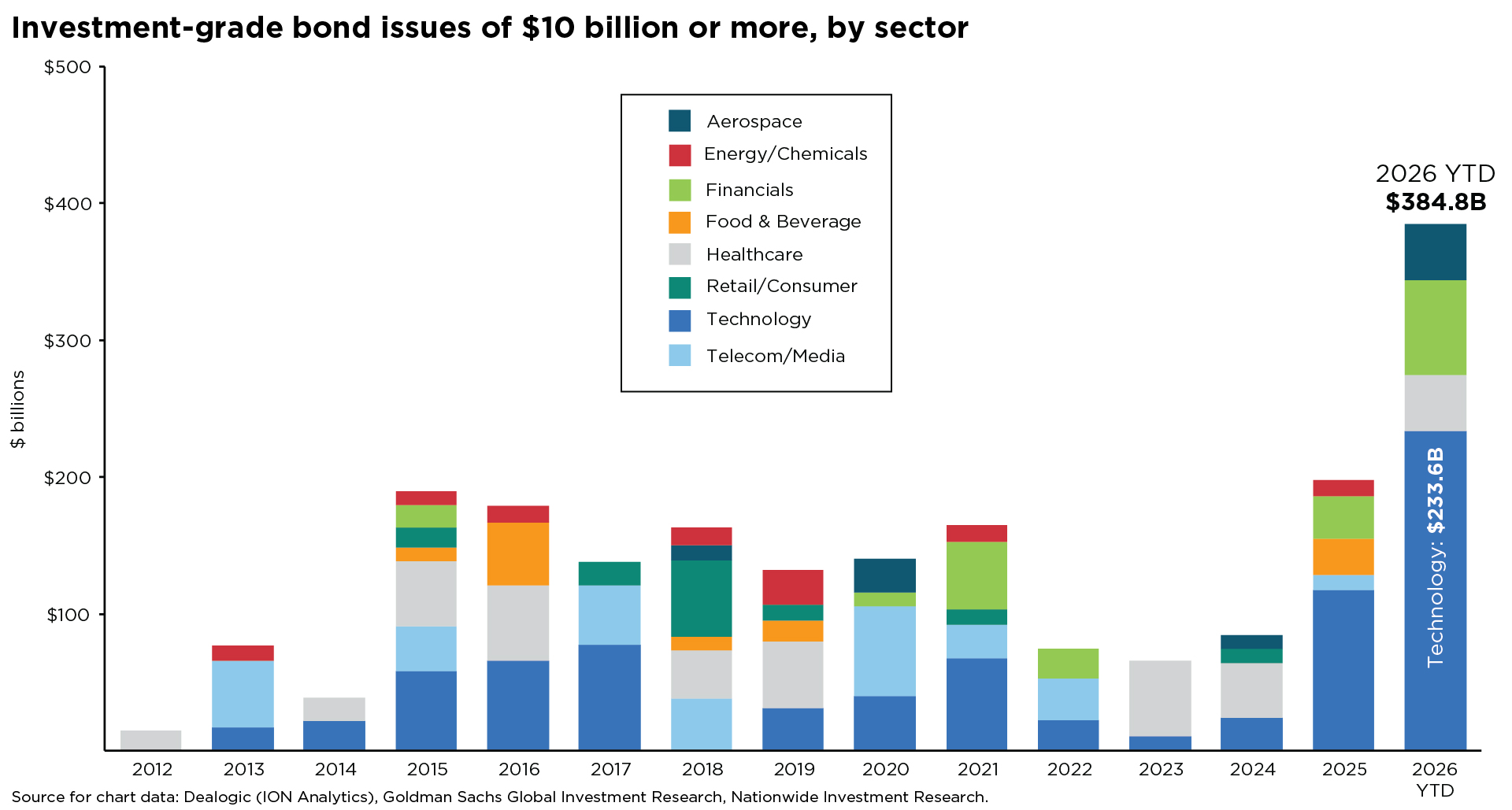
Investors should consider not only that bond issuance is likely to increase across global debt markets, but also that governments and corporations are increasingly competing for the same pool of global savings to fund deficits, infrastructure projects, and investments. This competition raises the return investors require to allocate capital.
Many of the world’s largest technology firms, long viewed as generators of excess savings, have been redirecting those resources toward AI-related capital expenditures. As spending on data centers, chips, power infrastructure, and broader computing capacity accelerates, the need for corporate debt financing may increase as well. In turn, competition for a finite pool of global savings could intensify.
Understanding the underlying drivers of yields is especially important for investors, as each component conveys a distinct signal about the economy. Could a higher term premium reflect fiscal deficits, uncertainty around Fed policy, a more fragmented global trading system, or onshoring trends? Certainly. Yet attributing the move in yields to any single factor is overly simplistic, as the growing demand for capital from the corporate sector is difficult to ignore.
It’s important to recognize that a portion of the rise in long-term yields may reflect not only concerns about government borrowing or persistent inflation but also a higher cost of capital driven by growing demand for private investment.
Author(s)

Mark Hackett, CFA®, CMT®, CFP®
Chief Market Strategist, Nationwide Investment Management Group
Mark Hackett is the Chief Market Strategist for Nationwide’s Investment Management Group, bringing more than 20 years of experience in the asset management industry to the role.
Trending articles
What could matter most for bond investors in 2026? Income, flexibility, and a disciplined approach to security selection.
As sports betting gains popularity, investors may blur the line between gambling and investing. Here's why time and compounding matter.
Looking beyond rates reveals what's historically fueled small-cap gains most: stronger earnings and a growing economy.
Sources/Disclaimers
This material is not a recommendation to buy or sell a financial product or to adopt an investment strategy. Investors should discuss their specific situation with their financial professional.
Except where otherwise indicated, the views and opinions expressed are those of Nationwide as of the date noted, are subject to change at any time and may not come to pass.