
Education and action help clients prepare for retirement health care costs
Key takeaways:
- Health care cost planning is an opportunity for financial professionals to help clients solve a critical financial need at an important time.
- Pre-retirees* with a financial professional or pre-retirees* who do not work with a financial professional but plan to ask one about Medicare benefits in the future are more than twice as likely as current retirees* to switch to a financial professional who can help them better understand Medicare.
12/03/2025 – Health care expenses are a top-of-mind concern for most Americans. Many households struggle to manage medical bills and prescriptions costs with their everyday expenses. But even beyond these present-day worries, health care costs can have a longer-term effect, impacting financial security in retirement.
Nationwide’s 2025 Health Care Survey, powered by the Nationwide Retirement Institute®, revealed a surprising consequence of rising health care costs—they’re contributing to client inaction.
People are aware of the impact that high health care costs can have on their retirement finances. They also know the importance of planning ahead for these expenses. But many clients are not doing the most important part—taking action. And that can put their future financial security at risk.
As a financial professional, you can help bridge this gap between awareness and action by working with your clients to include retirement health care costs as part of their overall financial plan. It starts with a conversation that’s focused on education.
Short-term costs, long-term consequences
Health care can be a personal and sensitive topic for a client to discuss with a financial professional. Introducing money into that conversation can further complicate these discussions.
The numbers around retirement health care costs can be daunting for clients to consider. According to the Milliman Retiree Health Cost Index for 2025, total retirement health care spending can reach $275,000 for a healthy 65-year-old male and $313,000 for a healthy 65-year-old female retiring this year. For women, retirement health care costs are often higher than men because women have a longer life expectancy.
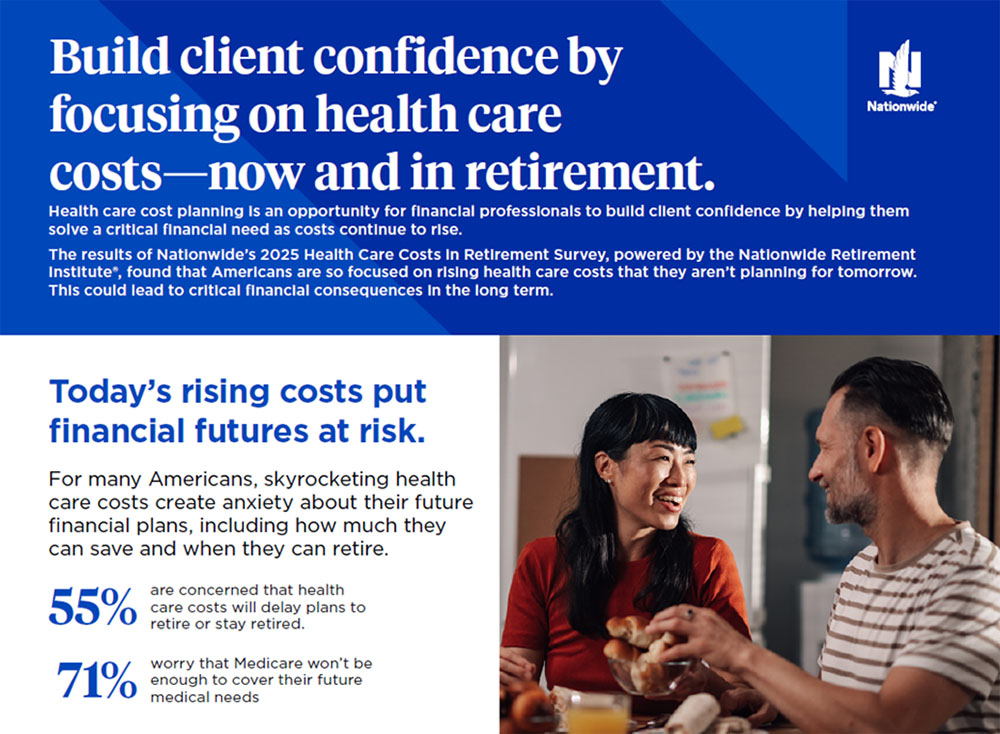
For some clients, these big numbers can be so intimidating that that they affect how they view and manage their current finances. Our survey found that a little over half of U.S. adults (55%) are concerned that health care costs will cause a delay to their plans to retire or stay retired. A similar number (51%) report that medical / health expenses have drastically reduced how much they saved or will be able to save for retirement.
From a financial professional perspective, this is an opportunity for you to build trust by demonstrating your ability to educate clients about Medicare and long-term care, among other topics, and offer solutions that make planning for retirement health care costs easier.
For example, our survey found that two-thirds of U.S. adults (66%) can’t estimate how much they’ll need for health care in all of retirement. Nationwide’s Health Care/Long-Term Care Cost Assessment is a tool you can use to deliver a personalized cost estimate for clients, making these numbers real but also manageable.
Clients are overwhelmed and underprepared
Beyond the math, client concerns over retirement health care costs can also have an emotional impact. Among survey respondents, 71% are terrified of what rising health care costs may do to their retirement savings and 73% said out-of-control health care costs are one of their top fears for retirement.
Despite these fears, the vast majority of Americans see the importance of health care cost planning; 90% believe managing health care costs should be part of their personal financial plan.
But while many clients are aware they should be planning for these expenses, few are taking steps to do something about it. As we discovered during our survey, the reason often comes down to a lack of knowledge. We gave respondents a true/false test of 16 Medicare-related statements. The average number of correct answers was seven—far from a passing grade.
Education is another entry point as you initiate health care planning conversations with clients. Most respondents in our survey said it’s extremely important that healthcare costs are easy to understand. Moreover, nearly three-quarters (74%) said they wish they understood Medicare coverage better.
If you’re looking to counter the emotional aspects of health care cost planning, building client knowledge is a great place to start.
The opportunity for financial professionals
But your role in helping clients take the next step can differentiate your practice by growing through acquiring new clients and retaining current ones. There’s a significant need among clients for guidance around Medicare decisions. Many clients of financial professionals or those who do not work with a financial professional but who plan to ask one about Medicare benefits in the future (72% in our survey) said they would be likely to switch to a financial professional who could help them navigate Medicare if theirs didn’t.
Moreover, there’s a strong interest in Medicare cost planning among younger clients who have yet to retire. According to our survey, these pre-retiree* (age 55-65) clients or pre-retirees* who do not work with a financial professional but to ask one about Medicare benefits in the future are slightly more than twice as likely than their retired* counterparts to switch to a financial professional who can help them better understand Medicare (71%* vs. 35%, respectively).
Health care cost planning can help you prospect among younger clients who can develop into longer-term relationships. You can support clients by helping to reduce the stress associated with managing medical bills, enabling them to head into retirement with more confidence about their long-term financial security.
A great place to start is by focusing on the top three health-care-related topics clients want to discuss with you: the overall costs for Medicare coverage (42% of U.S. adults report this); out-of-pocket costs depending on the Medicare plan they have (41%); and identifying the pros and cons for Medicare Advantage versus Medigap for their personal situation (35% of those who are non-retirees age <65).
To help you plan these client discussions, turn to Nationwide for support and solutions. Resources like the Nationwide Health Care/Long-Term Care Cost Assessment can help clients understand the impact of health care expenses on their retirement finances and take action to incorporate these costs into their financial plans.
Author

Kristi Martin Rodriguez
Senior Vice President, Nationwide Financial Marketing
Kristi leads a dynamic team responsible for all marketing and thought leadership activities across Nationwide Financial.
Trending articles
Social Security uncertainty creates a timely opening to educate clients on claiming age, retirement income planning, and broader financial needs. View insights from our survey.
Americans remain resilient, but 2026 challenges are reshaping financial success, with consumers leaning slightly more toward protection than growth. Learn more in our latest Index.
Learn how pets shape retirement happiness and health, and why financial professionals should understand clients’ pet priorities.