Juan José (JJ) Pérez


Business growth, protection & transfer
Business growth, protection & transfer
Business owners need your help — even if they haven’t asked for it
Key takeaways:
- Small and mid-market business owners are strained, juggling inflation, workforce challenges, and rising costs, often at the expense of their own financial security.
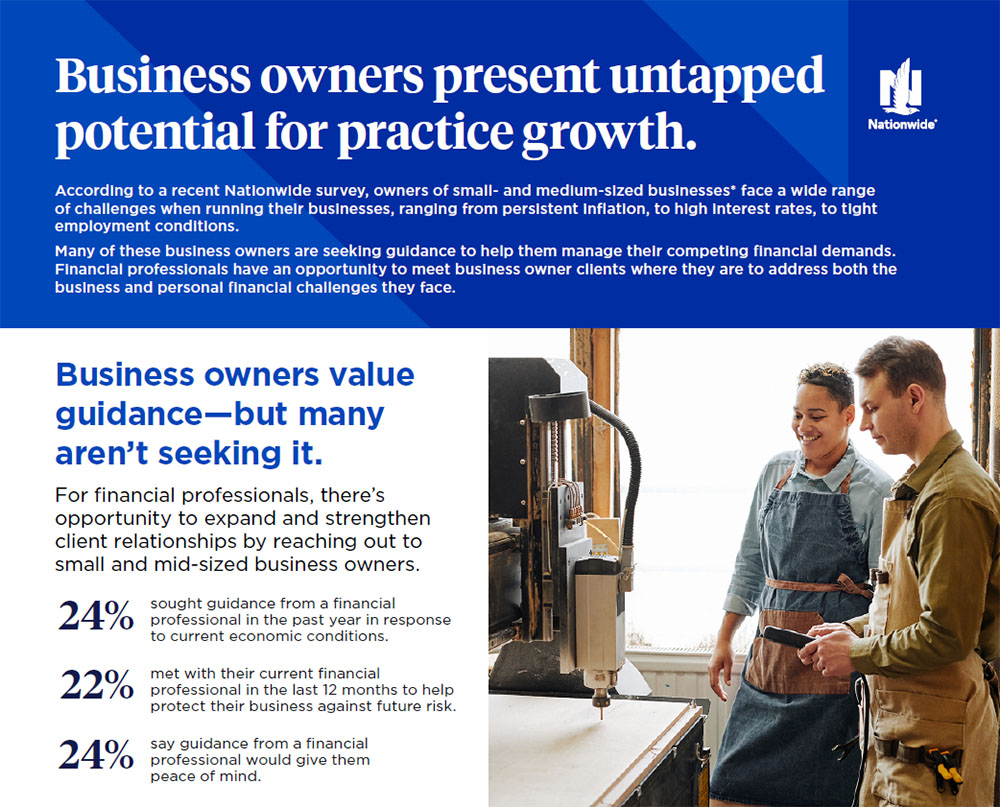
- Only 24% have met with a financial professional, despite many saying that getting financial advice would have given them peace of mind.
- Financial professionals have an opportunity to step in with holistic support across business and personal needs, including succession planning, retirement, and employee benefits.
02/06/2026 — Business owners are doing what they always do in challenging times: adapting. But a tough economic environment — shaped by inflation, high interest rates, and talent pressures — is forcing many to shoulder financial burdens that could put their long-term security at risk.
Nationwide recently conducted a survey of small and mid-market* business owners. The findings revealed a critical disconnect: while many business owners are feeling the weight of economic uncertainty, few are turning to a financial professional for guidance.
Only 24% of those we surveyed have met with a financial professional in the past year in response to current economic conditions. Yet nearly a quarter say getting advice would bring peace of mind, especially as they juggle rising costs, workforce challenges, and succession planning.
That gap signals an opportunity for financial professionals to step in and offer meaningful support by helping business owners navigate immediate financial pressures without losing sight of their future.
Business owners are steadying their businesses — often at a personal cost
Nearly a third of small business owners (SBOs) and nearly one-fifth of mid-market business owners (MMBOs) we surveyed said they would cut their own salary before reducing or eliminating employee benefits.
That protective mindset is admirable, but it often comes at the expense of their own long-term financial security. In the past year alone:
- 14% of business owners reduced their retirement savings.
- 13% tapped into personal retirement funds to support their business.
Despite these signs of strain, most aren’t having conversations with a financial professional. That’s where you can play a pivotal role. By recognizing where personal and business priorities intersect, you can help business owner clients stay focused on the bigger picture — including life after work. Yes, even while they’re navigating short-term financial pressures.
What business owners want to talk about
When asked what they’d discuss with a financial professional, business owners pointed to a mix of near-term concerns and long-term goals. Several stood out as areas where you can offer direct support:
- Succession planning
- Employee retirement plan offerings
- Voluntary benefits
- Personal retirement
- Access to credit
- Financial risk management strategies for the business
Topics like inflation, economic uncertainty, and supply chain disruptions also came up. While these aren’t issues financial professionals typically solve for, they provide useful context for grounded planning conversations.
Financial professionals who can meet business owners where they are — understanding both the business and personal risks the owner is trying to solve — are in a strong position to offer differentiated value.
You don't need to be an expert in every facet of planning, but as an advocate and “risk management quarterback,” you can help your clients uncover their top priorities and connect them with the right solutions. That may include building a mutual referral network of specialists — like 401(k) providers or employee benefits providers — to create partnerships that benefit both your clients and your practice.
Balancing business growth with talent pressures
Attracting and retaining employees remains a top workforce challenge, cited by 27% of business owners over the past year. That pressure is expected to grow: 41% of small business owners and 57% of mid-market owners said recruiting and retention will continue to be among their biggest challenges in the year ahead.
That’s one reason benefits planning has become a key priority for business owners. One in five of those surveyed said improving employee benefits is one of their biggest business opportunities in the coming year.
Specifically, there’s growing interest in voluntary benefits: 56% of small and 79% of mid-market business owners are interested in offering them to their employees.
While you may not focus on benefits strategy in your practice, understanding this essential piece of a client’s broader financial picture can lead to more informed planning conversations. By partnering with a knowledgeable provider, you can help connect business owner clients to resources or specialists who support employee benefits strategy, ensuring all the risks they are concerned about are addressed.
Navigating rising healthcare benefit costs with confidence
Healthcare costs continue to climb, and 62% of business owners said it’s among their chief concerns in the year ahead. Many are proactively addressing this challenge: 46% of small business owners and 78% of mid-market business owners reported increasing or planning to increase health insurance coverage for employees.
Some have even adopted self-insured health plans. That includes 15% of small business owners and 29% of mid-market business owners, many of whom may need guidance navigating this transition.
Financial professionals who can introduce solutions like medical stop-loss insurance — or connect clients with experienced employee benefits specialists — can help ensure business owners are fully supported. Nationwide's group benefits team offers employee benefits, workplace retirement plans, and medical stop-loss support for financial professionals looking to provide a more holistic planning experience targeted to the needs of business owners.
Help clients think ahead, even when they’re focused on today
Many business owners are focused on more immediate priorities. Although they understand the importance of planning ahead, few are taking proactive steps to do so.
Succession planning is an obvious example: in our survey, owners acknowledged planning for the future is vital to the longevity of their business, yet they often leave it on the back burner.
Only 12% of business owners identified succession planning as a top opportunity in the coming year, opening the door to proactive planning conversations. A few thoughtful questions can uncover needs a client hasn’t yet articulated and help them start building a more intentional path to ensure the continuity of their business when they’re no longer at the helm.
The same goes for personal retirement planning. Focused on day-to-day operations, many owners are letting their personal finances slide. This presents financial professionals with an opportunity to support an area of financial planning that sometimes gets overlooked — helping these clients align their personal goals with the demands of business ownership, so the future they’re building for their business doesn't come at the cost of their own.
Business owners are balancing a lot — and they want your help
Running a business amid economic uncertainty, rising costs, and talent pressures isn’t easy. And many owners are doing it without the necessary financial advice that could help them plan more confidently.
Financial professionals have a chance to step in — with empathy, expertise, and solutions that help business owners protect what they’ve built. Keep in mind, it may be up to you to start the conversation. Business owners may not be asking directly for support to help them achieve their business and financial goals, but that doesn’t mean they don’t need it.
By helping small- and mid-market business owners manage both their business and personal financial goals, financial professionals can become a trusted partner these clients can rely on as their needs evolve and their business grows.
Nationwide offers a full range of business solutions designed to help you support your business owner clients, including tools and support for employee benefits, succession planning, retirement strategies, and risk management.
Author

Juan José (JJ) Pérez
Senior Vice President, Strategic Customer Solutions
JJ is senior vice president of Nationwide Financial (NF) Strategic Customer Solutions. In this role, he has responsibility for the teams that accelerate results for internal and external partners across the portfolio of NF businesses.
Trending articles
Social Security uncertainty creates a timely opening to educate clients on claiming age, retirement income planning, and broader financial needs. View insights from our survey.
Americans remain resilient, but 2026 challenges are reshaping financial success, with consumers leaning slightly more toward protection than growth. Learn more in our latest Index.
Learn how pets shape retirement happiness and health, and why financial professionals should understand clients’ pet priorities.
Sources and disclaimers
The Harris Poll, on behalf of Nationwide, conducted an online survey in the U. S. among 510 advisors and financial professionals and 2,007 investors ages 18+ with investable assets (IA) of $10K+, August 19-September 2, 2025. Among the investors, there were 180 Recent Retirees (5 years or less) and 274 longer term retirees (more than 5 years).
This material is not a recommendation to buy or sell a financial product or to adopt an investment strategy. Investors should discuss their specific situation with their financial professional.
Except where otherwise indicated, the views and opinions expressed are those of Nationwide as of the date noted, are subject to change at any time and may not come to pass.