

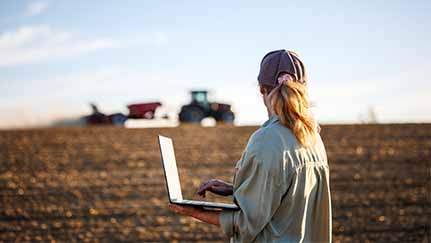
Most of today's large row crop farmers and small grain producers have integrated precision agriculture tools into their operations. That trend has created new efficiencies and changed how they raise their crops.
Such adoption yields a continuously growing collection of data and information that helps new generations of technology perform even better on the farm. But there's also a proverbial snake in the grass when it comes to the security of that high-value farm-level data and information.
Every October since 2004, Cybersecurity Awareness Month is a key time to review how prepared you are for the increasing onslaught of ransomware and other cyberattacks. That’s especially true in agriculture, where digital tools are common on farms, ranches and agribusinesses around the country. And it’s why Nationwide is committed to raising awareness for the ways to keep your agricultural business safe from this rising danger.
“Today's precision ag technology creates vulnerabilities and can put high-value farm data at risk from theft or illicit use,” said Vikas Chopra, Associate Vice President of Technology Risk Management at Nationwide. “It's a call for farmers to prioritize cybersecurity on their operations to preserve their data and ensure it's only used for its intended purposes.”
Why is farm cybersecurity important?
Farm cybersecurity matters because agriculture has become a growing target for cyberattacks, for many reasons. In 2025 alone, there were 265 ransomware attacks on U.S. food and agriculture businesses alone. A single ransomware or cyberattack can disrupt planting, harvest or livestock operations at the worst possible times. Attacks on connected equipment, grain cooperatives and food processors can ripple across entire supply chains.
Industry experts have warned that cyberattacks are rising because of the increased prevalence of technology in crop and livestock production, as well as further up the supply chain. They’re especially likely during critical planting and harvest seasons, when downtime is most damaging and producers are most likely to pay to restore operations quickly.
“A few high-profile ransomware incidents against food and agriculture companies in recent years have disrupted things like meat processing and grain handling. Even if you don’t pay the ransom, the inability to get a job done in a timely manner can be seriously costly,” Chopra said. “These types of attacks show just how fast a digital attack can become a physical, operational and financial problem on the ground.”
Recognize your data's value
Though perpetrators of cyberattacks continuously grow and evolve their capabilities, cybersecurity measures also continue to advance. But consistent cybersecurity depends just as much on smart human behavior when working with data and technology. That starts with the tools and platforms you use and where you share your farm’s high-value data, Chopra said.
“Protecting your data today is a matter of first recognizing its value, then working in secure hardware and systems, treating it just like you would any other critically important information on your operation,” Chopra added. “There's a value exchange in using any digital platform. When free services are offered to users, whether ag-specific or not, they typically come with a caveat. The old ‘you get what you pay for’ truly applies to digital technology and vulnerability to cyberattacks.”
What steps can you take to protect your farm from cyberattacks?
Start the process of securing your farm's precision ag data by looking at the technology you use and its providers. Cybersecurity is common in agriculture today. But not all platforms have the same protection. Ask questions of your machinery and precision ag partners to confirm the security of your data on their platforms.
To protect your farm from cyberattacks, actively manage your data, choose secure platforms, store information safely and involve your whole team in good cybersecurity habits. According to an FBI report, there are a few steps farmers can take to address potential vulnerabilities in data security:
- Watch for business email compromise and payment fraud. Cybercriminals may impersonate a supplier, employee or customer to redirect a payment or shipment. Before making a change, confirm the request using a trusted phone number or contact method — not the information included in the message.
- Test your incident response and recovery plan. Keep a list of important systems, vendors and emergency contacts. Test backups regularly and document manual steps for continuing critical operations if systems are unavailable, especially during planting, harvest or livestock activities.
- Be proactive and actively manage data. Just like you lock your car or truck or use a personal identification number (PIN) with your debit card, you can take simple steps to protect your data. Stay on top of software updates, frequently change account passwords and enable multi-factor authentication.
- Evaluate platforms and providers. Account for things like your overall comfort level with each platform's features and security protocols. As long as it’s cost-effective, paying even a small monthly fee often nets stronger security settings.
- Secure your data and backups. If stored in the cloud, make sure the platform has adequate security protocols. If doing so locally, use a server or storage device with adequate firewalls that's not connected to the internet. Keeping regular, offline backups is one of the best defenses against ransomware.
- Involve your whole team. Meet with employees and other farm stakeholders regularly to ensure everyone involved understands the need for cybersecurity and how to keep data secure.
Protect your business from cyberattacks
Cyber liability coverage from Nationwide can help offset the devastating effects hacking, data theft and identity fraud can have on your business from a financial and reputation standpoint. Talk to your Nationwide Farm Certified agent to learn how to protect you and your farm business.