

Forklifts make material handling easier in warehouse and industrial environments; unfortunately, they also bring serious risk for injury, damage to property and disruption of operations when they are operated unsafely. Many forklift accidents happen because operators don’t fully understand how a forklift’s center of gravity affects stability. A basic understanding of this concept can prevent tip‑overs, injuries, and property damage.
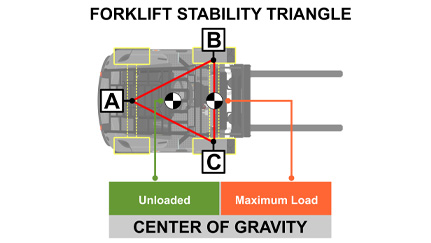
The forklift center of gravity
The center of gravity (COG) is the point where an object’s weight is balanced. When balancing a stationary object, the height of the COG impacts the stability of that balance. Consider balancing a pencil on your finger when the pencil is horizontal (long) versus vertical (tall). A forklift has two centers of gravity to consider:
- The forklift's own center of gravity (unloaded): This is where the weight of the empty forklift is balanced in all directions. It is determined by the construction of the forklift and its components, such as the counterweight at the back.
- The combined center of gravity (loaded): When you pick up a load, the forklift’s COG shifts forward. For safe operation, this new COG must stay inside the “stability triangle” -- the area between the two front wheels and the pivot point on the rear axle.
Drivers often understand that picking up a load moves the center of gravity forward; however, it is equally critical to understand the concept of load center and COG relative to the location of a load and its COG on the forks. This directly impacts the capacity of the forklift and the risk of a tip-over.
Load center
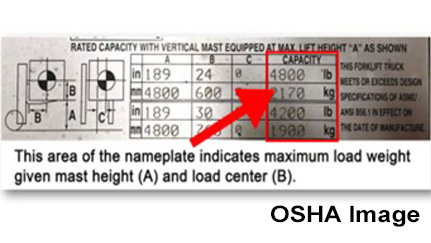
The load center is the horizontal distance from the heel of the forks to the load’s center of gravity. This is the point where the total force exerted by the load is balanced.
In an evenly distributed load, it is essentially the distance to the halfway point; however, in an unevenly distributed load, the load center may now be further out. The further out the load center moves, the less capacity the forklift has. The safe lifting capacity of a forklift is provided on the data plate and includes the lifting height and load center.
Not properly accounting for the true load center often leads to an unstable load and tipping of the forklift. Load center isn’t just related to the load itself; it can even be impacted by the size of the pallet selected for moving the load.
Load center example: Impact of pallet selection
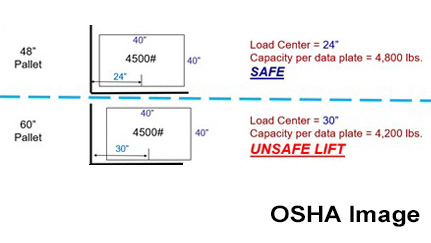
In this example the lifting capacity of the forklift with the load center at 24 inches is 4,800 pounds and the load to be lifted has a weight of 4,500 pounds that is evenly distributed.
What happens if the load is placed in the center of a 48-inch pallet versus a 60-inch pallet? The load center moves from 24 inches to 30 inches, and the forklift’s capacity drops to 4,200 pounds making it an unsafe lift.
3 key factors affecting forklift stability
Load distribution
When the weight of a load is evenly distributed, the COG is typically at the center of the load; however, when it is not evenly distributed, the COG is no longer at the center. This can be hard to tell in a containerized load. Likewise, the higher the COG the less stable the load (like the pencil illustration). Both uneven loads and high COG increase the risk of tipping.
Speed and maneuvering
Without getting into the laws of physics, we have all experienced how our body’s COG continues in a straight line while in a car that is turning, resulting in sliding or leaning. The same holds true with loads on the forklift. Sharp turns and sudden movements can shift the COG and destabilize a forklift.
Surface conditions
Ramps/slopes, loading docks, potholes, uneven or slippery surfaces can affect the angle and operation of the forklift, shifting the COG and increasing the risk of losing the load or an overturned forklift.
Improving stability = Better forklift safety
Provide comprehensive training
Operators should be trained in load stability, load center, proper maneuvering, and the importance of maintaining the center of gravity within the stability triangle.
Use only approved forklift attachments
All attachments will change the COG and an attachment may not have the same capacity as the forklift. This is why all attachments should be approved by the forklift manufacturer.
Maintain legible and appropriate data plates for the attachment in use
Each attachment should have a data plate that provides the load capacity based on the truck capacity and the attachment’s designed load center.
Perform regular maintenance
Ensure forklifts and attachments are regularly inspected and maintained to prevent mechanical failures.
Implement safety protocols
Establish and enforce safety protocols, such as speed limits, stopping at intersections, proper use of horns, proper load handling procedures, and pedestrian safety. Excess speed can lead to sudden stops and turns that decrease stability.
Related resources
- Forklift/PIT safety program (PDF)
- Forklift safety: 4 practical tips to reduce risk
- 5 tips for safer forklift operations
- Worker safety talk: Forklift safety
- How to prevent forklift-related accidents and injuries (PDF)
- Gas forklift operator’s daily checklist (PDF)
- Electric forklift operator’s daily checklist (PDF)