

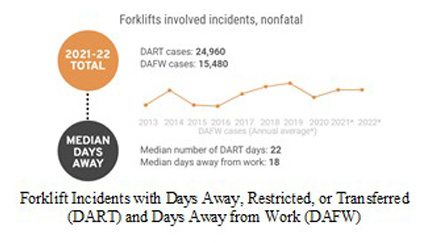
Forklifts are critical tools in warehouses and industrial settings for mechanical material handling; however, their operation can open the door to accidents and injuries that severely impact your employees and your business. Forklift incidents are on the rise and lead to injuries that keep workers away from their normal job duties.
Understanding how to manage those risks can prevent costly accidents and injuries. Here are four practical tips that you need to know to reduce risk.
1. Understand forklift stability
Know the stability triangle: A forklift’s stability depends on its center of gravity and the “stability triangle” formed by the two front wheels and the pivot point of the rear axle. When carrying a load, the center of gravity shifts – keeping it inside the triangle is key to prevent tipping.
Factors affecting stability:
- Load weight and distribution: Uneven loads increase tipping risk.
- Speed and maneuvering: Sharp turns and sudden movements can destabilize forklifts.
- Surface conditions: Ramps, slopes, loading docks, and uneven or slippery surfaces can affect the forklift's balance.
- Forklifts with specialized or accessory attachments: Re-evaluate for changes as these items typically lower the capacity
For a deeper understanding of these concepts, review our forklift safety article: Understanding center of gravity and stability
2. Follow basic forklift safety practices
Train operators thoroughly
Cover load stability, proper maneuvering, and how to keep the center of gravity within the stability triangle. Include hands-on practice and workplace-related hazards.
Protect pedestrians
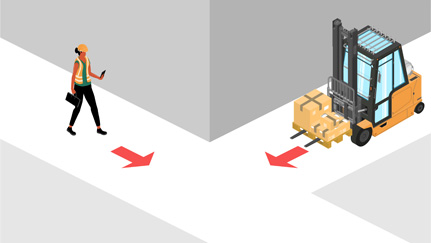
Establish designated walkways and crosswalks, ensure pedestrians make eye contact with forklift operators, and maintain a safe distance from forklifts. Pedestrian training is essential to minimize accidents.
Maintain equipment regularly
Implement a preventative maintenance schedule to ensure forklifts are regularly inspected and maintained, preventing mechanical failures that could lead to accidents.
Enforce safety protocols
Establish and enforce safety protocols, such as speed limits, stopping at intersections, proper use of horns, working backup alarm, and load handling procedures. Further enhance safety with technologies like collision warning devices and blue safety lights.
3. Address specific hazards
Loading docks
- Establish truck driver rules and expectations while onsite and post them.
- Secure trucks and trailers with wheel chocks and dock lock mechanisms (when installed) before loading or unloading.
- Verify the dock plate is secured and weight limits are not exceeded.
- Inspect the flooring of trailers for condition and use trailer jacks or stands to prevent tipping when there is not a truck-tractor connected to the trailer.
- Release the bill of lading paperwork to the truck driver once the loading is complete and the forklift is confirmed to be out of the trailer.
Fueling and charging
- Ensure proper ventilation in battery charging areas to prevent hydrogen gas buildup.
- Use appropriate PPE when handling batteries and propane tanks and follow guidelines for safe storage and transportation.
- Batteries may require cranes to lift safely.
- Propane tanks require more than one person to lift.
Working at heights
- Operators using order pickers or working at heights must use fall protection restraints.
- Ensure cages are secured to the forklift mast and operators remain at their forklifts during operations.
4. Implement risk management strategies
Protect property and people
This includes protection of building supports, rack storage, and sprinklers. In addition, identify loading and unloading areas when docks are not used.
Utilize emerging and traditional technology
Consider technological solutions like wearables or badges with detection capability to alert drivers and/or activate traffic signals to prevent accidents, or computer vision/AI software to monitor and analyze camera footage. Other controls may include high-visibility work vests, dome mirrors, stop signs, barrier separation, marked pedestrian walkways, and no forklift traffic areas in high pedestrian areas during shift changes.
Validate
Conduct regular training and evaluations for forklift operators, providing refresher training as needed. Document evaluations and ensure operators are demonstrating awareness of potential hazards and safe operating practices.
By understanding and addressing the risks associated with forklift operation, organizations can significantly reduce the potential for accidents and injuries, ensuring a safer and more efficient workplace.
Related resources
- Forklift/PIT safety program (PDF)
- Forklift safety: Understanding center of gravity and stability
- Worker safety talk: Forklift safety
- 5 tips for safer forklift operations
- How to prevent forklift-related accidents and injuries (PDF)
- Gas forklift operator’s daily checklist (PDF)
- Electric forklift operator’s daily checklist (PDF)