

Markets and economy
Election anxiety is rising.
What does history tell investors?
Key Takeaways:
- While elections can shape the policy conversation, fundamentals such as interest rates, earnings, and AI-driven investment are likely to matter more for market returns.
- History suggests investors are often best served by staying disciplined rather than reacting emotionally to political headlines.
10/14/2026 — Investors spent much of the past month wrestling with higher oil prices, rising bond yields, and a strengthening dollar. Now, attention is turning to the approaching midterm election, the next potential test of market sentiment.
Many investors are weighing shifting narratives and competing predictions about the midterm election's impact on the stock market and whether different outcomes could derail the four-year-old bull market in stocks.
Investor concern about the midterms is already influencing investor behavior. According to recent Nationwide Retirement Institute® research, 75% of investors believe the election could affect their long-term financial plan. Notably, 2 in 5 investors have already made changes to their retirement savings or investment portfolio in anticipation of the election outcome.
The historical record on equity market performance during midterm election years is reassuring. Despite recent volatility, the S&P 500® Index has significantly outperformed the typical year-two pattern of the presidential cycle, gaining 14% year-to-date as of this writing and far exceeding the 3.6% average full-year return for midterm election years since 1970. Even with plenty for investors to worry about, the S&P 500 recorded its best second-quarter performance (up 14.9%) in a midterm year since 1939.
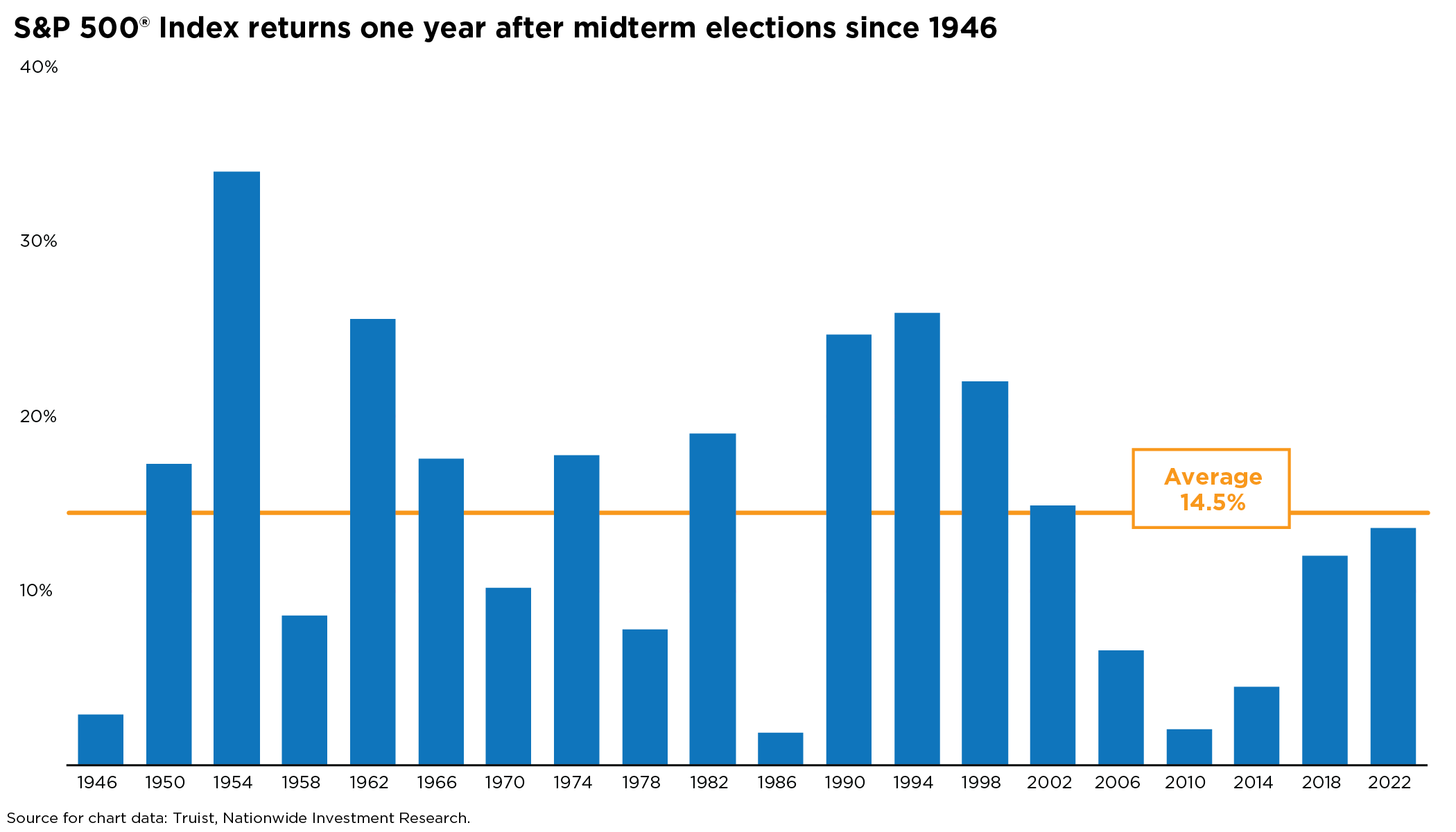
Looking ahead, historical stock market performance following midterm elections is encouraging. The S&P 500 has never posted a negative return one year after a midterm election, going back to 1946. (See chart.) Over a shorter time horizon, the S&P 500 has risen 100% of the time in the six months following midterm elections since 1950.
That said, investors should recognize that history is not destiny, and past performance does not ensure future results. Still, the historical record provides a reassuring roadmap for investors who maintain a disciplined investment portfolio strategy and resist the urge to make emotional decisions driven by political headlines.
With the midterms less than a month away, it’s a good time to remind investors that fundamentals, not politics, have historically been the primary drivers of long-term market performance. The direction of interest rates, the strength of corporate earnings, and the durability of the AI capital expenditure cycle are likely to play a far greater role in shaping market returns over the coming year than the outcome of the midterm elections.
Author(s)

Mark Hackett, CFA®, CMT®, CFP®
Chief Market Strategist, Nationwide Investment Management Group
Mark Hackett is the Chief Market Strategist for Nationwide’s Investment Management Group, bringing more than 20 years of experience in the asset management industry to the role.