Kevin Jestice, CFA, CIPM


Retirement savings & income
Retirement savings & income
What clients don't know about Social Security: How to turn knowledge gaps into planning opportunities
Key takeaways:
- Consumers remain uncertain about Social Security's future, creating opportunities to build credibility and deepen client relationships through timely guidance around claiming decisions and retirement income planning.
- More than half (51%) of consumers we surveyed say they have filed or plan to file for Social Security as early as possible, reinforcing the importance of educating clients about how claiming age can affect lifetime benefits.
- Many Americans don’t understand how Social Security works, with nearly half (47%) lacking confidence in their understanding of the program.
- Social Security conversations with clients and prospects provide a meaningful jumping-off point to uncover broader planning needs, from retirement income and tax planning to guaranteed income solutions that may help strengthen financial resilience.
08/18/2026 — For more than a decade and in partnership with The Harris Poll, Nationwide Retirement Institute’s® Social Security Survey has examined how Americans 18 and older think about Social Security and the role it plays in retirement planning. Our 13th annual survey offers new insights into how consumers view Social Security, retirement income and retirement preparedness.
For financial professionals, the results from our latest Social Security survey highlight opportunities to build added credibility with clients and prospects by addressing common misconceptions before they make claiming decisions that may affect their retirement income for years to come. The survey also provides practical insights you can use to tailor conversations with different client groups and determine whether guaranteed income solutions may help support essential retirement spending needs.
Many Americans remain uncertain about the future of Social Security. Most respondents expect the Social Security trust fund to be depleted decades from now, and many said they weren't sure when that might happen. When told the trust fund is projected to be depleted around 2033 (and most recently acknowledged by Social Security’s trustees that this date may be even sooner), most said that timeline was sooner than expected. Nearly three-quarters (72%) also worry the program will run out of funding during their lifetime, and 25% believe they won’t get a dime of the Social Security benefits they have earned.
Helping clients make more informed Social Security claiming decisions
Uncertainty about the future of Social Security appears to be influencing when Americans choose to claim benefits. Some people may not fully understand that the age at which they claim Social Security affects their lifetime benefit, or that their election is usually not reversible. More than half (51%) of respondents to our survey said they have filed or plan to file for Social Security as early as possible to help ensure they receive benefits before the program changes or runs short on funds.
However, there are real and lasting financial consequences to filing for benefits earlier than later. Claiming Social Security at age 62, the earliest most people can begin collecting retirement benefits, can permanently reduce lifetime payments by as much as 30% compared to waiting until full retirement age and 77% lower than waiting until age 70. Future cost-of-living adjustments are calculated based on that lower benefit amount as well, potentially compounding the long-term impact of claiming early. Combined with the projected 22% across-the-board benefit reduction, claiming benefits as early as possible could reduce a client's monthly benefit to roughly half of what they would have received by waiting until full retirement age.

These survey findings reinforce the importance of helping clients understand the long-term tradeoffs before filing. You can help them make the most of Social Security by educating them about how claiming at different ages can affect their lifetime benefit. Providing clients with a personalized filing strategy comparison, such as the one available through the Nationwide Retirement Institute’s Social Security 360 Analyzer® may be a great place to start.
However, even when clients make informed claiming decisions, Social Security will likely only cover a portion of their income needs. If there's still a gap between essential monthly expenses and expected Social Security benefits, guaranteed income solutions such as annuities and in-plan lifetime income funds in a workplace retirement plan can help cover those expenses and has been shown to lead to higher levels of satisfaction in retirement.
Rethinking retirement income as living costs rise
Historically, retirement income planning has been based on two assumptions: that living expenses tend to decline in retirement (as work-related expenses end) and that Social Security will cover a meaningful portion of essential expenses. Additionally, many retirement income strategies have relied on replacing roughly 70% to 80% of a client's pre-retirement income to help maintain their lifestyle.
The convergence of rising living costs and questions about Social Security's future means those assumptions may not hold true for every client. In fact, 40% of non-retirees expect their living expenses to increase during their first year of retirement. Among current retirees, nearly one-third (32%) say their living expenses did increase, while another 54% say they stayed about the same.
Moreover, Social Security remains a significant source of day-to-day cash flow for the majority of American households. In fact, 57% of those expecting to receive Social Security say they plan to use their full benefit to cover monthly expenses. At the same time, nearly one-quarter (25%) of future retirees expect to rely more heavily on personal savings to supplement Social Security than previous generations.
This is an important reminder that clients may end up tapping retirement assets sooner, or to a greater extent, than planned. A diversified retirement income strategy can help clients prepare for common spending shocks, such as out-of-pocket healthcare and long-term care costs, while reducing reliance on Social Security and portfolio withdrawals to fund essential expenses. For some clients, guaranteed income solutions can create another dependable source of income, particularly as living costs continue to rise.
Personalize client conversations based on four common concerns
Concerns about Social Security are widespread, but our survey shows different demographics prioritize different aspects of retirement planning. Millennials are especially interested in tax planning and guaranteed income. Gen X, women, and those nearing retirement are more likely to worry about inflation and Social Security's long-term solvency (or future benefit cuts), while also expecting to rely on Social Security to cover monthly expenses.
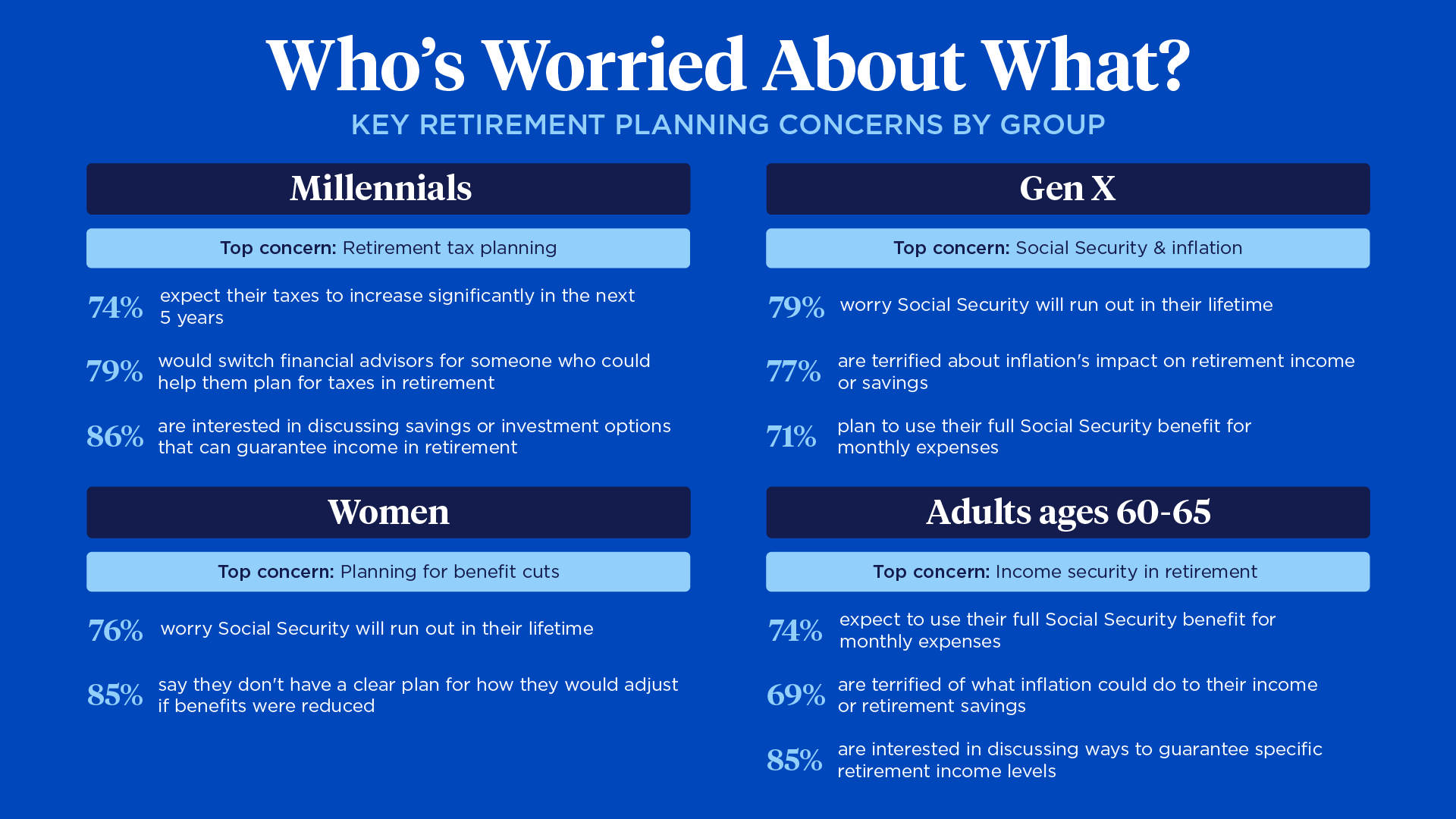
Being aware of these differences can help you identify where clients may need additional education, planning, or reassurance. Although the questions may vary by client, each conversation presents an opportunity to evaluate how Social Security fits within a retirement income strategy. Those insights can also reveal whether clients are relying too heavily on a single source of retirement income, helping you uncover opportunities to strengthen their financial resilience.
Lead with education, not a product pitch
One of the strongest themes to emerge from this year's survey is how much education clients still need around Social Security. Nearly half (47%) say they are not confident in their knowledge of the program, and respondents estimated the average full retirement age to be 59 (for most workers today, full retirement age is 67). Together, those findings highlight an opportunity to educate clients about how Social Security works and the factors that can influence their retirement income, including the claiming rules around benefits.
What's more, education is only the beginning of the conversation. Helping clients evaluate claiming decisions before they file, along with understanding how Social Security and other retirement income may be taxed, can lay the foundation for more meaningful and differentiating planning discussions. From there, you can explore where guaranteed income solutions may make sense and tailor your recommendations based on your clients’ unique needs.
Support those conversations by using Nationwide's Social Security 360 Analyzer® to offer clients a personalized filing strategy comparison that can help answer one of their most important questions: When should I take my Social Security benefits?
Looking for more Social Security planning resources?
Author

Kevin Jestice, CFA, CIPM
President, Retirement Solutions
Kevin Jestice is President of Nationwide Financial Retirement Solutions, where he leads a national team of 1,200 associates serving nearly 3 million participants with almost $250 billion in assets under management (AUM).
Trending articles
Social Security uncertainty creates a timely opening to educate clients on claiming age, retirement income planning, and broader financial needs. View insights from our survey.
Americans remain resilient, but 2026 challenges are reshaping financial success, with consumers leaning slightly more toward protection than growth. Learn more in our latest Index.
Learn how pets shape retirement happiness and health, and why financial professionals should understand clients’ pet priorities.
Sources and disclosures
The research was conducted online in the United States by The Harris Poll on behalf of Nationwide among 1,823 US adults aged 18+ who currently receive or expect to receive Social Security (“national sample”), May 11 – June 4, 2026.
For complete survey methodology, including weighting variables and subgroup sample sizes, please contact news@nationwide.com.
This material is not a recommendation to buy or sell a financial product or to adopt an investment strategy. Investors should discuss their specific situation with their financial professional.
Except where otherwise indicated, the views and opinions expressed are those of Nationwide as of the date noted, are subject to change at any time and may not come to pass.