
After a long stretch of mild price increases, inflation has returned — and it may be here to stay. The Consumer Price Index (CPI) remains higher than average, and many economists expect inflation to hover around 3% to 4% for several years.1 While that may sound manageable, the effects on retirement income can be significant — especially as fixed rates decline and yields on savings and money market accounts shrink.

As a financial professional, this environment gives you an opportunity to fill a critical need while also demonstrating your value. You can help clients understand how inflation can quietly erode purchasing power and recommend strategies to help them preserve income (and confidence) in retirement.

The couple is leaning close together at a kitchen table, appearing focused and engaged as they review paperwork.

Inflation hits retirees harder than the headlines suggest

The headline CPI figure often understates what retirees actually experience. Common retirement expenses (such as health care, housing, food and energy) tend to rise faster than the overall inflation rate. Over time, that can make even a well-funded plan feel stretched.

For clients already retired or nearing retirement, inflation compounds another key threat: sequence-of-returns risk. If markets decline early in retirement and withdrawals continue, portfolio longevity can shrink dramatically even if returns improve later. Add inflation to the mix, and the risk of outliving one’s assets rises sharply.

Staying invested to keep pace with inflation

Long-term participation in the equity markets remains one of the most effective ways to outpace inflation. Historically, since its inception in 1957, the S&P 500 has averaged annual returns of 10.54%,2 compared with 3.86% annual inflation over the same period.3 That’s a real return of 6.68%.

Of course, past performance can’t predict future results, but the lesson endures. Portfolios overweighted in cash and bonds can lose real value during inflationary periods.

As clients shift from accumulation to income, it’s critical to balance the need for stability with the need for growth. A diversified strategy that includes equities, inflation-hedging assets and guaranteed income solutions can help sustain purchasing power through long retirements.

Help clients navigate inflation

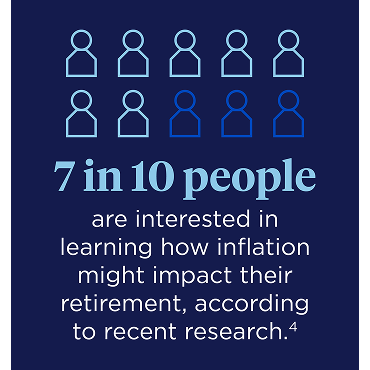
7 in 10 people are interested in learning how inflation might impact their retirement, according to recent research.4

Amid today’s economic uncertainty, clients want guidance. In fact, according to recent Nationwide research, 7 in 10 Americans are interested in learning from a financial professional how inflation might impact their retirement. An equal number want to discuss key risks such as inflation and market volatility.4

This is your opportunity to start that conversation by helping clients understand that inflation is more than a number on a chart. It’s a real factor that can reshape retirement realities — and proactive planning today can make a meaningful difference over time.

For clients seeking both growth potential and protection, Nationwide offers annuity solutions that can help them stay invested for long-term objectives while providing the stability of fixed-rate accounts.

Help your clients stay ahead of inflation 

[1] “Inflation’s Last Half Mile: Higher for Longer?” Randal J. Verbrugge, doi.org/10.26509/frbc-ec-202409 (May 30, 2024).
[2] "S&P 500 Average Returns and Historical Performance," J.B. Maverick, investopedia.com/ask/answers/042415/what-average-annual-return-sp-500.asp (Sept. 22, 2025).
[3] “Inflation Calculator,” Federal Reserve Bank of Minneapolis, minneapolisfed.org/about-us/monetary-policy/inflation-calculator (accessed September 15, 2024).
[4] “The Nationwide Retirement Institute® 2025 Social Security Survey,” conducted by The Harris Poll on behalf of the Nationwide Retirement Institute. This online survey was conducted June 2-17, 2025, among 1,812 U.S. adults age 18 or older.